India’s ED freezes $250,000 in digital-arrest scam that drained a Guwahati pensioner
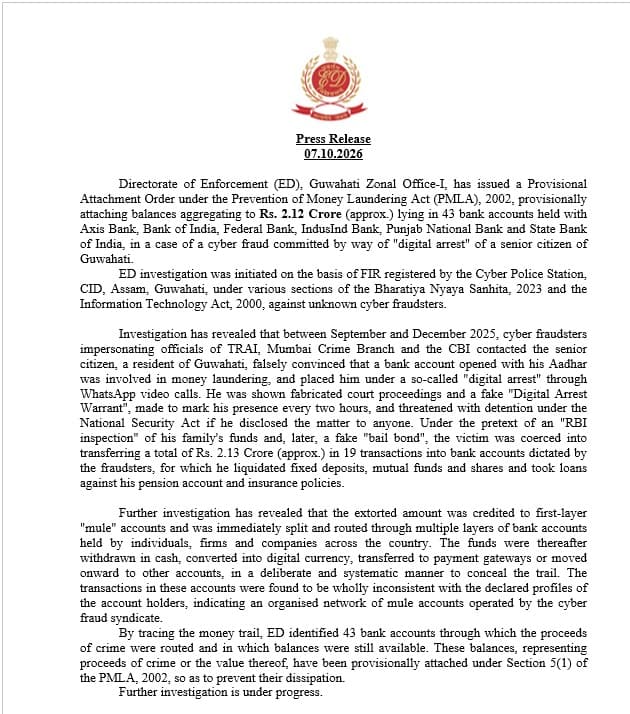
India’s Enforcement Directorate has provisionally attached about ₹2.12 crore ($250,000) across 43 bank accounts in a digital-arrest scam that targeted a Guwahati senior citizen. Fraudsters posed as TRAI, Mumbai Crime Branch and CBI officers on WhatsApp, coerced 19 transfers totaling about ₹2.13 crore, then layered the money through mule accounts nationwide.
GUWAHATI: India’s Enforcement Directorate (ED) has frozen about ₹2.12 crore ($250,000) across 43 bank accounts linked to a “digital arrest” scam that drained a Guwahati senior citizen, the agency said on 7 October 2026.
ED Guwahati Zonal Office-I issued a Provisional Attachment Order under the Prevention of Money Laundering Act, 2002, covering balances still held in Axis Bank, Bank of India, Federal Bank, IndusInd Bank, Punjab National Bank and State Bank of India.
The probe began from an FIR at Cyber Police Station, CID Assam.
How the scam worked
Sources say that between September and December 2025, fraudsters impersonating TRAI, Mumbai Crime Branch and CBI officials contacted the victim on WhatsApp video calls.
They claimed an account opened with his Aadhaar was tied to money laundering, showed fabricated court proceedings and a fake “Digital Arrest Warrant,” forced him to check in every two hours, and threatened National Security Act detention if he told anyone.
Under a fake “RBI inspection” and later a fake “bail bond,” he was coerced into transferring about ₹2.13 crore in 19 transactions, liquidating fixed deposits, mutual funds and shares and borrowing against his pension and insurance.
Mule layering
The money was credited to first-layer mule accounts, then split across individuals, firms and companies nationwide before cash withdrawals, crypto conversion, payment-gateway transfers and further hops.
ED traced proceeds still sitting in 43 accounts and attached them under Section 5(1) of the PMLA to stop dissipation.
Further investigation is ongoing.