AI Copyright Showdown 2026: Why Anthropic Paid $1.5B in the US While OpenAI Won in India
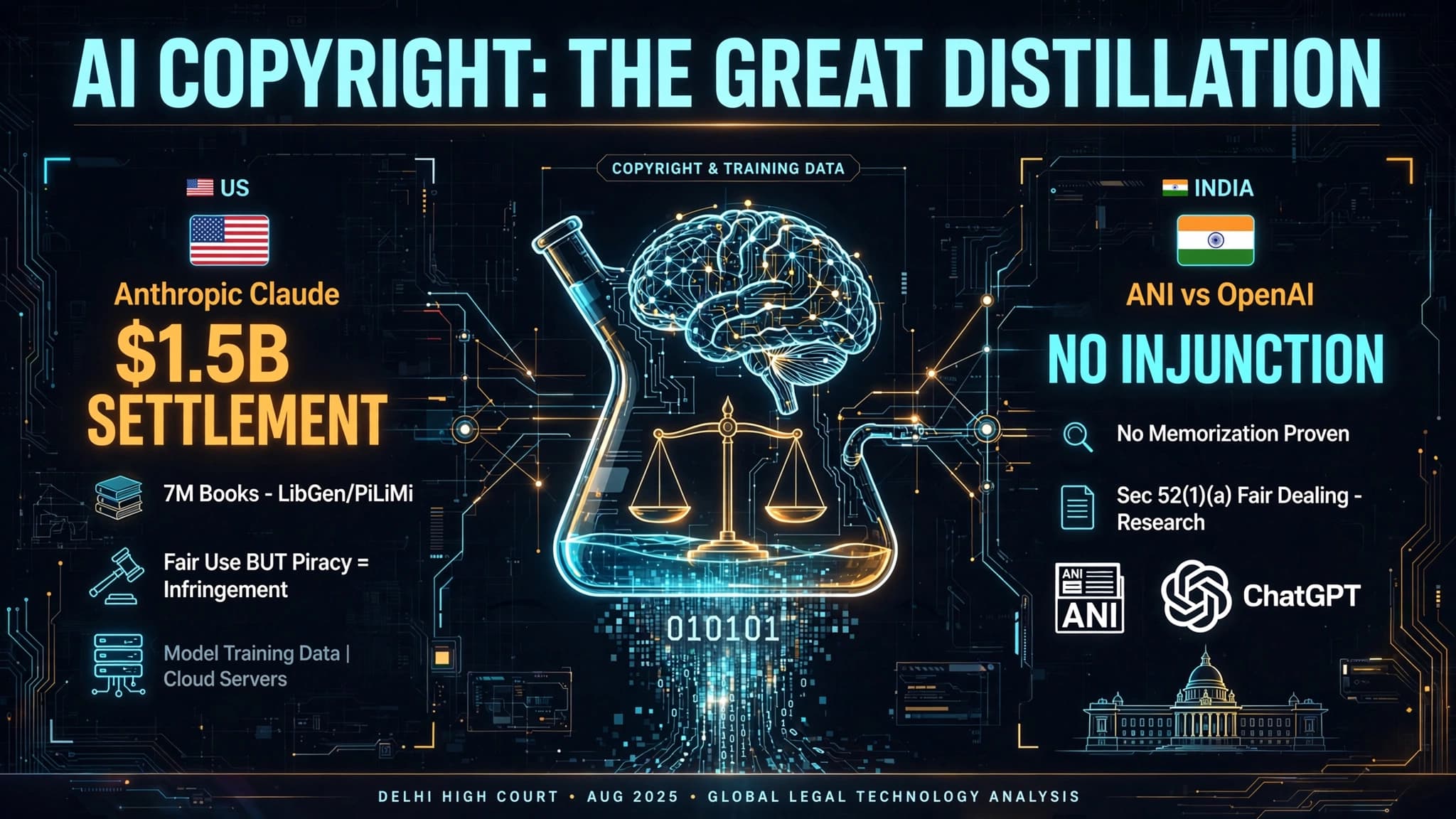
In a tale of two distilleries, a U.S. court ruled Anthropic's Claude was exceedingly transformative but fined it $1.5 billion for bootlegging the mash, while Delhi ruled OpenAI's ChatGPT left no trace of ANI's spirit in its final pour. AI law now has a single question: was your distillation licensed?
THE GREAT DISTILLATION: HOW AI COPYRIGHT LAW LEARNED TO SEPARATE THE SPIRIT FROM THE SPIRITS
The week of July 24, 2026 created a global split-screen for AI. In San Francisco, a federal judge signed off on the largest copyright recovery in U.S. history against an AI company. In New Delhi, the Delhi High Court refused to grant even an interim injunction against another for essentially the same conduct.
Both cases asked the same question: Can you train an LLM on copyrighted works without a license? Both answered: it depends, not on whether you distilled, but on where you got the mash and what remains in the glass.
This is the new Distillation Attack Doctrine in copyright. In AI security, a distillation attack extracts a model's intelligence without stealing its weights. In copyright, courts are now policing a legal distillation attack, extracting human expression without copying verbatim. The pun writes itself, and the law is now taking it seriously.
1. Bartz v. Anthropic: The $1.5 Billion Penalty for a Bootlegged Mash
In August 2024, authors Andrea Bartz, Charles Graeber and Kirk Wallace Johnson sued Anthropic for training Claude on millions of books taken from shadow libraries Library Genesis (LibGen) and Pirate Library Mirror (PiLiMi).
In June 2025, U.S. District Judge William Alsup issued the landmark split ruling that defines U.S. AI law today. He held that Anthropic's "training of its Claude LLMs on authors' works was 'exceedingly transformative, and therefore protected by fair use", like any reader aspiring to be a writer, the model was not racing to replicate but to turn a corner and create something different.
The mash, however, was pirated. Judge Alsup found Anthropic may have illegally downloaded as many as 7 million books from pirate websites and held that saving pirated copies to build a "central library of all the books in the world" was not fair use.
The class was certified for all owners of ISBN-bearing books downloaded from LibGen and PiLiMi. Facing a December 2025 trial, Anthropic settled.
A federal judge approved Anthropic's $1.5 billion settlement, the largest known settlement of a U.S. copyright case, with approximately $3,000 per work for nearly 500,000 books. Crucially, the settlement only covers past infringement from illegally-downloaded books, it does not create a forward license to distill.
U.S. Rule: You can distill the spirit, but you can't steal the bottles to do it.
2. ANI Media Pvt. Ltd. v. OpenAI: India's Aftertaste Test
Filed in November 2024, ANI accused OpenAI of using its published news content without permission to train ChatGPT and of hallucinating fake stories attributed to ANI.
On July 24, 2026, Justice Amit Bansal of the Delhi High Court dismissed ANI's interim injunction application in 2026 LiveLaw (Del) 687, in India's first substantive finding on AI training.
The court applied an aftertaste test:
First, ANI had failed to show that ChatGPT memorised or reproduced its news reports in responses generated for users.
Second, "OpenAI's act of storing ANI's original works...falls under Section 52(1)(a) Copyright Act and therefore does not amount to infringement", with storage for LLM training protected as research under fair dealing.
And with a distinctly Indian public-interest balance, the court held: "Irreparable injury would be caused not only to Open AI but also to the public at large if an interim injunction is granted". The court did, however, hold that it has territorial jurisdiction over foreign AI models, a warning for all global labs.
India Rule: If your distillation leaves no trace of my expression in the final pour, it's not infringement.
The Stark Difference: Source vs. Output
Legal Pivot | U.S. - Claude / Anthropic | India - ChatGPT / ANI |
|---|---|---|
What Court Policed | Input - Acquisition of data | Output - Substitution in market |
Doctrine | Fair Use §107, transformative use | Fair Dealing Sec 52(1)(a), research + non-expressive use |
Distillation Test | Was the mash bootlegged? Piracy = infringement even if output is transformative | Was the final spirit contaminated? No memorization = no infringement |
Proof Needed | Proof of download from LibGen/PiLiMi | Proof of regurgitation / substantial similarity |
Remedy | $1.5B, strict liability for pirated sourcing | No injunction, public interest favors AI research |
In short: The U.S. says high-proof models require high-proof provenance. India says high-proof models require low-proof resemblance.
Implications for Global Technology Law
For General Counsel of any AI company training in 2026, the distillation doctrine creates a dual-track compliance roadmap:
- Clean Your Distillery for the U.S.: Purchase-and-scan is fair use, piracy is not. Audit all training corpora for Books3, LibGen, PiLiMi and similar sources. Document chain of title. The $1.5B settlement was the cost of a contaminated mash.
- Engineer for No Aftertaste for India: Implement anti-memorization filters, publisher opt-out/blocklists, and output logging to prove no substantial similarity. Your best defense in Delhi is proving ChatGPT doesn't taste like ANI.
- The Hallucination Defense Cuts Both Ways: ANI alleged ChatGPT falsely attributed fake news to it. The court treated hallucinations as evidence against copying, because a hallucination is not a copy. This creates a perverse incentive that rights-holders will now attack.
The era of "scrape first, ask later" is over. The era of "prove your source and prove your spirit" has begun. Courts have become master distillers themselves, and they are now deciding which AI distillations deserve a license to brew, and which are just elegant bootlegging.