Kerala Designates Cyber Operations Division as State Cyber Crime Coordination Centre (S4C)
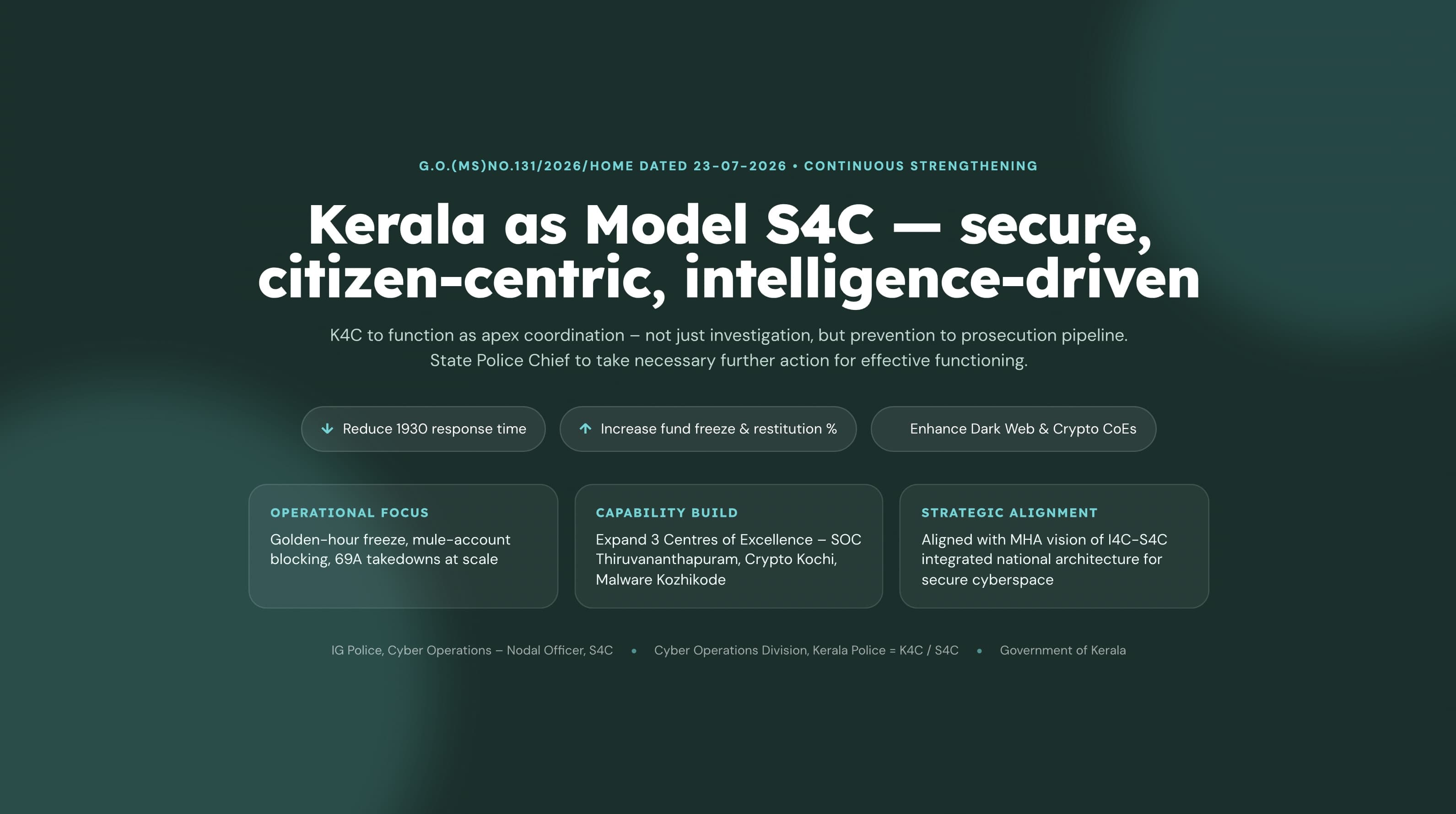
S4C is the structured state-level arm of India’s national cybercrime coordination framework. In Kerala, it formalises and strengthens the role of the Police Cyber Operations Division as the official state nodal body for cybercrime coordination with I4C.
In a significant step towards strengthening the fight against cybercrime, the Government of Kerala has formally declared the Cyber Operations Division of the Kerala Police as the State Cyber Crime Coordination Centre (S4C) for the state. The order, issued as G.O.(Ms) No. 131/2026/HOME on 23 July 2026, recognises the existing integrated cyber-policing framework as fully meeting the national requirements set by the Ministry of Home Affairs (MHA).
Background: From National Framework to State-Level Coordination
Cybercrime has emerged as one of the fastest-growing threats in India, spanning financial frauds, social media offences, dark web activities, cryptocurrency-related crimes, and emerging risks involving artificial intelligence.
Recognising that effective action requires strong state-level structures, the MHA has been urging all States and Union Territories to establish, strengthen and operationalise State Cyber Crime Coordination Centres (S4Cs). These are envisaged as the state-level counterparts of I4C, apex nodal agencies for coordinating the prevention, detection, investigation and prosecution of cybercrimes, along with related functions such as threat intelligence, capacity building and inter-agency coordination.
In February 2026, at the National Conference on “Tackling Cyber-Enabled Frauds & Dismantling the Ecosystem” in New Delhi, Union Home Minister Amit Shah launched the State Cyber Crime Coordination Centre (S4C) dashboard of I4C. The dashboard is designed to empower State and UT police forces with real-time data insights, improve coordination, and enable faster, more effective responses to cyber-enabled crimes.
Kerala’s Preparedness and Formal Declaration
Kerala had already built a comprehensive cyber-policing architecture well before the formal S4C declaration. Administrative sanction for the Cyber Police Division (headed by the Inspector General of Police, Cyber Operations) was granted in January 2024. In October 2025, all Cyber Crime Police Stations in the state were brought under the administrative and operational control of the Cyber Division Headquarters, creating a unified statewide command structure.
The State Police Chief reported that this framework fully satisfies the mandatory requirements of an S4C. Key components include:
- Public Outreach Group and Cyber Fraud & Social Media Group: Manages the 24×7 Cyber Crime Helpline 1930 and the National Cyber Crime Reporting Portal; coordinates immediate freezing of funds, placement of lien and restitution with banks and financial intermediaries; blocks mule accounts, rogue IMEIs and MSISDNs; and initiates proactive takedown actions under Sections 69A and 79(3)(b) of the Information Technology Act.
- Cyber Security and Advanced Crimes Group: Handles cyber hygiene, incident response with CERT-K, and complex cases involving AI, emerging threats and dark web exploitation.
- Research and Analysis Unit and Cyberdomes: Serves as the technical analysis arm using OSINT, CERT, I4C and NTRO feeds for big-data analytics and threat intelligence. Specialised Centres of Excellence operate at:
- Thiruvananthapuram, Security Operations Centre and Dark Web Monitoring;
- Kochi, Cryptocurrency Investigation and Blockchain Analytics; and
- Kozhikode, Malware Analysis and Reverse Engineering.
- Training, Capacity Building and Public Outreach Group: Designs specialised curricula in coordination with KEPA/PTC, maintains a trained personnel database, and runs public-awareness and cyber-hygiene campaigns.
The Inspector General of Police, Cyber Operations, has been nominated as the Nodal Officer of the S4C. The Centre will function under the overall control of the State Police Chief and act as the apex state-level nodal agency for a wide range of activities, including prevention and investigation of cybercrimes, mitigation of cyber-financial frauds, operation of the 1930 helpline and National Portal, cyber-threat intelligence, digital forensics, inter-state and inter-agency coordination, training, research and public awareness.
The Role of Cyberdome
Central to Kerala’s cyber capabilities is Cyberdome, the Cyber Centre of Excellence of the Kerala Police. Conceived as a high-tech public-private partnership platform, Cyberdome brings together government departments, academia, industry, ethical hackers, research groups and international partners to build a cyber-threat resilient ecosystem. Located at the Thejaswini Annexe Building in Technopark, Thiruvananthapuram, it focuses on technology augmentation for policing, proactive prevention, investigation support, training and R&D.
The specialised Centres of Excellence mentioned in the S4C order (Security Operations Centre & Dark Web Monitoring in Thiruvananthapuram, Cryptocurrency & Blockchain Analytics in Kochi, and Malware Analysis & Reverse Engineering in Kozhikode) operate under the Research and Analysis Unit and Cyberdomes framework. Cyberdome has long served as the technological R&D and collaboration hub supporting the Cyber Division’s operational work.
Significance
The formal declaration of S4C in Kerala is both a recognition of the state’s advanced cyber infrastructure and a clear alignment with the national strategy led by I4C. With the S4C dashboard now available to states and a fully functional nodal structure in place, Kerala is positioned to deliver faster inter-agency coordination, more effective fund recovery in financial frauds, stronger technical analysis, and sustained public awareness.
As cyber threats continue to evolve, the combination of a dedicated Cyber Operations Division, specialised Cyberdomes, seamless integration with the national I4C ecosystem, and real-time tools such as the S4C dashboard represents a robust model for other states. The State Police Chief has been directed to take further measures to ensure the continuous strengthening of the S4C in line with guidelines issued by the Ministry of Home Affairs and I4C.
Citizens are encouraged to report cyber frauds and other cybercrimes immediately on the helpline 1930 or through the National Cyber Crime Reporting Portal (cybercrime.gov.in) for swift action.