Meta Mandates AI Disclosure Labels for Ads Targeting India
Meta now requires advertisers running campaigns in India to declare if their ads use AI-generated or AI-edited media, adding an “AI info” label to boost transparency under the country’s new synthetic content rules.
New Delhi, India
Meta has introduced mandatory AI media disclosure options in its Ads Manager for campaigns targeting India, requiring advertisers to indicate whether ads include content created or edited with artificial intelligence. This step implements transparency measures aligned with India’s updated intermediary rules on synthetically generated information and forms part of broader platform efforts to label AI-influenced advertising.


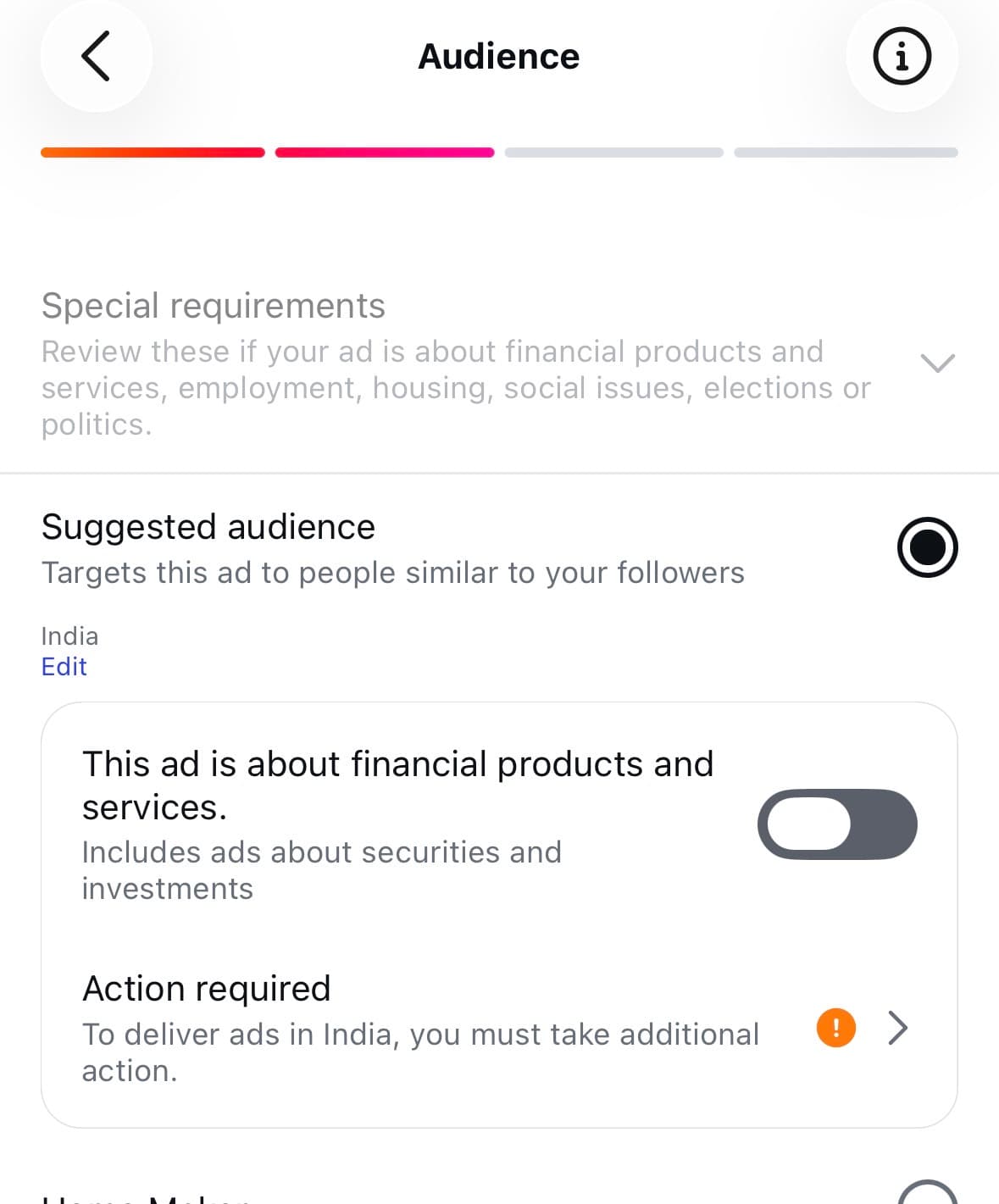
The interface prompts advertisers with an “Additional action required” screen to “Complete requirements” and provide information needed to comply with local regulatory guidelines. Under an “AI info” section, users encounter a toggle for “Ad includes media created or edited with AI,” accompanied by the note that ticking the box may add an AI info label to the ad, with a link to information on AI transparency. Separate audience-targeting screens for India also flag special requirements for categories such as financial products and services, along with an “Action required” notice stating that additional steps must be taken to deliver ads in the country.
Background: India’s Synthetic Media Rules
In February 2026, India’s Ministry of Electronics and Information Technology (MeitY) notified amendments to the Information Technology (Intermediary Guidelines and Digital Media Ethics Code) Rules, 2021. Effective later that month, the changes formally define “synthetically generated information” (SGI), content artificially or algorithmically created, generated, modified, or altered in a manner that appears authentic or true. This encompasses deepfakes and other realistic AI-generated or AI-edited images, video, and audio.
The rules impose due-diligence obligations on intermediaries, particularly significant social media intermediaries. Platforms must take reasonable technical measures to prevent unlawful SGI, ensure permissible synthetic content is clearly and prominently labelled (with visibility standards for visual and audiovisual material), embed metadata or unique identifiers where feasible, and facilitate user declarations about AI involvement at upload. The framework responds to documented risks of deepfakes and synthetic media being used for misinformation, election interference, financial fraud, impersonation, and reputational harm. Draft proposals released in late 2025 had already signalled these directions, emphasising labelling, provenance, and faster action on harmful content.
Meta’s Platform Response and Global Context
Meta has long required disclosure for certain digitally created or altered content in social-issue, electoral, and political ads (photorealistic images, video, or realistic audio depicting real people saying or doing things they did not, non-existent realistic people or events, or altered real events). Non-disclosure can lead to ad rejection and further penalties. More recently, the company has expanded AI transparency tools across Facebook and Instagram ads. These include automatic “AI info” labels when advertisers use Meta’s own generative features (such as background generation, image generation, or animation tools) or when industry-standard signals (including C2PA metadata) detect third-party generative AI tools. In regions with specific legal requirements, explicitly including India, alongside the European region, California, New York, and Taiwan, advertisers are given the option (and in practice the expectation) to self-disclose GenAI use so that a more visible label can appear near the “Sponsored” indicator.
The India-specific prompts visible in Ads Manager operationalise this dual approach: platform-level detection and labelling plus advertiser self-attestation tailored to local law. Similar interface elements have been observed by advertisers and documented in industry reporting throughout 2026.
Public Policy Significance
For global public-policy audiences, Meta’s implementation illustrates several converging trends. First, major platforms are functioning as de-facto implementers of national digital-content rules, translating statutory labelling and due-diligence duties into product features that advertisers must navigate before campaigns can run. Second, India, home to one of the world’s largest digital advertising markets and user bases, has moved relatively quickly from consultation to enforceable rules on synthetic media, providing a significant non-Western reference point alongside the EU AI Act’s transparency provisions and emerging U.S. state-level requirements.
The approach raises familiar policy questions: the precision of automated detection versus over- or under-labelling; the burden on advertisers (especially smaller or local ones) of additional compliance steps; the risk that visible AI labels could stigmatise legitimate creative uses of generative tools; and the challenge of consistent cross-border standards when platforms must reconcile differing national thresholds for what constitutes disclosable synthetic content. At the same time, the rules and Meta’s response aim to reduce information asymmetry for users, support fact-checking and accountability ecosystems, and limit the most deceptive uses of photorealistic synthetic media in paid promotion.
As generative AI tools become standard in advertising production, the India case underscores the accelerating shift from voluntary platform guidelines toward legally anchored transparency obligations. How effectively these measures reduce harm without unduly constraining legitimate expression and commercial communication will be closely watched by regulators, platforms, advertisers, and civil society worldwide.