Why companies should use Meta's Brand Rights Protection tool for countering Impersonation Scams
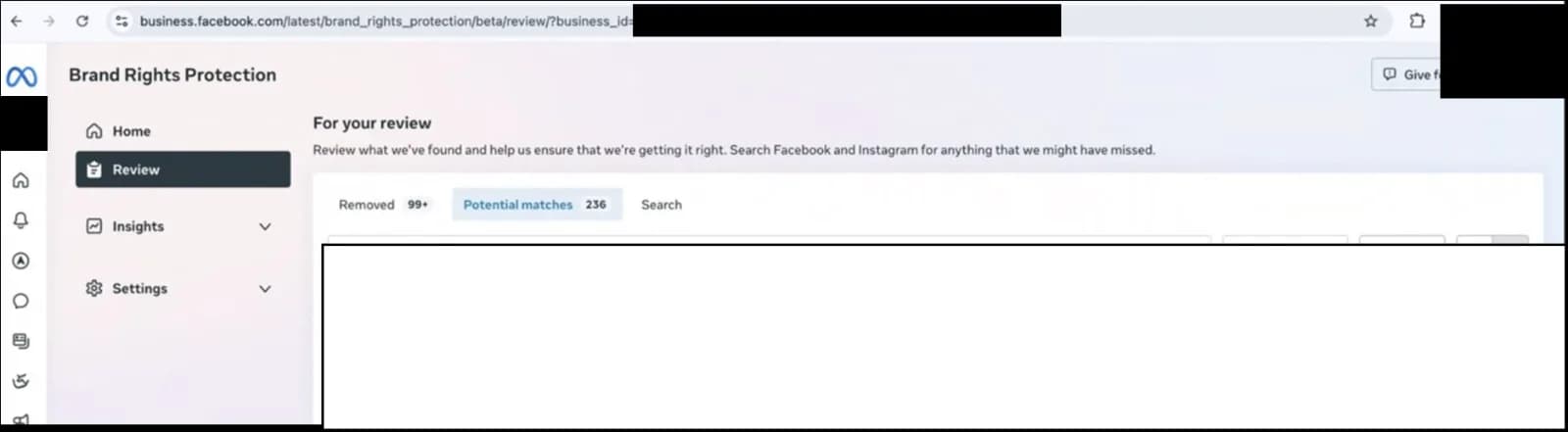
Impersonation through fake brand stores, cloned support pages and scam ads is one of the fastest-growing forms of social media fraud. Meta removed over 159 million scam ads in 2025, and the FTC recorded $2.1 billion in reported social media scam losses for Americans. Meta's Brand Rights Protection tool gives verified trademark owners AI-assisted monitoring, bulk reporting and allowlisting to find and remove fakes on Facebook and Instagram.
Impersonation has become a primary engine of online fraud. Fake brand stores, cloned customer-support pages, scam ads built around seasonal sales, and accounts collecting payments under false identities are among the fastest-growing categories of social media scams.
The scale is massive. Meta reported removing more than 159 million scam ads globally in 2025, 92% of them before any user reported them. The US Federal Trade Commission (FTC) reported $2.1 billion in social media scam losses for Americans in 2025, an eightfold rise since 2020 and the highest of any contact method. Facebook accounted for the largest share, followed by WhatsApp and Instagram. Investment scams, shopping scams (often counterfeit or undelivered goods from fake stores) and impersonation schemes were the main drivers. The problem demands constant vigilance: one European financial portal reported roughly 256 violations in a single month in 2024 using Meta's reference tools, and a German court later found Meta liable for slow removal of fake ads that misused the brand's logo and imagery.
To combat this, Meta offers rights holders a dedicated portal within Meta Business Suite: Brand Rights Protection.
What is Brand Rights Protection?
Brand Rights Protection is Meta's official private workspace for verified intellectual property owners to protect their assets across Facebook and Instagram. For eligible brands, it replaces reliance on standard public reporting forms.

Meta says the tool "enables brands to protect their intellectual property across Meta technologies. It allows brands to identify and report content for counterfeit, trademark and copyright infringement and business impersonation."
The portal sits in Meta Business Suite at business.facebook.com. Access requires a Meta Business portfolio, an approved application, proof of an active registered trademark, no history of intellectual property violations, and an assigned IP reviewer. It is free but gated: brands apply through Meta Business Help and submit trademark documents.
How it fights impersonation scams
The traditional approach was reactive: spot a fake ad, copy the link, submit a form and wait while scammers launched more. Brand Rights Protection moves toward proactive, AI-assisted monitoring.
- Reference Library: Brands upload official logos, product photos, packaging and related assets, with bulk upload and support for hundreds of images. Meta's systems scan ads and commerce listings for unauthorised matches, flagging scam ads that reuse stolen imagery for fake promotions.
- AI-powered match detection: Meta's AI surfaces suspected violations in the Matches tab based on reference images, past takedown requests, trademark data and allowlist information. Each action improves the relevance of later matches. Brands review and confirm before anything is removed. Enhanced AI matching for logos, names and likeness is still in closed beta for some users.
- Bulk reporting and allowlisting: Brands can flag many violating ads or accounts at once. Official pages, accounts, distributors and partners can be allowlisted so legitimate uses are filtered out and false positives drop. Impersonation reports need at least one official account on the allowlist as a baseline of authenticity.
- Expanded scam reporting: Since mid-2025, enrolled brands can report suspected scam or misleading ads at scale even when the ads don't directly misuse the brand's IP, using an "Other" violation type. Takedown drafts are now sorted by category: copyright, counterfeit, impersonation and trademark.
Why it matters globally
For consumers, impersonation and counterfeit scams mean stolen payment details and goods that never arrive. For brands, they erode trust, flood comments with complaints and waste ad spend competing against fakes that use the brand's own name and assets.
Brand Rights Protection moves defence from whack-a-mole towards continuous monitoring. A brand in any market can catch unauthorised campaigns, such as cloned pages running fake seasonal-sale creatives, more systematically and earlier than user reports alone would.
It is not a silver bullet. Scammers adapt by tweaking images, misspelling names, rotating domains and using subtle variations. Human review is still needed before potential matches are removed, and Meta faces criticism and litigation over the volume and speed of its scam-ad enforcement. Still, for businesses dealing with cloned support accounts, counterfeit listings or brand-exploiting scam ads, Brand Rights Protection is a core frontline tool once they qualify.