Business Workflows at Risk - Reading Between the Lines of Indian CERT-In's Latest Warning
CERT-In has received reports of unauthorised financial transactions at organisations outside the financial sector. Some hit service providers supporting government-linked payment workflows, and platforms responsible for vendor or partner payouts.
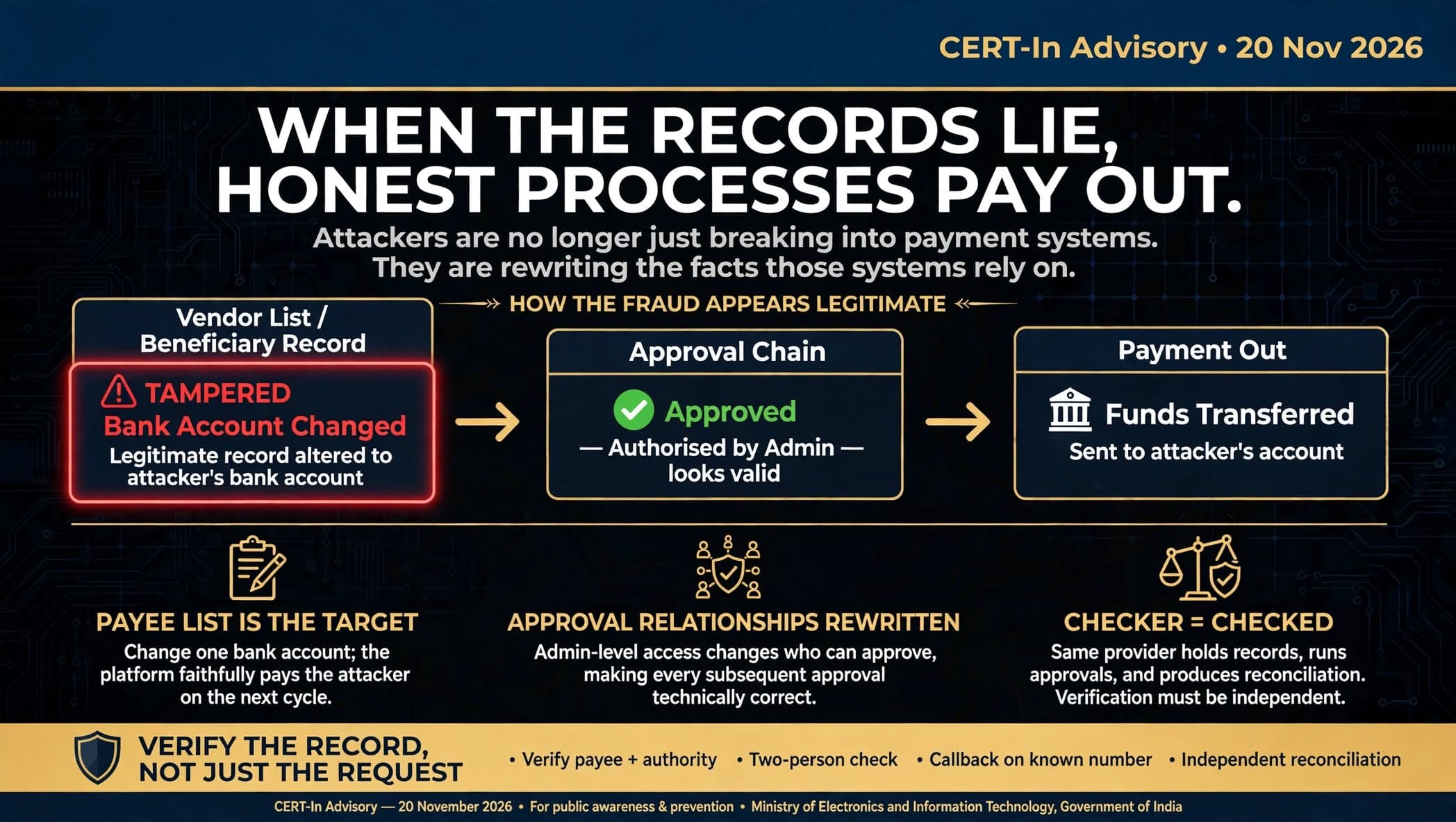
CERT-In's Critical advisory of 20 November 2026 spends just a few paragraphs on what it calls "financially motivated abuse of business payment workflows". They are carefully worded, and the wording says more than the length suggests. Read closely, they describe a quiet shift: attackers are no longer just breaking into payment systems. They are rewriting the facts those systems rely on, and letting honest processes pay out.
This piece separates what CERT-In says from what its wording suggests. Interpretations are ours, not CERT-In's.
Methods of Compromises
The methods: misusing business applications and provider-run workflows, not just payment APIs; altering business records or approval relationships, then using legitimate payment processes; using trusted systems and established approvals so nothing looked suspicious at first; and exploiting gaps in independent verification, reconciliation and review of record changes.
Its conclusion: a transaction can pass the usual checks even when the records behind it were changed without authorisation. Organisations must verify the underlying records and the authority for a payment, not only the payment request.
Reading between the lines
1. "Outside the financial sector" means outside the safety net
Banks and regulated fintechs have fraud teams, transaction monitoring and a sector CERT (CSIRT-Fin). The victims here sit outside that perimeter. CERT-In's previous advisories this autumn were aimed at banks, fintechs and payment firms. The fact that it now has reports from non-financial organisations suggests the losses are already real, and are landing on organisations that may never have built fraud controls because they never thought of themselves as handling money at risk.
2. "Government-linked" means public money, routed through private hands
CERT-In does not say which workflows were hit. But a "service provider supporting government-linked payment workflows" describes a common arrangement: a department owns the money and the decision, while a private technology firm runs the system that prepares, routes or records the payment. Disbursements to beneficiaries, contractors and suppliers are the obvious candidates, though the advisory names none. The implication is uncomfortable. The department may trust the provider's records completely, and the provider may be the one that was compromised.
3. "Vendor or partner payouts" means the payee list is the target
Payout platforms exist to send money to many recipients on a schedule. Their most valuable asset is not the payment rail but the list of who gets paid and where. Change one bank account in that list and the platform will faithfully pay the attacker on the next cycle, with no break-in visible at the moment of payment.
4. "Rather than... payment APIs alone" signals displacement
Note the word "alone". APIs are still in play, but they are no longer the whole story. In October and early November, CERT-In's warnings (CIAD-2026-0046 and CIAD-2026-0058) focused on attackers calling payment APIs directly. One reasonable reading is that as APIs get hardened, attackers move upstream, to the business applications that feed the APIs. CERT-In does not draw this link itself, but the sequence fits.
5. "Approval relationships" means someone had admin-level reach
Changing a beneficiary's bank account is one thing. Changing who approves a payment is another. That usually needs access to configuration or administrative functions, not just a user login. The advisory does not say how attackers got that reach. It could be stolen admin credentials, a compromised provider account, or misuse by someone with legitimate access. Any of those means the approval chain itself was rewritten, so every subsequent approval was, technically, correct.
6. "Without immediately raising suspicion" means late discovery
The key word is "immediately". The transactions were noticed eventually, but not when they happened. In record-tampering fraud, the usual alarm is the genuine payee asking why they were not paid, or a reconciliation that finally does not balance. By then the money has typically moved on. The advisory implies a detection gap measured in payment cycles, not minutes.
7. "Gaps in independent verification" means the checker and the checked were the same
This is the most revealing line. Verification only works if it is independent. If the same provider holds the records, runs the approvals and produces the reconciliation, a single compromise defeats all three. CERT-In's own recommendations confirm this reading: it asks that the verification source not be alterable through the same compromised provider environment, and warns that multiple approvals within one provider-controlled system may not be enough.
8. The closing line redefines what "authorised" means
For years, security has asked: was this request genuine? Was the user logged in, was the request signed, did the approver approve? CERT-In is saying that is no longer enough. A payment can be properly requested and properly approved, and still be fraudulent, because the data it was built on was false. The new question is: is the record true, and did the person who changed it have the right to?
Who provides these services
Important: CERT-In has not named any affected organisation. The companies below are listed only to show what each category looks like in practice. Their inclusion does not suggest that any of them has been compromised.
The advisory names two kinds of victim: service providers supporting government-linked payment workflows, and platforms handling vendor or partner payouts. In India, these categories include the following.
Category | What they do | Examples |
|---|---|---|
State treasury and financial-management systems | Private IT firms that build and run the software states use for budgets, treasury, pensions and payments | TCS, which has run Odisha's treasury and IFMS platforms since 2005 |
Pension, tax and identity record-keepers | Maintain records that public payments and contributions depend on | Protean eGov Technologies, KFin Technologies and CAMS, the NPS record-keeping agencies registered with PFRDA |
Last-mile benefit disbursement | Pay out welfare entitlements such as NREGA wages and pensions through local service points | CSC e-Governance Services, working with NPCI's Aadhaar-enabled payment system |
Government e-procurement platforms | Hold the supplier and tender records that contractor payments are based on | (n)Code Solutions (a GNFC division), C1 India |
Vendor and partner payout platforms | Let businesses pay thousands of vendors, partners or customers at once by file upload or API | Cashfree Payouts, RazorpayX Payouts; globally, Tipalti, Payoneer and Stripe Connect |
Where payee records live | ERP, accounting, HR and payroll systems, where a bank account or approval chain is actually edited | SAP, Oracle, Tally, Zoho Books; HR platforms such as Workday |
Government-run systems sit in the same chain. The Public Financial Management System (PFMS) is the payment platform for Aadhaar-based benefit transfers, with NPCI and bank networks behind it. NIC's GePNIC handles e-procurement for many government departments.
One design trade-off stands out. Payout platforms compete on speed: RazorpayX advertises no cooling period for new beneficiaries, and Cashfree promotes payouts regardless of banking hours or cooling periods. That speed is a genuine business need. But record-tampering fraud works best when a newly changed payee can be paid instantly. The controls that slow it down have to sit with the organisation that owns the payee list.