Telegram Law Enforcement Data Request: How to Investigate Telegram
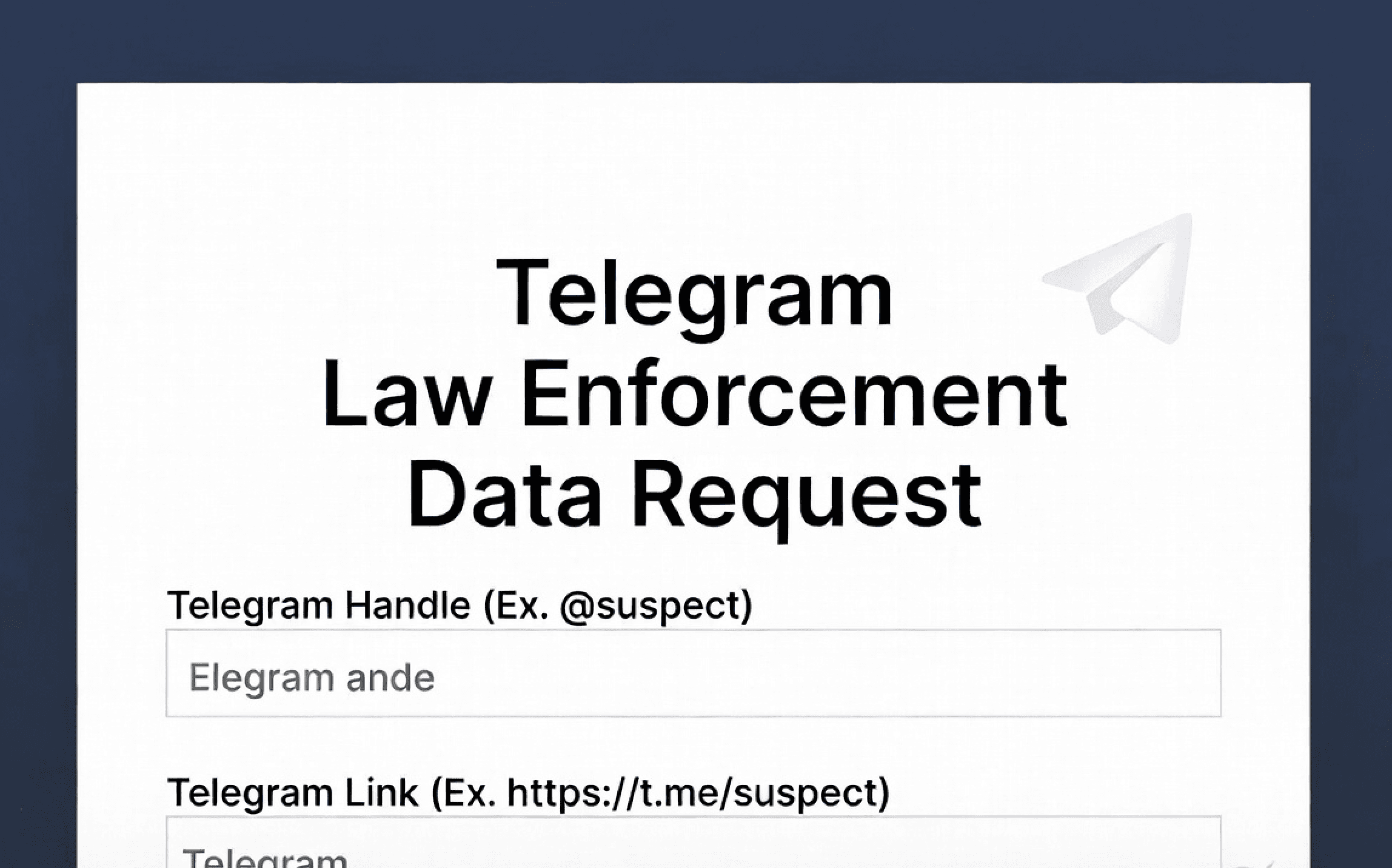
Telegram has no LERS portal — police request data by email under legal process. Identifiers, the data provided (IP, phone), and India's IT Rules timeline.
Telegram is one of the world’s most widely used apps — and a fixture of cyber investigations, from the sale of restricted material and pirated content to the renting of bank accounts, SIM cards and SIM boxes. Here is how law enforcement lawfully obtains Telegram data.
- No LERS portal: unlike WhatsApp or Meta, Telegram has no self-service law-enforcement portal — requests go by email under valid legal process.
- Identifiers accepted: a Telegram handle (e.g. @suspect) or link (e.g. t.me/suspect).
- Data provided: primarily IP address and phone number to authorised agencies.
Identifiers for a data request
Telegram data is sought through two main identifiers:
- Telegram handle (e.g. @suspect)
- Telegram link (e.g. https://t.me/suspect)
Pro tip: if the handle or link is hidden by privacy settings, open Telegram Web in a browser and copy the link from there.
What data Telegram provides
Per its privacy policy, Telegram discloses primarily two data points to relevant authorities: IP address and phone number.
For India
India’s framework lets courts and authorised personnel — including cyber police — lawfully seek data from Telegram. Under Rule 3(1)(j) of the IT (Intermediary Guidelines and Digital Media Ethics Code) Rules, 2021, intermediaries must assist authorised agencies and comply within 72 hours (24 hours for online real-money gaming) of a written order.
- Grievance Officer (India): [email protected]
- Nodal Officer (India): [email protected], [email protected]
- Vice President: [email protected]
- Copyright infringement (DMCA): [email protected]
Every legal request must carry a clear justification of the offence — attach screenshots or evidence showing why the data is sought. Requests without justification are rejected; well-documented ones get faster responses.
What if Telegram does not respond in your country?
Telegram responds where there is a law compelling it. The first step is a legal framework empowering the government to seek data; the second is a nominated resident nodal officer for communication. By volume of disclosure requests, India is among Telegram’s highest — a function of the scale of abuse and a legal regime that binds Telegram to provide data.
See also
- Overview: law-enforcement data-request portals across all platforms
- WhatsApp LERS Portal: police & government data request guide
- Facebook & Instagram LERS Portal: police data request guide
For the full directory of platform law-enforcement request portals, see our LERS portal hub.