Spain's Computer Frauds Rise Again to One in Six Recorded Crimes as Ministry Warns Against Fake Family Messages
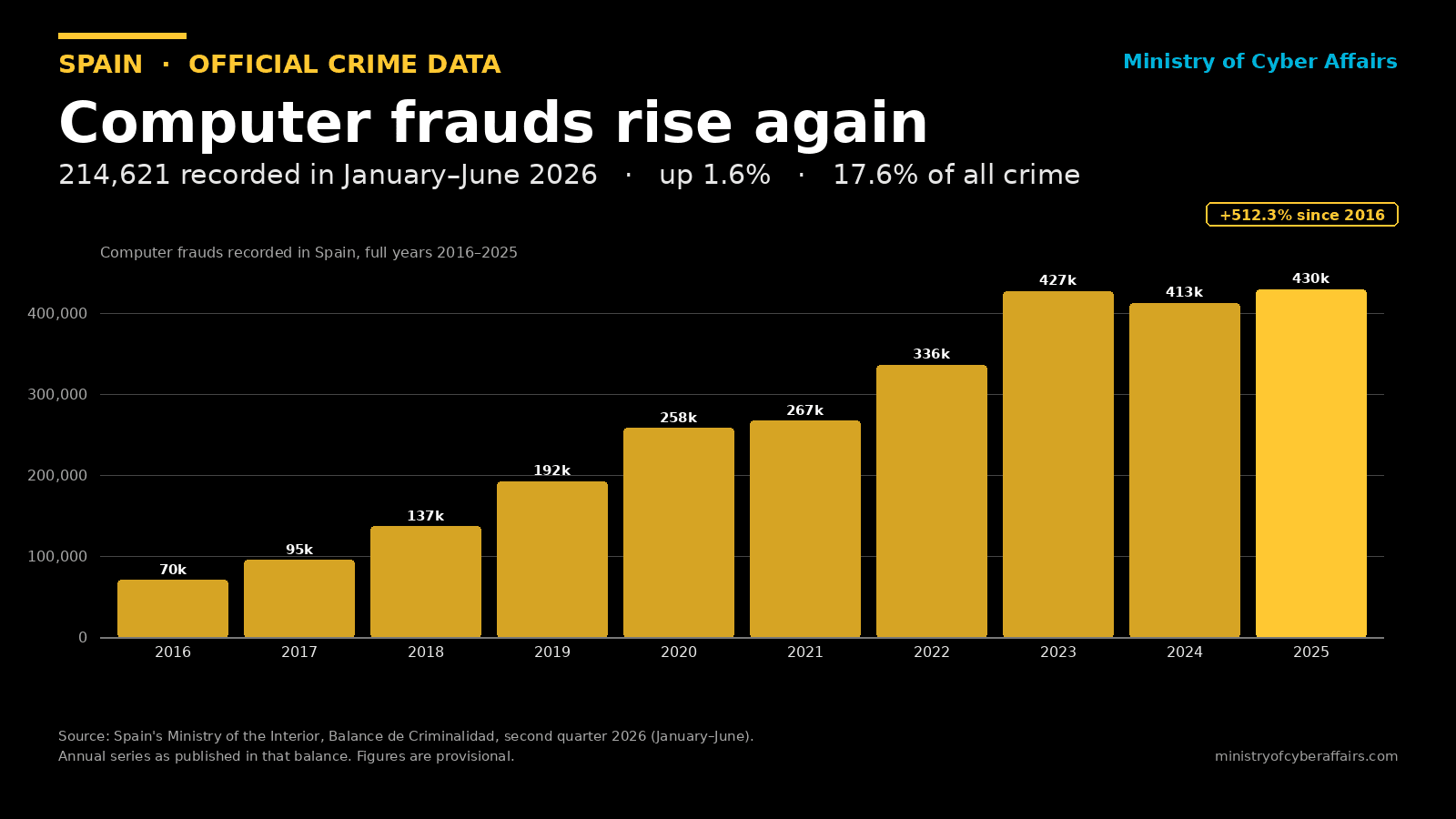
Computer frauds recorded by police in Spain have risen again and now account for about one in six of all recorded crimes. In the first half of 2026, officers registered 214,621 computer frauds, up 1.6% from a year earlier and 17.6% of all recorded crime, according to the Interior Ministry's latest crime balance. On 12 November the ministry warned people not to send money after unexpected messages, including fake family requests for a loan.
Spain's Ministry of the Interior on 12 November 2026 warned the public not to transfer money after an unexpected request, posting a mocked-up WhatsApp exchange in which someone asks for an advance of €960 (about $1,064) and is told the message will be passed to the police.
"If you receive an unexpected request for money, be suspicious and do not transfer money," the ministry said.
"When in doubt, let the conversation continue with @policia."
The warning comes against a backdrop of computer frauds that remain at historically high levels.
The ministry's latest Balance de Criminalidad, covering January to June 2026, the most recent quarter published, recorded 214,621 computer frauds (estafas informáticas), 1.6% more than in the same period of 2025.
Those offences made up 87.3% of all cybercrime and 17.6% of the 1,217,476 criminal offences registered in the half-year.
Cybercrime as a whole rose 0.6% to 245,936 offences, or 20.2% of all recorded crime, a rate of 10.0 offences per 1,000 inhabitants.
The figures are provisional, pending consolidation.
A decade of growth, a dip, then another rise
The longer view is sharper than the latest half-year increase.
The same official balance states that computer frauds recorded in the full year 2025 totalled 429,677, compared with 70,178 in 2016, a rise of 512.3% in ten years, using data from all police forces.
The ministry's own annual series in that report shows the climb was not uninterrupted: recorded computer frauds fell in 2024, to 412,850, before rising again in 2025.
The Interior Ministry's Informe sobre la Cibercriminalidad en España 2025, published on 10 July 2026 by the Office for Cybersecurity Coordination, puts the full-year picture in the same range.
Police recorded 488,426 cybercrimes in 2025, 5.1% more than in 2024 and 19.8% of all crime.
Almost nine in ten of those offences, 429,677, were computer frauds, up 4% on 2024.
The number of victims rose 9.3% to 383,285.
The most common age group, for both men and women, was 51 to 65; frauds involving credit or debit cards and travellers' cheques affected 146,737 people.
Forces arrested or investigated 19,876 people, up 2.9%, and the share of known cases that were cleared rose 11.4% to 14.6%.
Demand for official help has grown faster than the recorded crime figures.
INCIBE, Spain's national cybersecurity institute, said its free 017 "Tu Ayuda en Ciberseguridad" service handled 95,064 enquiries in January–June 2026, almost double the 49,599 in the first half of 2025 and close to the 98,546 recorded in the whole of 2024.
Digital transformation minister Óscar López said the rise reflected greater awareness of the free service as well as new offences in a more digital society.
In that half-year, 40% of enquiries from the public and 30.6% from businesses concerned scams in which a criminal impersonates a trusted organisation or person and tries to steal information by telephone (vishing), SMS (smishing) or email (phishing).
In 2025 the same service handled 142,767 enquiries, up 44.9%, and INCIBE's CERT managed 122,223 cybersecurity incidents, up 26%.
The "child in trouble" message
The graphic posted by the ministry is a WhatsApp-style chat.
An incoming message, timed 8:50, says: "My phone has broken and a new one costs 960 euros; since I can't make instant transfers, can you advance it to me and I'll send you a normal transfer?"
The green reply, timed 9:18, reads: "I'll pass this to the Police now so they can help you."
Spanish police have long described this pattern as the "hijo en apuros", "child in trouble", scam, also known internationally as "Hi Mum."
A criminal poses as a son, daughter or other relative, claims an urgent problem such as a broken phone, and asks for money to be sent at once, sometimes promising to repay it by a slower transfer.
The ministry's advice is not to reply with money or codes, and either to ignore the request or to hand the conversation to the police.
A parallel threat: fake bank fraud departments
A separate case announced by Spain's National Police on the same day shows another high-volume method.
Officers arrested 43 people accused of sending mass SMS messages that impersonated banks' antifraud or security units, warning of a supposed fraudulent transaction and then persuading customers, typically over the age of 65, to move money or hand over access.
The force said the scheme caused losses of more than €1.14 million (about $1.26 million), that 134 offences against more than 130 victims had been clarified, and that 95 people had been formally accused in all.
The year-long inquiry by the Economic and Fiscal Crime Unit (UDEF) is continuing.
How to protect yourself
Police and the ministry say a simple rule covers both the fake family message and the fake bank alert: do not send money, passwords or codes because an unexpected text or call told you to.
- If a relative suddenly asks for money, call them on a number you already have, or check with another family member, before transferring anything.
- If a message or call claims to be from your bank's fraud department, hang up. Contact the bank only through an official app, a number you already know, or a branch.
- In Spain, unexpected scam approaches can be reported to the National Police (@policia, or 091) and to INCIBE's 017 helpline. The figures above are police-recorded offences and official helpline enquiries; many attempts are never reported.
The same "relative in distress" WhatsApp messages, and spoofed bank-fraud alerts, are also used against families in India.
The same rule applies: never send money or share credentials after an unsolicited message; call the person on a number you already have.
Dollar figures use the European Central Bank reference rate of €1 = $1.1081 on 12 November 2026.