Singapore Police and Four Banks Disrupt Over 900 Scam Attempts, Averting S$35 Million in Losses in a Two-Month Drive
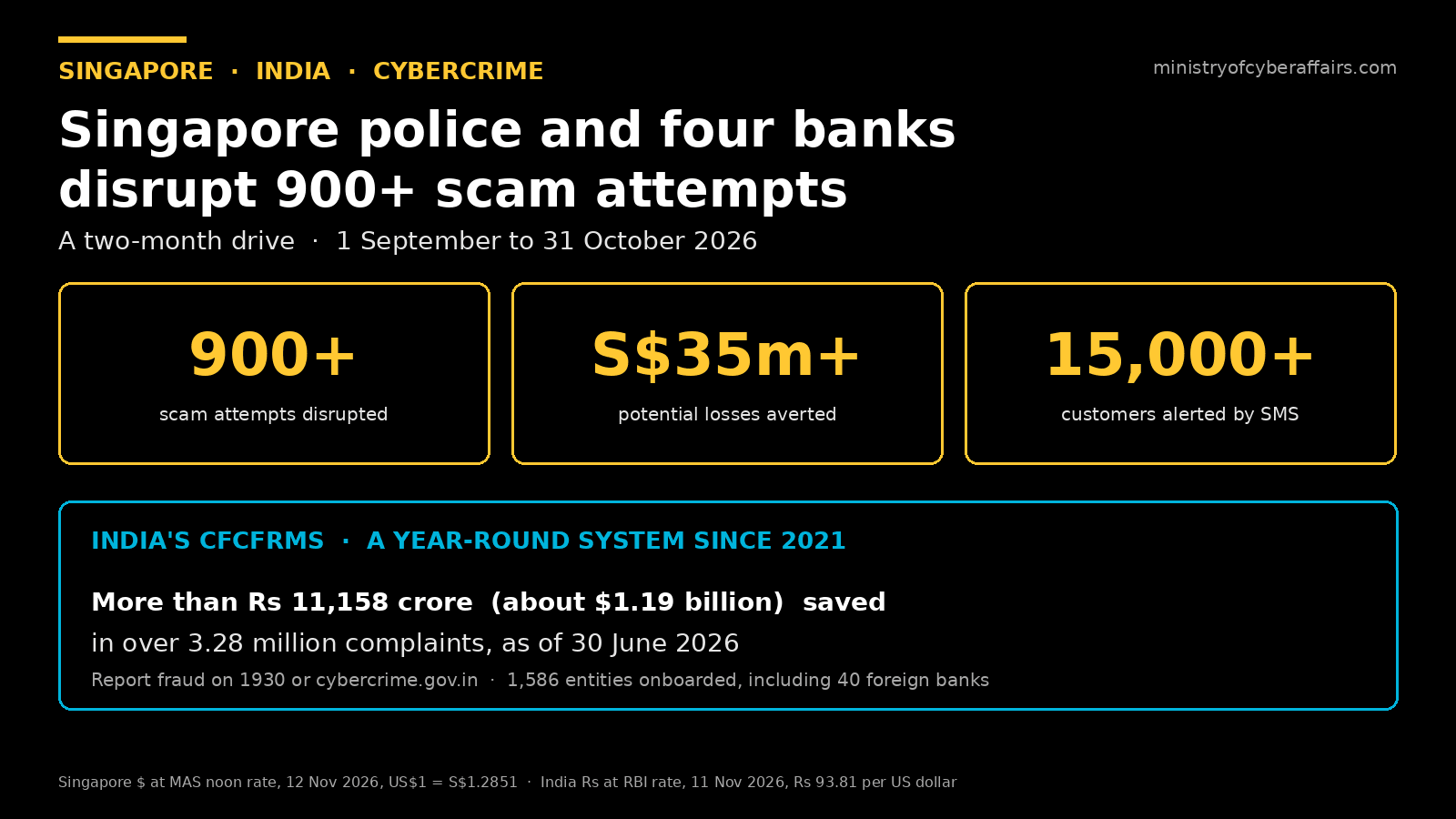
Singapore's Anti-Scam Centre and four banks disrupted more than 900 scam attempts between 1 September and 31 October 2026, the police said, averting over S$35 million (about $27.2 million) in potential losses. The centre operates year-round, with bank staff on site. India, by contrast, runs a standing national system: the Citizen Financial Cyber Fraud Reporting and Management System, which since 2021 has saved more than Rs 11,158 crore (about $1.19 billion) in over 3.28 million complaints.
The two-month operation
The Singapore Police Force said on 11 November 2026 that the Anti-Scam Centre (ASC) of its Cyber Command had worked with four banks, DBS, UOB, OCBC and GXS, to disrupt more than 900 scam attempts.
The exercise ran from 1 September to 31 October 2026.
It was a time-bound joint operation, not a named campaign, and the release did not report arrests, accounts frozen or money recovered, only potential losses that were averted.
Using robotic process automation, the centre and the banks exchanged information quickly so that potential victims could be identified and contacted.
From 1 September to 31 October, ASC officers and the participating banks sent over 27,000 SMS alerts to more than 15,000 bank customers identified as potential scam victims.
Those interventions, the police said, averted over S$35 million (about $27.2 million) that would otherwise have been transferred to scammers.
The attempts spanned several types of fraud: e-commerce scams, job scams, friend-impersonation scams, government-official impersonation scams and investment scams.
The release named no officers.
It was issued by the Public Affairs Department of the Singapore Police Force.
The four partners named in the release are all banks.
No telecommunications companies or foreign police forces were listed as partners in this operation.
What the Anti-Scam Centre does year-round
The September–October exercise should not be read as the only work the centre does.
The ASC sits inside the Singapore Police Force's Cyber Command and handles scam reports throughout the year.
In a written parliamentary answer on 12 January 2026, Singapore's Minister for Home Affairs, K Shanmugam, said that when a scam is reported the centre coordinates with banks to trace and freeze accounts, typically within a day and in some cases within hours.
Staff from seven major banks are co-located with the centre for real-time response.
The centre also works with telecommunications companies to terminate scam-tainted phone lines, and with GovTech on the misuse of Singpass accounts.
The police have also announced similar two-month robotic-process-automation operations with banks earlier in 2026.
The latest results sit on top of that standing partnership, rather than replacing it.
How India's CFCFRMS differs
India's counterpart is not a time-limited drive.
The Citizen Financial Cyber Fraud Reporting and Management System (CFCFRMS), run by the Indian Cyber Crime Coordination Centre (I4C), an attached office of the Ministry of Home Affairs, was launched in 2021 so that people can report financial cyber fraud immediately and the authorities can try to stop money being siphoned off.
Complaints can be made on the National Cyber Crime Reporting Portal at https://cybercrime.gov.in or with help from the toll-free 1930 helpline, which then flows to banks and other financial intermediaries.
The system is built around a hold, or lien, on disputed funds.
A standard operating procedure for the portal and CFCFRMS sets out how complaints are processed, how banks are to coordinate, how lien markings can be removed, and how money is to be restored to claimants.
A Money Restoration Module and a Grievance Redressal Module, covering the freezing of bank accounts and lien-marking of amounts, have been functional since April 2026, the government told Parliament.
Official figures, given in written replies in the Lok Sabha and Rajya Sabha in July and August 2026, are as of 30 June 2026 unless otherwise stated:
- More than Rs 11,158 crore (about $1.19 billion) had been saved in more than 32.80 lakh (3.28 million) complaints since the system was launched in 2021.
- 1,586 entities had been onboarded onto the platform, including 40 foreign banks operating in India.
- A Suspect Registry of cyber-criminal identifiers, launched by I4C with banks and financial institutions on 10 September 2024, had received more than 30.48 lakh (3.05 million) suspect identifiers from banks. Some 32.08 lakh (3.21 million) Layer 1 mule accounts had been shared with participating entities, and transactions worth Rs 25,698 crore (about $2.74 billion) had been declined.
- More than 15.75 lakh (1.58 million) SIM cards and 5.77 lakh (577,000) IMEI numbers, as reported by police authorities, had been blocked by the Government of India.
- I4C's Samanvaya platform, a data-sharing and analytics system for law-enforcement agencies, with a Pratibimb module that maps suspects and crime infrastructure, had led to the arrest of more than 29,837 accused and more than 233,593 cyber-investigation assistance requests, the government said in a Rajya Sabha reply on 12 August 2026.
A Cyber Fraud Mitigation Centre at I4C brings together representatives of major banks, financial intermediaries, payment aggregators, telecom service providers, IT intermediaries and state and union-territory police for immediate joint action.
That standing co-location is closer in spirit to the bank staff posted at Singapore's Anti-Scam Centre than to any single two-month operation.
The contrast, then, is one of design as much as of the latest numbers.
Singapore's September–October results show what a concentrated, time-bound bank partnership can stop in two months.
The Anti-Scam Centre itself, however, already works every day, with bankers on site, to freeze accounts when a scam is reported.
India's CFCFRMS is a national, always-on reporting and fund-hold system that any victim can trigger through 1930 or the reporting portal, and which is wired into hundreds of banks and other intermediaries, including foreign banks operating in India.
How to protect yourself
The Singapore Police Force urged the public to "ACT" against scams:
- Add security features, such as the ScamShield application and two-factor authentication on bank, social media and Singpass accounts. Set transaction limits on internet banking, including PayNow, to cap how much can be lost.
- Check for signs of a scam: question requests for personal information or money, verify online listings and reviews, and pause. If an offer is too good to be true, it is probably a scam.
- Tell the authorities and others. In Singapore, report to the bank, to ScamShield (www.scamshield.gov.sg or 1799), or file a police report. The police hotline is 1800-255-0000; information can also be submitted at www.police.gov.sg/i-witness. Report fraudulent pages or accounts to the platform concerned.
In India, suspected financial cyber fraud can be reported at once on 1930 or at https://cybercrime.gov.in, so that a hold can be attempted on the money.
Singapore dollar figures use the Monetary Authority of Singapore noon rate of US$1 = S$1.2851 on 12 November 2026 (S$1 = US$0.7781).
Indian rupee figures use the Reserve Bank of India reference rate of Rs 93.81 per US dollar on 11 November 2026.