India's Telecom Regulator TRAI Reports 1.529 Million Spam Complaints and Bars 110,325 Resources in July–September
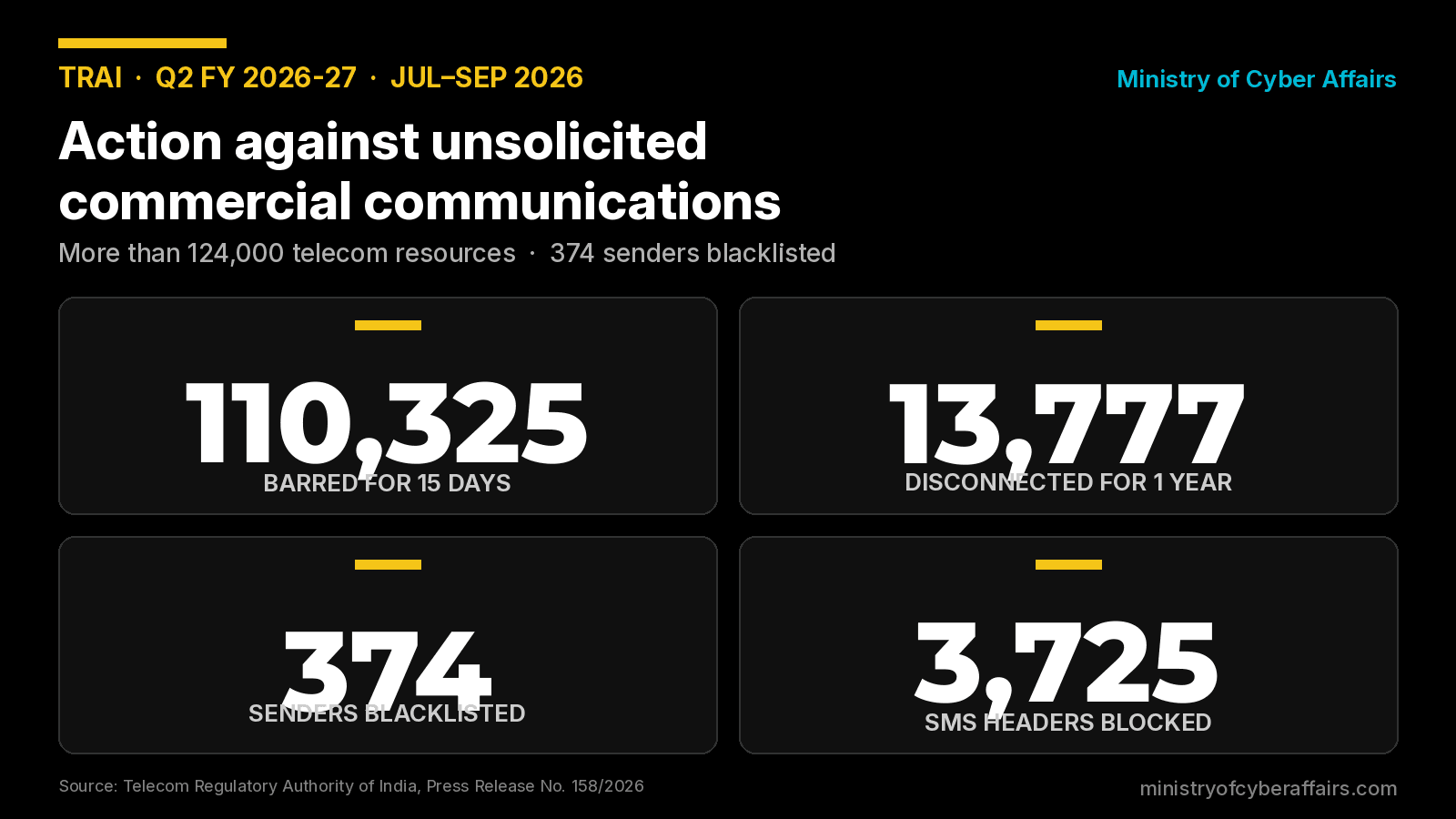
India's telecom regulator TRAI registered 1.529 million complaints of unsolicited commercial communications in July–September 2026, up from 1.085 million in April–June. It said operators barred 110,325 telecom resources for 15 days for a first violation, disconnected 13,777 for one year for repeat breaches, blacklisted 374 senders and blocked 3,725 SMS headers. Complaints worked out to about 2.14 per million calls, compared with about 1.5 in the previous quarter.
The Telecom Regulatory Authority of India on 13 November 2026 released its quarterly highlights of action against unsolicited commercial communications (UCC) for 1 July to 30 September 2026, the second quarter of financial year 2026-27.
The report, Press Release No. 158/2026, was compiled from information furnished by telecom service providers and issued in New Delhi under Secretary Harinder Kumar.
Deepak Sharma, Advisor (Quality of Service-II), is named as the contact for clarifications.
India's subscriber base stood at 1.349 billion on 30 September 2026.
During the quarter, telecom networks originated 714.01 billion calls and 702.28 billion SMS messages.
TRAI registered 1.529 million UCC complaints, of which 0.723 million were classed as actionable.
An operator annexure to the same release gives the unrounded totals as 1,529,734 complaints received on terminating networks and 723,831 actionable complaints.
That is a clear rise from the previous quarter.
In April–June 2026, when the subscriber base was 1.348 billion, networks originated 730.82 billion calls and 691.09 billion SMS messages, and TRAI registered 1.085 million complaints, of which 0.553 million were actionable, according to Press Release No. 111/2026 of 4 August 2026.
Complaints in July–September worked out to about 2.14 per million originated calls, up from about 1.5 per million in April–June, even though overall originated call volumes were slightly lower.
Enforcement across multiple layers
TRAI said enforcement targeted outgoing barring, long-term disconnection, sender blacklisting across all operators and SMS header blocking, to curb repeat violations.
Action in July–September included:
- 110,325 telecom resources barred for 15 days for a first violation of the regulations
- 13,777 telecom resources disconnected for one year for a repeated violation
- 374 senders blacklisted for one year
- 3,725 SMS headers blocked
Together, the 15-day bars and one-year disconnections amount to 124,102 resources, which TRAI summarised as action against more than 124,000 telecom resources, along with the blacklisting of 374 senders.
A sender, the release says, is a principal entity or telemarketer who owns one or more telephone numbers or the SMS headers used for communication.
Blacklisted senders are not to be given new telecom resources during that year.
Compared with April–June, first-violation bars and especially one-year disconnections were lower, while sender blacklisting and header blocking rose.
In the earlier quarter TRAI reported 137,053 resources barred for 15 days, 46,786 disconnected for one year, 263 senders blacklisted and 2,873 SMS headers blocked, or action against 183,000 telecom resources in the regulator's own rounding.
Among originating networks, Vodafone Idea accounted for the largest number of complaints, 539,285, and the most 15-day bars, 47,249.
Bharti Airtel recorded 352,062 originating complaints and disconnected the most resources for a year, 7,889.
Reliance Jio recorded 293,716 originating complaints and blacklisted the most senders, 274.
Tata Teleservices recorded 208,783 originating complaints and barred 26,539 resources for 15 days.
A footnote to the originating-network annexure says the blocked SMS headers include those identified through UCC complaints and those reported through the Indian Cyber Crime Coordination Centre (I4C) and the Chakshu portal.
The TRAI DND app and preference registrations
The TRAI DND app remained the main channel for reporting spam.
It accounted for 1.421 million complaints, or 92.9% of all UCC complaints received by access providers in July–September, up from 0.966 million complaints, or 89%, in April–June.
Downloads of the app had reached 4.236 million by 30 September, compared with 3.316 million at the end of June.
TRAI said it ran media campaigns on 132 FM channels, 15 All India Radio FM channels, 23 private television channels, two Doordarshan channels and 97 newspapers, organised a "TRAI DND Reel Challenge" on the MyGov portal from June to August 2026, and conducted 322 consumer awareness programmes that reached about 31,000 participants in person.
More than 3 billion SMS messages were sent to customers during the quarter to publicise the app, and one digital campaign recorded more than 24.8 million impressions.
Consumers can use the TRAI DND app, their telecom service provider's app or website, or call or send an SMS to 1909 to register or change Do Not Disturb preferences, so as to block or receive promotional communications from senders in any or all sectors.
The app is also described as a convenient way to report UCC.
As of 30 September, 224.49 million preferences were registered, or 16.64% of the 1.349 billion subscriber base, compared with 224 million registered preferences, about 16% of subscribers, at the end of June.
TRAI repeated that more than 1.12 billion subscribers have not registered any preference and therefore remain accessible for commercial communications from registered telemarketers and senders.
Designated number series and blocked promotional traffic
Promotional voice calls are required to originate from the dedicated 140 numbering series and are checked against the customer's registered preferences before delivery.
In July–September, 15.27 billion promotional calls were originated on the 140 series, of which 1.70 billion were blocked after that check.
In April–June the comparable figures were 13.16 billion originated and 1.48 billion blocked.
Registered senders and telemarketers originated 660.71 billion commercial SMS messages in July–September, and 11.09 billion promotional SMS messages were blocked after preference verification.
In April–June, 248.06 billion commercial SMS messages were originated and 7.30 billion promotional messages were blocked, according to the earlier quarterly release.
The 1600 series is reserved for service and transactional calls by banking, financial services and insurance entities, and for government-to-citizen communication.
Calls on that series totalled 1.27 billion in July–September, up from 1.15 billion in April–June.
On 10 August 2026, TRAI also introduced a 1601 series for service and transactional calls by utilities and by logistics and delivery firms.
The July–September release does not give a separate volume for 1601 calls.
AI-based flagging of suspected spam
To warn customers about suspected spam from ordinary 10-digit numbers that sit outside the regulated telemarketing channels, operators use artificial intelligence systems that flag traffic on the basis of calling-pattern analysis.
In July–September those systems flagged 18.28 billion of 705.96 billion incoming calls, and 1.62 billion of 854.4 billion incoming SMS messages, as suspected spam, 19.9 billion flagged communications in all.
In April–June the same systems flagged 22.99 billion incoming calls and 1.44 billion incoming SMS messages, or 24.43 billion in all.
Operators also issued 4.59 million warning notifications to entities assessed as having a high probability of sending spam, completed electronic know-your-customer checks for 34,025 suspected senders, and disconnected 9,977 connections after those checks failed.
An annexure gives the unrounded warning-notification total as 4,595,967 and says 13,291,902 calling-line identities were identified as having a high probability of being used to send spam.
Warning notifications in the April–June release were reported only for the period from 23 June, when the practice began, and totalled 243,000 in that first week, so the two quarters are not directly comparable on that measure.