SIM Box in Nepal used Indian mobile towers for conducting scams - Nepal Police identifies Chinese Links
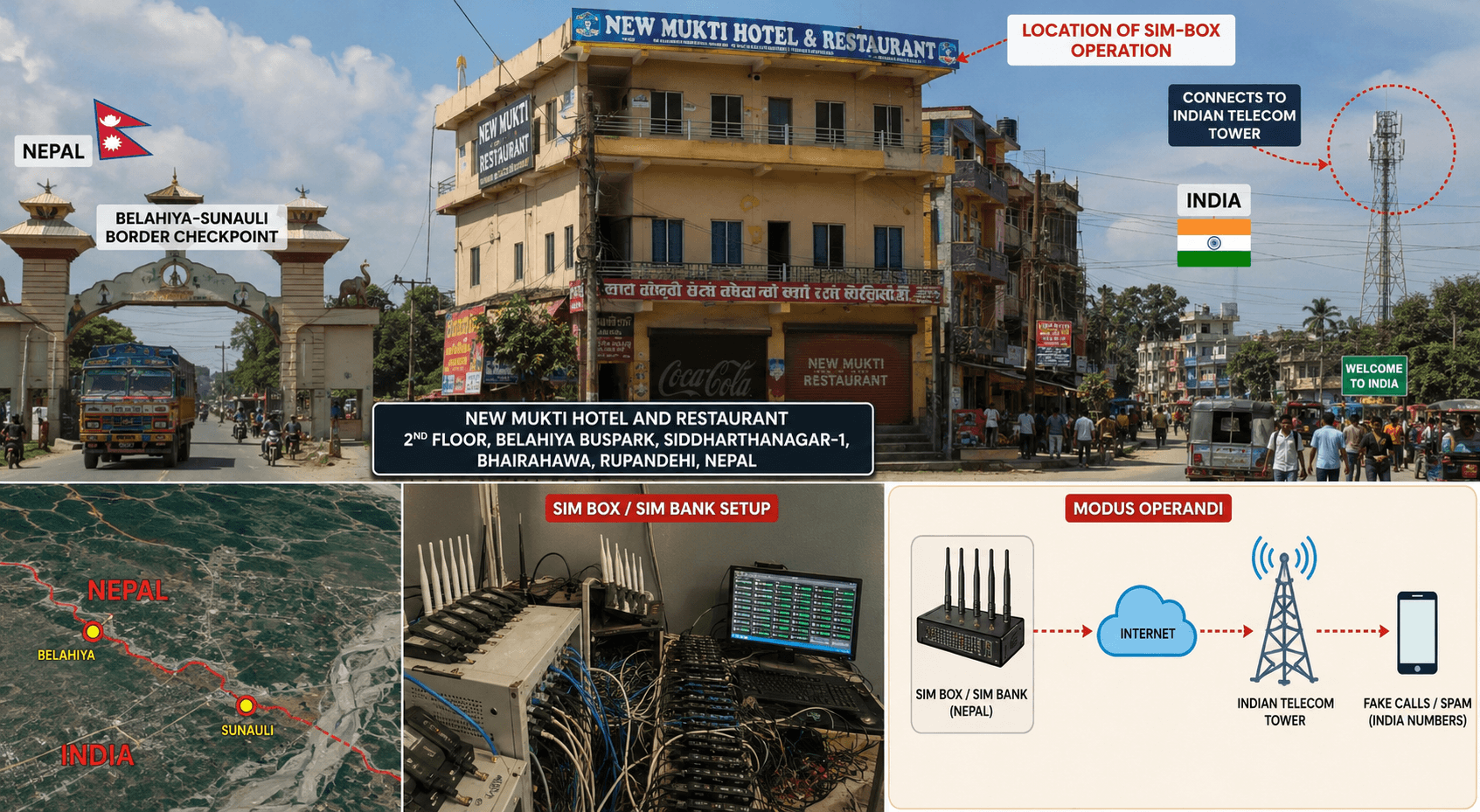
Nepal Police uncovers illegal VoIP bypass hub targeting India from hotel 300 meters from Sunauli border. 56 Indian SIMs, 3 Chinese SIMs, Voter Cards Seized in Bhairahawa.
Bhairahawa, Rupandehi | July 31, 2026 - In a major crackdown on cross-border cybercrime, Nepal Police has busted an illegal SIM-box operation running from a hotel on the Indo-Nepal border and arrested a 62-year-old man.
The raid was conducted on July 30 at the New Mukti Hotel and Restaurant, 2nd floor, Belahiya Buspark, Siddharthanagar Municipality-1, Bhairahawa - located right at the Belahiya-Sunauli border checkpoint, the busiest transit point between India and Nepal.
The accused has been identified as Chhirng Gurung, 62, resident of Gorkha District. According to the District Police Office, Rupandehi, he has been taken into custody under the Nepal Telecommunications Act, 2053 and granted a 5-day remand by the court for further investigation. Nepal Police's official press release was issued on Wednesday evening.
What Was Seized: A Full-Fledged Illegal Exchange
Police recovered a complete call-bypass setup:

- 2 SIM box / SIM-bank devices with multiple antennas - capable of holding hundreds of SIMs
- 56 Indian SIM cards + 38 Ncell SIMs + 1 Nepal Telecom (NTC) SIM + 3 Chinese SIMs
- Network infrastructure: WorldLink routers, multiplexer, inverter, battery backup, cooling fan
- 3 mobile phones, one scooter used for logistics
- Cash: NPR 11,000 and INR 7,900
- Indian Voter ID cards - indicating possible identity fraud to procure SIMs
Investigators say the hotel room had been converted into a clandestine telecom exchange, running 24/7 with battery and inverter backup to avoid detection during power cuts. Local sources have informed that the sim box was being operated and setup by the Chinese Nationals.
What is SIM Box Fraud and Why It Was Targeting India?
A SIM box is an illegal VoIP gateway. It works by converting international voice calls coming over the internet into local mobile calls using stacks of local SIM cards.
In this case, the modus operandi was clear: International calls - likely from the South East Asia - were being routed through the internet to Bhairahawa and then pumped into Indian mobile networks as local calls using the 56 Indian SIMs.
This is called International Call Bypass.
It does two things:
- It causes massive revenue loss to Nepal Telecom, Ncell and the Government of Nepal, as they lose international termination charges.
- For India, it is far more critical. Calls that appear as a local Indian mobile number (+91) are actually international calls. The caller ID is spoofed/masked.
This technique is widely used for cyber-fraud, extortion, "digital arrest" scams, and has been flagged by Indian agencies as a national security risk, as it is used to hide the origin of calls from across the border.
How Are 56 Indian SIMs Active Inside Nepal?
Belahiya Buspark is on the Nepali side, but Indian mobile towers from Sunauli and Maharajganj blanket the area with strong signal. It is common knowledge that Indian SIMs of Jio, Airtel, Vodafone Idea work 1-2 km inside Nepal without international roaming. Transnational fraudsters exploit this signal overspill.
The recovery of 56 Indian SIMs, along with Indian voter cards, suggests:
- Regulatory Grey Zone: Indian operators continue to provide full-strength coverage well beyond the zero line, without geo-fencing. This signal management has now become a tool for crime.
- Open Border Misuse: The India-Nepal open border allows uninterrupted movement. A person can buy SIMs in Gorakhpur or Sitamarhi and activate a SIM box in Bhairahawa within hours.
Recently, on 29th July 2026 - Maharajganj Police (which borders Nepal) have busted a similar international call-routing racket operated through a SIM Box and arrested one accused.
The presence of Chinese SIMs and Indian voter cards alongside Indian and Nepali SIMs points to a possible transnational syndicate.
Nepal Police is now coordinating with the Nepal Telecommunications Authority (NTA) to analyze call detail records (CDRs) from the seized Ncell and NTC SIMs and to trace the IP addresses where the VoIP calls originated.
For India, this bust should be a wake-up call. There is an urgent need for:
- Joint DoT and NTA drive to reduce cross-border signal spillover through power control and directional antennas
- Strict audit of points-of-sale issuing multiple SIMs on the same ID in border districts like Maharajganj, Siddharthanagar, East Champaran, Kishanganj
- Real-time intelligence sharing between Bihar/UP Police and Lumbini Province Police on VoIP frauds
The investigation is ongoing. The forensic analysis of the routers and SIM boxes is expected to reveal thousands of bypassed calls made in the last few months.