Germany Warns of Fake Crypto Trading Platforms Showing Profits That Exist Only on Screen
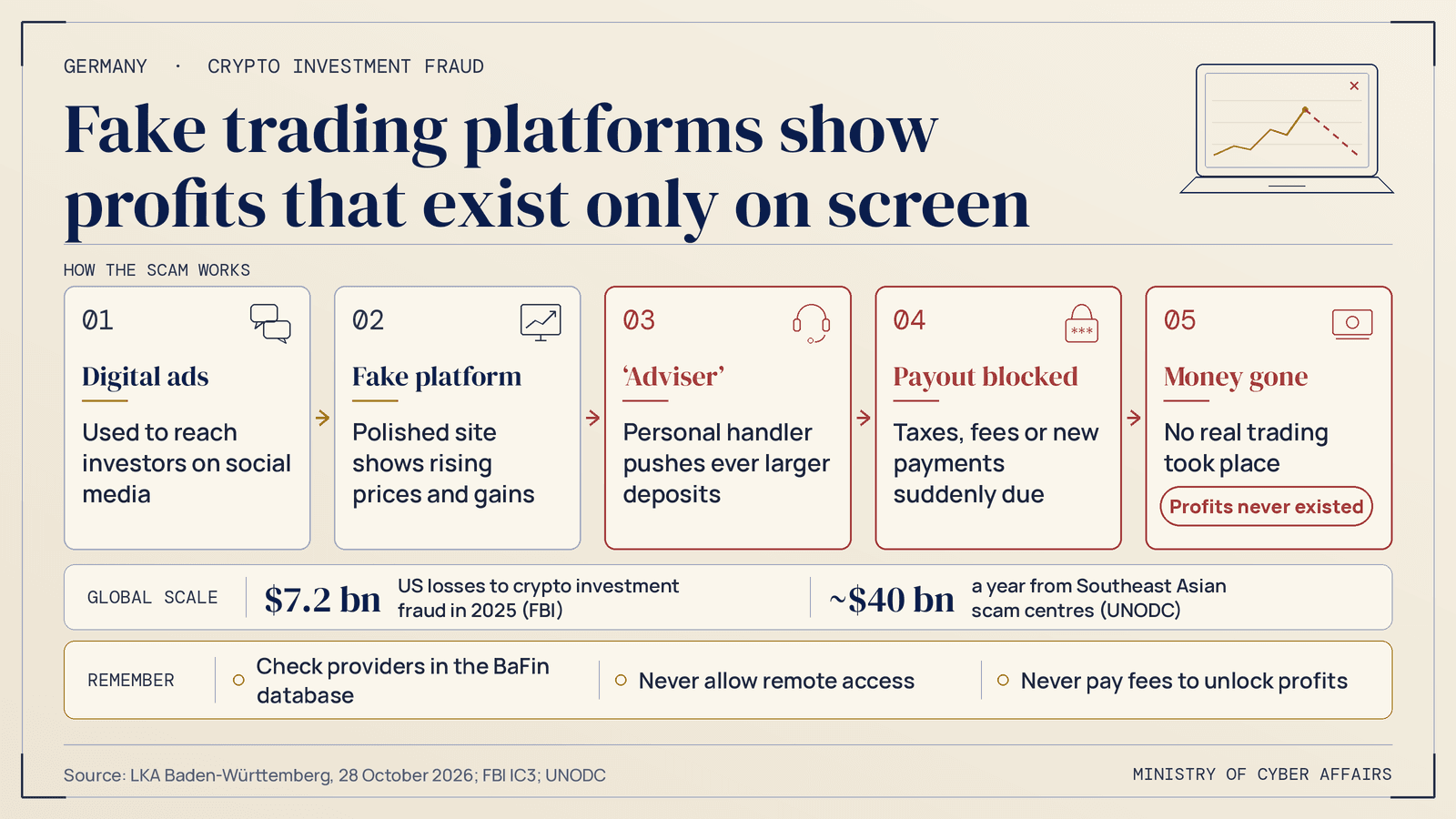
Germany's Baden-Württemberg State Criminal Police Office has warned of "cybertrading" fraud, in which fake trading platforms show invented profits and fake advisers push victims into ever larger deposits, then charge fees to withdraw money that was never invested. The warning comes days after a 73-year-old Stuttgart man lost about 250,000 euros to the same kind of scam.
The Landeskriminalamt Baden-Württemberg (LKA BW), the state criminal police office of Baden-Württemberg in Germany, has warned crypto investors about "cybertrading" fraud: trading platforms that show strong gains on screen while no real trading takes place.
The alert, published on 28 October 2026, is part three of LKA BW's five-part "Crypto Security Week". The series also covers tampered hardware wallets, seed phrases, phishing and recovery scams.
 How the scam works
According to LKA BW:
- Supposedly lucrative investments are advertised through ads, social networks and messengers.
- Professionally designed trading platforms display impressive price movements and profits.
- Fake financial experts handle each victim personally and push for ever larger deposits.
- When the victim tries to withdraw, taxes, fees or other payments suddenly fall due.
"The profits shown are often entirely made up. In some cases no real trading takes place at all," LKA BW said.
A recent case
On 23 October, Stuttgart Police reported that a 73-year-old man from Bad Cannstatt had lost about 250,000 euros to a crypto investment scam that began on social media. The fraud ran from March 2025, with the money transferred to several bank accounts.
A global industry
LKA Baden-Württemberg's warning addresses a crime that has grown into a global industry. The FBI said cryptocurrency investment fraud was the costliest crime reported to it in 2025, with $7.2 billion in losses from 61,559 complaints, and that such scams are largely run by Southeast Asian crime groups using trafficked people as forced labour. The UN Office on Drugs and Crime estimated in April 2025 that hundreds of industrial-scale scam centres, concentrated in Cambodia, Laos, Myanmar and the Philippines, generate just under $40 billion a year. In October 2025, US authorities sanctioned Cambodia's Prince Group, indicted its chairman Chen Zhi for running forced-labour compounds behind "pig butchering" schemes, and sought forfeiture of about 127,271 bitcoin worth roughly $15 billion. In Europe, Europol has also dismantled call centres running fake crypto platforms, including a 2023 network that cost mainly German victims over €2 million.
What police advise
- Be suspicious of unrealistic promised returns.
- Check providers independently, for example in the company database of BaFin, Germany's financial regulator.
- Never let yourself be pushed into quick investments.
- Never give a "broker" remote access to your devices.
- Never pay extra fees to unlock supposed profits.
"If an investment sounds too good to be true, look especially closely," LKA BW said.
More guidance is available from Germany's police prevention service at polizei-beratung.de.