Philippine Authorities Arrest 18 Foreign Nationals in Sophisticated 'Parcel Scam' - Impersonationg Japan Police
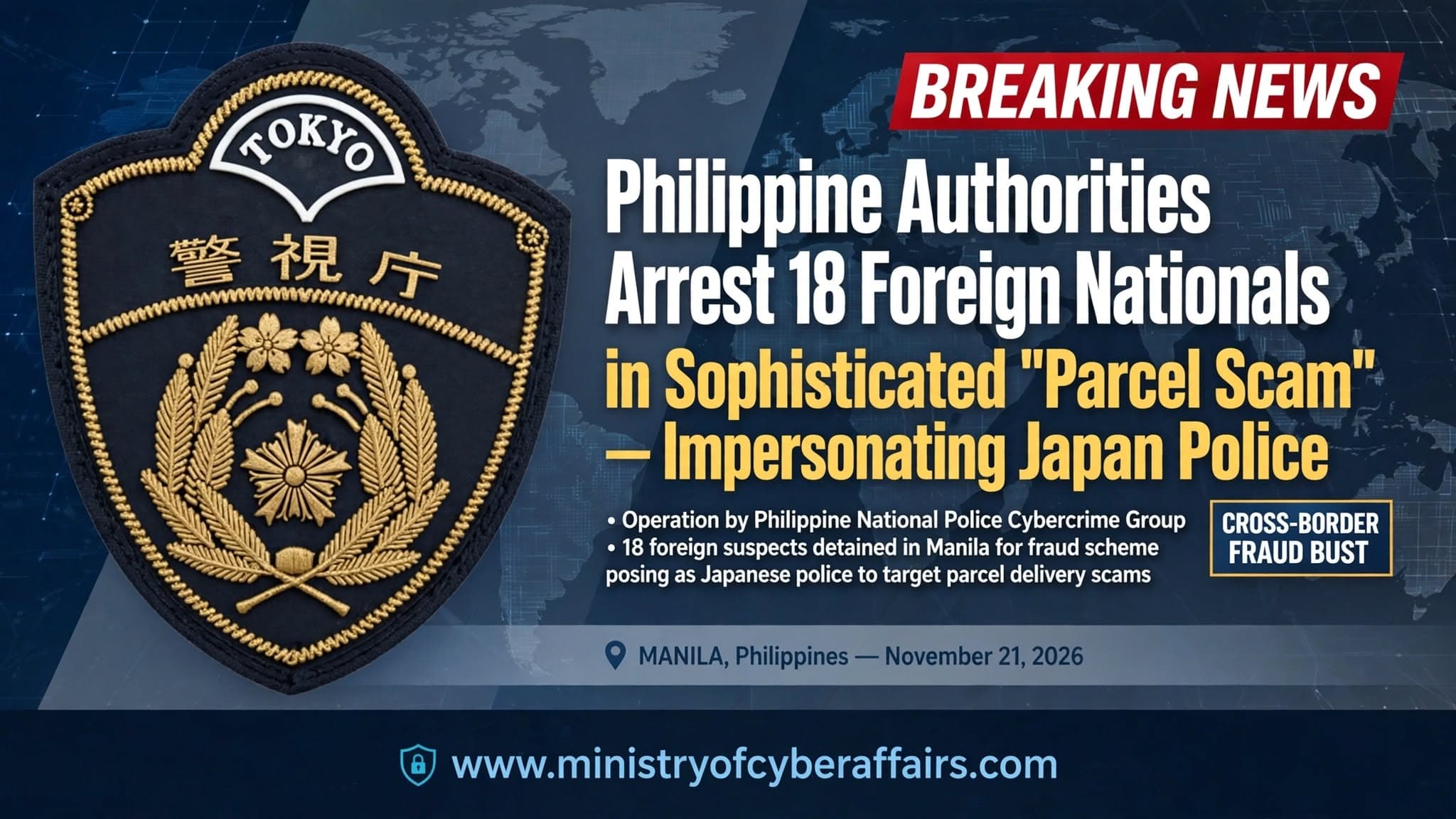
Parcel Scam is also known as Law Enforcement Impersonation Scam in some countries. The scam was being conducted from scam compounds of Cambodia and Myanmar, now which is being shifted to Philippines.
On 20 November, officers from the Bureau of Immigration's Fugitive Search Unit raided an alleged parcel scam hub in Pasay City and arrested 18 foreign nationals. The Bureau said most were Japanese nationals, with the others Chinese, Taiwanese and Indian nationals. Upon arrival, officials were forced to bypass a locked security gate, ultimately discovering a sophisticated setup designed for defrauding victims

1. Fake Japanese Police call on LINE
The suspects allegedly posed as Japanese police officers using AI software and deepfake technology to deceive victims.
The call came through LINE, an app Japanese victims already trust for everyday calls. The victim did not see a stranger in a foreign call centre. They saw a Japanese man in a dark shirt, speaking in polite Japanese, in front of what looked like a police office.
2. Parcel from Fukui
The script recovered by investigators follows a single story:
A parcel sent by international mail from Fukui Central Post Office, 福井中央郵便局, has been flagged.
The caller, claiming to be from Fukui Prefectural Police, asks the victim to confirm their identity. The script specifically mentions identity verification with a My Number Card, マイナンバーカード.
Once the victim accepts the premise, the caller escalates: the parcel allegedly contains contraband. The Bureau's account matches this pattern: suspects would pretend to be Japanese police officers and call victims through fake delivery notifications, claiming a package was on its way, then threaten them by saying it contained contraband.
3. The face: trained models, not a filter
Footage of a seized screen shows a Chinese-language, real-time face-swap tool feeding a virtual camera into LINE.

The left panel shows a Logitech BRIO webcam as input, LINE as output, and toggles for 开启AI换脸功能, enable AI face-swap, and 开启虚拟摄像头, enable virtual camera.
The right panel shows a 模型列表, model list, with numbered pre-trained faces: 3号, 4号, 5号, 6号, 7号, 8号 and more. Each is a different Japanese male identity. The operator could switch personas without restarting the call.
The product name is not legible in the broadcast frame, and the Bureau has not named it. What the footage proves is the method: a trained-model swap, not a one-photo filter, output as a virtual camera so the video-call app treats it as a normal webcam.
4. Pressure: script, backdrop, cubicle
During the raid, authorities found fake Japanese police backdrops and uniforms, scripts used to deceive victims, and soundproof cubicles where suspects allegedly communicated with targets.

The handwritten script itself shows red corrections, a working document, edited and rehearsed. Combined with the backdrop and the AI face, the operation was built to survive the one check victims are told to make: "Ask for a video call."
Why does the scam tactic work globally?
Authority plus video plus urgency. A voice can be doubted. A face that moves, blinks and answers on video, in a police-style setting, is harder to dismiss, especially when the caller already knows the victim's name and a plausible parcel story.

What investigators have not yet released
Victim numbers, total losses, and possible local accomplices have not been established. The Bureau said it was coordinating with Japanese and Chinese police authorities and the Indian government to establish the backgrounds of those arrested.
Red flag for the public: Real Japanese police do not conduct a criminal investigation over LINE, do not ask you to verify identity with your My Number Card on a video call, and do not threaten arrest over a parcel you did not send. If you get such a call, hang up and contact your local police station directly.