WhatsApp Group Investment scam impersonating “Victory Pioneers Capital” busted by Delhi Police
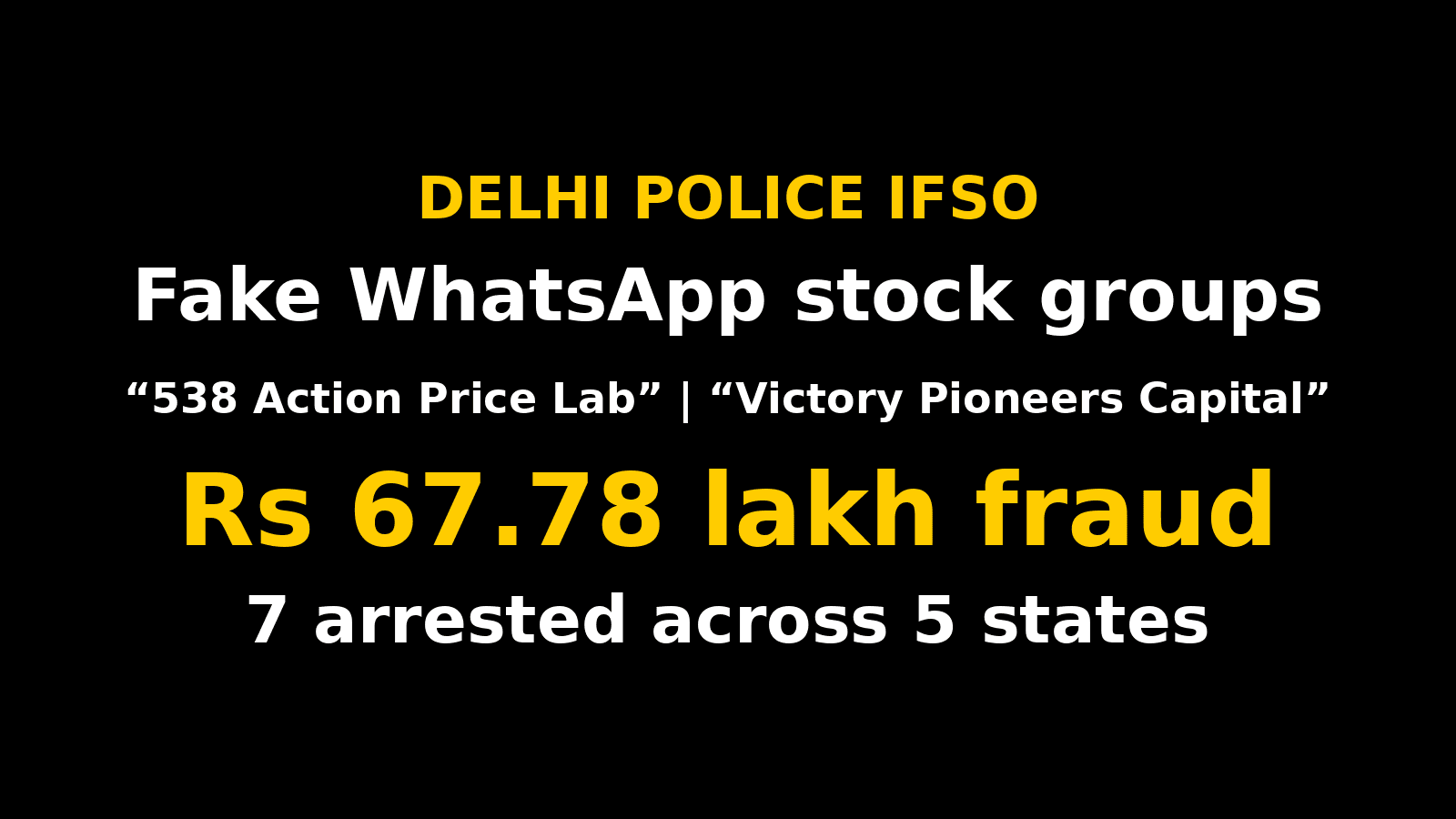
Delhi Police’s Intelligence Fusion and Strategic Operations (IFSO) unit arrested seven people across five states after a Dwarka family lost $72,252 (Rs 67.78 lakh) to fake WhatsApp stock groups “538 Action Price Lab” and “Victory Pioneers Capital” and the fraudulent site aikyaemerging.com. Police say the money moved through a mule-account syndicate using bank accounts of bogus firms.
Delhi Police’s Intelligence Fusion and Strategic Operations (IFSO) unit said on 20 November 2026 that it had arrested seven people in a pan-India network that cheated a Dwarka family of $72,252 (Rs 67.78 lakh) through fake WhatsApp stock-tip groups and a fraudulent investment site, aikyaemerging.com.
When the family tried to withdraw, handlers demanded a further $118,062 (Rs 1,10,75,424) to clear “pending orders and other dues”, then disappeared when the family refused, according to the official press release.
What happened
The complainant, Nandan Singh Nayal of Dwarka, New Delhi, and his family were induced to invest in shares and initial public offerings (IPOs) through WhatsApp groups named “538 Action Price Lab” and “Victory Pioneers Capital”.
The family transferred Rs 67,78,000 in 22 transactions into bank accounts supplied by the fraudsters.
The case was registered as FIR No. 93/2026 at the Special Cell police station under Sections 318(4), 319(2) and 61(2) of the Bharatiya Nyaya Sanhita (BNS), covering cheating, cheating by personation and criminal conspiracy.
IFSO reconstructed a money trail that police said involved thousands of transactions and multiple layers of beneficiary accounts.
Seven accused were arrested in coordinated inter-state operations across five states within 15 days.
The release gives the accused's places of residence as Uttar Pradesh, Haryana and Delhi, and does not name the other states where arrests were made.
How the scam worked
- Chat groups: operators posed as stock-market experts and circulated fabricated profit screenshots and investment advice.
- Fake platform: victims were directed to aikyaemerging.com, which police called a fraudulent platform. It showed fictitious gains and promised attractive returns and IPO allotments.
- Payments: money went into bank accounts supplied by the fraudsters, not a regulated broker.
- Withdrawal block: when the family tried to withdraw, handlers demanded Rs 1,10,75,424 more. After the family refused, the fraudsters stopped responding.
The money trail
Police said the cheated amount was routed through bank accounts of bogus firms that formed part of an organised mule-account network.
A mule account is a bank account used to receive and move stolen money, often opened in another person's or a shell firm's name.
The syndicate allegedly arranged these accounts using manipulated or arranged Know Your Customer (KYC) documents.
The proceeds were withdrawn through ATMs and bearer cheques, or converted into cryptocurrency.
Only two amounts were itemised.
A YES Bank account allegedly provided by one accused received $7,995 (Rs 7.50 lakh), and a company current account allegedly operated by another received $10,660 (Rs 10 lakh).
The accused
Police named the seven accused and their alleged roles as follows. The release does not give parentage. None has been convicted.
- Pawan Kumar, 44, Prayagraj, Uttar Pradesh: allegedly provided a YES Bank account used to receive Rs 7.50 lakh of the cheated amount.
- Md. Izhaan, 27, Lucknow, Uttar Pradesh: allegedly involved in supplying mule-account kits to the network.
- Aryan Kanaujia, 21, Kanpur, Uttar Pradesh: allegedly worked as a courier for account kits and received payments in cryptocurrency.
- Sanu Katheriya alias Kartik, 21, Kanpur, Uttar Pradesh: allegedly acted as a dealer arranging mule bank accounts for the syndicate.
- Ankit alias Monu, 30, Gurugram, Haryana: allegedly supplied technical assistance, including "APK-based facilities" (Android app packages) used to operate the fraudulent banking network.
- Ashbind Kumar Singh alias Boss, 45, Delhi: allegedly operated a company current account used as a beneficiary account, which received Rs 10 lakh.
- Hemant Kumar Shah alias Jitendra, 43, Delhi: allegedly played a key role in the mule-account syndicate. Police said digital evidence on his mobile phone revealed details of other suspected bogus-firm bank accounts.
Seven mobile phones were seized. The release lists no other recoveries.
The police team
The investigation was conducted by SI Amit Rathee, assisted by W/HC Saroj, HC Sanjay and HC Kuldeep.
It was supervised by Shri Manoj Kumar Mishra, ACP/IFSO, under the overall supervision of Shri Gaurav Tyagi, IPS, DCP-I/IFSO, Delhi Police.
A lookalike of a UK fund manager's name
The police release does not say whether aikyaemerging.com copied any real firm.
Open-source records reviewed for this article show that the domain is not connected to Aikya Investment Management Limited.
That firm is a London-based emerging-markets manager authorised by the UK Financial Conduct Authority (FRN 935193) and registered with the US Securities and Exchange Commission.
Its official website is aikya.co.uk.
Public RDAP records show aikyaemerging.com was registered on 22 January 2026 at 08:45 IST through Gname.com Pte. Ltd., with the registrant's address given as Hong Kong.
Certificate Transparency logs show certificates for "m." and "pc." subdomains the next day.
Separate mobile and desktop subdomains like these are common in fake trading-platform kits.
The domain is now on "client hold".
There is no suggestion that the legitimate firm was involved.
A global pattern
The method matches "pig-butchering" and fake-brokerage scams reported worldwide.
Scammers build confidence in chat groups and show invented profits and IPO allotments on a dashboard.
They then block withdrawals and demand more money, such as taxes, "pending orders" or unlock fees, before disappearing.
Many such sites borrow the names of real brokers and asset managers, so a quick search seems to confirm they are legitimate.
Red flags and what to do
- Regulated brokers do not solicit retail stock or IPO investments through unsolicited WhatsApp groups, or guarantee IPO allotments.
- Check any intermediary on the Securities and Exchange Board of India (SEBI) register, and use only a firm's official website or app.
- Never pay a fee or "pending order" charge to withdraw your own money.
- Never send money to private-firm bank accounts shared in a chat.
- In India, report fraud at cybercrime.gov.in or call the 1930 helpline, and alert your bank immediately.
- Outside India, contact the FBI's Internet Crime Complaint Center (IC3) in the United States, Action Fraud in the United Kingdom, or your local equivalent.
Indicators
- Fraudulent investment platform: aikyaemerging.com (also m.aikyaemerging.com, pc.aikyaemerging.com and www.aikyaemerging.com)
- WhatsApp group name: "538 Action Price Lab"
- WhatsApp group name: "Victory Pioneers Capital"
- Registrar: Gname.com Pte. Ltd.; nameservers a.share-dns.com and b.share-dns.net