India's Police Expose Cambodia-Run 'Digital Arrest' SIM-OTP Chain Built on 3,648 SIMs From Amroha, as DoT's SIM-Binding Deadline Nears
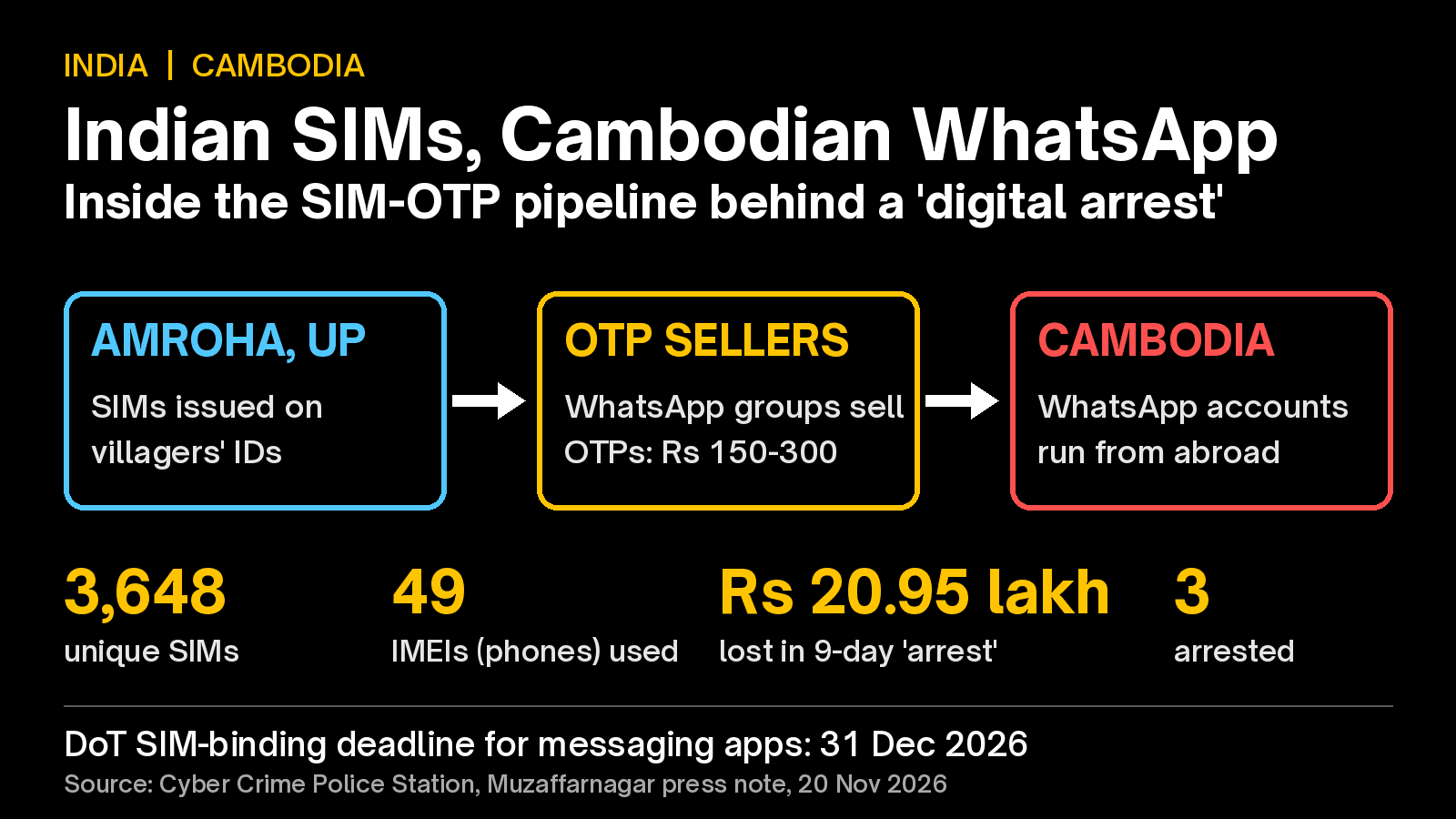
Police in Muzaffarnagar, Uttar Pradesh, say a complainant was held in a nine-day 'digital arrest' and lost Rs 20,94,900 ($22,331) to callers whose WhatsApp ran from Cambodia on a SIM issued in Amroha district. Three men were arrested in a SIM-OTP chain that, police say, ran 3,648 SIMs taken on villagers' IDs through 49 phone IMEIs and sold OTPs on WhatsApp for Rs 150-300 ($1.60-3.20). It is the model DoT's SIM-binding rules, due by 31 December 2026, are meant to stop.
The Cyber Crime Police Station in Muzaffarnagar, Uttar Pradesh, has exposed a supply chain that turned SIM cards issued to unsuspecting villagers in India into WhatsApp accounts operated from Cambodia. According to the station's press note of 20 November 2026, the chain began with a telecom point-of-sale (PoS) agent in Amroha district and ended with one-time passwords (OTPs) sold to cyber criminals abroad over WhatsApp groups.
Police describe it as a 'digital arrest' and fake SIM-OTP syndicate "operated from Cambodia" and an inter-district gang. Three men were arrested with 10 mobile phones and 4 additional SIM cards.
The case lands six weeks before India's Department of Telecommunications (DoT) requires WhatsApp, Telegram, Signal and other messaging apps to stop working on any phone that does not contain the SIM card registered to the account.
The case: nine days of 'digital arrest'
- On 15 October 2026, cyber criminals called the complainant with the false claim that the complainant's mobile SIM had been found with terrorists in Kashmir and that the complainant's HDFC Bank account had been used for illegal transactions worth Rs 70 crore ($7.46 million).
- The callers then posed as officers of the Anti-Terrorism Squad (ATS) and the National Investigation Agency (NIA). Over WhatsApp, they sent the complainant a fake arrest warrant, a "confidentiality agreement" and fake notices from various government agencies.
- They told the complainant not to contact anyone and kept the complainant in 'digital arrest' for nine days, from 15 to 23 October 2026, threatening the complainant with arrest and life imprisonment.
- The complainant lost a total of Rs 20,94,900 ($22,331) and, on realising it was a fraud, filed a complaint on the national cybercrime portal.
- Case Crime No. 38/2026 was registered at the Cyber Crime Police Station, Muzaffarnagar, under Bharatiya Nyaya Sanhita (BNS) sections 318(4) (cheating), 336(3), 338 and 340(2) (forgery and use of forged documents) and 3(5) (common intention), and sections 66C (identity theft) and 66D (cheating by personation using a computer resource) of the Information Technology Act.
From one number to 3,648 SIMs
Police analysed the mobile numbers, WhatsApp chats, fake government documents and suspect bank accounts used in the case. They found:
- Most of the SIM cards used in the case were issued in Amroha district and used there, but the WhatsApp accounts on those numbers were being operated from Cambodia. Police say this showed that cyber criminals abroad were working with unknown persons in Amroha.
- Each SIM card used in the case had run in about 15 to 16 IMEIs (the unique identity number of a mobile handset).
- Those IMEIs belonged to phones made by Lava, Redmi, Vivo, Realme, G Five (a four-SIM handset) and Jio Phone. About 49 IMEIs were used in all, and they showed data for about 8,223 SIM cards.
- Deeper analysis narrowed this to 3,648 unique SIM cards that had run in those phones: 2,550 from Vi, 1,035 from Airtel and 63 from Jio.
- Most of the SIMs used in the case had been issued by a single PoS agent.
How the pipeline worked
Police set out the chain, step by step, as follows:
- The PoS agent lured simple, unsuspecting people in Amroha district with promises of help with rations, insurance, government schemes and aid in the name of an NGO called "SAVNIR FOUNDATION". He completed their KYC and issued SIM cards on their IDs.
- The SIMs went to distributor Akshay Kumar Agarwal, the Amroha distributor for Vi, who passed them to Abdul Malik, a PoS agent for Airtel, Jio, Vi and BSNL who worked under him.
- Abdul Malik activated each new SIM by placing a call to it from SIM cards taken on the IDs of his mother and an acquaintance. Akshay Kumar Agarwal paid him Rs 5 ($0.05) per SIM for this and had given him 4 phones for the work. Once the first call was made, Abdul Malik returned the activated SIMs to Akshay and collected new ones.
- According to Akshay Kumar Agarwal, a man named Monu then took the SIMs from him and sold them at Rs 150 ($1.60) per SIM to his cousin, Ankush Saini.
- Ankush Saini bought old phones, removed their original SIM trays and fitted new trays bought in the market, so that a SIM could be put in and taken out in seconds.
- He then sold the OTPs to fellow cyber criminals through WhatsApp groups, priced according to the platform. Police found groups on his phone selling OTPs for companies, shopping sites, online gaming, gas companies and social media. One group, named "NEW STOK", had about 2,700 numbers in it.
- For the WhatsApp account on the number used in this digital arrest, Ankush Saini sold the OTP to a fellow cyber criminal for about Rs 300 ($3.20).
- He took payment into the accounts of friends or of a Common Service Centre (CSC), or used what police call the "ATM UPI QR cash method": he sent the QR code shown on an ATM screen to his associates, who paid it by UPI, and he collected the cash.
- In the video briefing, the officer said the OTPs were also used on Flipkart and on gaming apps that give benefits to first-time numbers.
- Police say the buyers of these OTPs used them to commit digital arrest, online gaming, honey trap and investment frauds against people in India.
The OTP rate list
Police published a rate list recovered during the questioning of Ankush Saini:
- Flipkart: Rs 8 ($0.09) per OTP
- Gas agency delivery access code (DAC): Rs 4 ($0.04)
- Myntra: Rs 10 ($0.11)
- Gaming: Rs 12 ($0.13)
- Spin games: Rs 20 ($0.21)
- Betting games: Rs 10 ($0.11)
- YONO gaming: Rs 10 ($0.11)
- WhatsApp, 10 days: Rs 150 ($1.60)
- WhatsApp, 20 days: Rs 220 ($2.35)
- WhatsApp, unlimited: Rs 300 ($3.20)
The list does not explain the "10 days", "20 days" and "unlimited" tiers. The pricing suggests that a WhatsApp account is the most valuable product in the chain, and that buyers pay more the longer the number stays available to them.
A new e-commerce 'cancel and refund' fraud
Police say questioning also revealed a newer trend:
- Cyber criminals are targeting customers of shopping sites such as Amazon, Flipkart and Myntra, and of instant-delivery companies such as Blinkit, Zomato and Swiggy.
- They lure people with an offer: cancel an order worth up to Rs 2,000, Rs 5,000 or Rs 10,000 ($21.32, $53.30 or $106.60), still receive the goods, and also get a refund.
- The criminals then take 50% of the refund amount from the customer.
- According to Ankush Saini, cyber criminals are now also creating shopping-site accounts themselves to carry out the order-cancellation and refund fraud directly.
The accused and the recoveries
The press note names three arrested men:
- Ankush Saini, son of the late Sher Singh, of Amroha district: police say he bought the SIMs and sold the OTPs.
- Akshay Kumar Agarwal, son of Rajkumar Agarwal, of Amroha: the Amroha distributor for Vi.
- Abdul Malik, son of Tavvab Ahmad, of Amroha: a PoS agent for Airtel, Vi, Jio and BSNL.
Police recovered 10 mobile phones and 4 SIM cards, in addition to the SIMs inside the phones. Monu, who police say moved the SIMs from Akshay Kumar Agarwal to Ankush Saini, is not listed among those arrested. The press note does not identify the callers in Cambodia who carried out the digital arrest. In a video briefing posted with the press note, an officer said two more accused in the chain have yet to be arrested and that a Rs 25,000 ($266.50) cash reward was being given to the team. The charges have not been tested in court.
The Cambodia link
The press note does not name the group operating the WhatsApp accounts from Cambodia. However, the pattern matches what Indian and international authorities have described:
- India's Ministry of External Affairs told Parliament in February 2026 that 6,998 Indians were rescued from cyber-scam centres in Cambodia, Laos and Myanmar between 2022 and 2025, including 2,533 from Cambodia. The minister said the exact number of Indians still in such centres is not known.
- An analysis by the Ministry of Home Affairs (MHA), reported by The Indian Express in July 2025, attributed more than half of the roughly Rs 7,000 crore ($746 million) lost to online scams from January to May 2025 to networks in Myanmar, Cambodia, Vietnam, Laos and Thailand. It said the government had identified at least 45 scam compounds in Cambodia. The same report said the CBI had registered an FIR against PoS agents in several states for issuing ghost SIM cards.
- The Financial Action Task Force's 5 November 2026 report on scam compounds says such operations cause estimated losses in the tens of billions of US dollars each year. It identifies telecom indicators and suspicious phone numbers as early signals for disrupting fraud. Cases reported by India in that report, according to the Hindustan Times, showed that SIM sourcing and cross-border calling through SIM-box operators were outsourced by the compounds. As police describe it, the Amroha chain filled the SIM-sourcing role.
- The same report describes a late-2025 case in which the Indian Embassy in Phnom Penh and the Indian Cyber Crime Coordination Centre (I4C) geolocated a scam compound in Bavet, Cambodia, leading to the rescue of 81 Indian nationals over two days.
- In India, citizens reported Rs 22,495 crore ($2.40 billion) in cyber-fraud losses in 2025, from 24,02,579 financial fraud complaints, according to MHA figures given to the Rajya Sabha in February 2026.
What DoT's SIM-binding directions require
On 28 November 2025, DoT issued directions under the Telecommunications (Telecom Cyber Security) Rules, 2024, as amended on 22 October 2025, to app-based communication services that use an Indian mobile number to identify users. The amended rules call such services "Telecommunication Identifier User Entities" (TIUEs). According to DoT's press release of 1 December 2025, the directions went to WhatsApp, Telegram, Snapchat, Arattai, ShareChat, Josh, JioChat and Signal. They require:
- The app must be continuously linked to the SIM card of the registered mobile number installed in the device, "making it impossible to use the app without that specific, active SIM".
- Web versions of the app must log users out periodically, not later than every 6 hours, and allow the device to be re-linked by QR code.
- Implementation within 90 days and a compliance report within 120 days.
DoT said in that release that messaging accounts "continue to work even after the associated SIM is removed, deactivated or moved abroad". It said this enables "remote 'digital arrest' frauds and government-impersonation calls using Indian numbers". It added that "a session can currently be authenticated once on a device in India and then continue to operate from abroad". The directions do not affect users on roaming who keep the SIM in the handset.
Where SIM binding stands in November 2026
- The original 90-day deadline was not met. On 2 April 2026, the Minister of State for Communications, Dr Pemmasani Chandra Sekhar, told the Rajya Sabha that the timeframe for compliance is 31 December 2026.
- The same answer dropped the fixed six-hour web logout. Web sessions are now to be logged out "on the basis of risk-based analysis", with no specific time period.
- The Broadband India Forum, which represents technology companies including Meta and Google, raised concerns about the directions in December 2025. In February 2026 it cited a senior counsel's opinion calling them "ultra vires" and unconstitutional. The Cellular Operators Association of India backed SIM binding as a security safeguard.
- Meta confirmed to MediaNama in April 2026 that it is testing SIM binding on WhatsApp for regular users in India. Arattai has said it is building compliance features.
- An industry source told MediaNama this month that DoT has since asked apps to check for the SIM every 24 hours. DoT has not published this clarification.
How SIM binding would hit this model
The Muzaffarnagar case follows the exact sequence that DoT's release describes:
- A SIM is issued in India on a real person's ID.
- It is activated and briefly placed in a phone in Amroha.
- The WhatsApp OTP is sold.
- The account is then run from Cambodia while the SIM stays in India.
Under SIM binding, an account registered on that number should stop working on a phone in Cambodia unless the same SIM is physically inside that phone. The OTP alone would no longer be enough. A "WhatsApp unlimited" account sold for Rs 300 would, in principle, stop working at the next SIM check.
The directions do not end the trade, however:
- Criminals could still ship physical SIMs abroad, since DoT says roaming users with the SIM in the handset are not affected.
- They could also keep handsets loaded with Indian SIMs inside India and operate them remotely, or switch to apps and platforms not covered by the directions.
- That is why the upstream controls on PoS agents, KYC and SIM disconnection, described below, matter alongside binding.
DoT's wider action on SIMs and PoS agents
- In August 2023, DoT made registration and verification of every PoS (franchisees, agents and distributors) mandatory, with a written agreement with the telecom operator. A PoS involved in illegal activity is terminated and blacklisted for three years. It also introduced business connections for organisations, with full KYC of every end user.
- DoT reported in October 2026 that citizen reports through Sanchar Saathi had led to the disconnection of more than 50 lakh (5 million) mobile connections. It said its Financial Fraud Risk Indicator had helped prevent suspected losses of more than Rs 5,000 crore ($533 million).
- In September 2026, DoT blacklisted a PoS agent in Chhattisgarh who had illegally activated 25 SIMs using citizens' documents. It warned that fraudulent SIM issuance, misuse of telecom identifiers or tampering with IMEI numbers can attract up to three years' imprisonment and a fine of up to Rs 50 lakh ($53,299) under the Telecommunications Act, 2023. It also cautioned that the original subscriber may be liable if a SIM taken in their name is handed over and misused.
How to protect yourself
- Never give your ID documents, fingerprints or OTPs to anyone who promises rations, insurance, scheme benefits or NGO aid in return.
- Check the mobile connections issued in your name on Sanchar Saathi and report any you did not take.
- No police force, ATS, NIA or other agency carries out arrests over video call or WhatsApp. 'Digital arrest' is not a legal procedure.
- Ignore offers to cancel an online order, keep the goods and share the refund. It is fraud.
- Report cyber fraud at once on helpline 1930 or at cybercrime.gov.in, and report suspicious calls and WhatsApp messages on Chakshu in Sanchar Saathi.
Officers credited
The press note says the action was taken on the directions of the Additional Director General of Police, Meerut Zone, Meerut, and the Deputy Inspector General of Police, Saharanpur Range, Saharanpur. It was carried out under the supervision of Senior Superintendent of Police, Muzaffarnagar, Shri Suraj Kumar Rai. It was led by Superintendent of Police (Crime) Smt Indu Siddharth, Circle Officer (Crime) Shri Subhash Chand and Inspector-in-charge Shri Karmveer Singh of the Cyber Crime Police Station.
The police team:
- Inspector-in-charge Shri Karmveer Singh
- Sub-Inspector Shri Mahendra Singh
- Sub-Inspector Shri Gaurav Kumar
- Sub-Inspector Shri Jai Sharma
- Sub-Inspector Shri Pankaj Kumar
- Head Constable 384 Sunil Kumar
- Head Constable 719 Balkishan
- Head Constable 387 Akash Chaudhary
- Head Constable 351 Sunil Kumar
- Constable 1260 Robin Kasana
- Constable 796 Narendra Kumar
- Constable 934 Mohit Kumar
Technical support came from Computer Operator Grade B Gyan Singh and Computer Operator Atul Singh, all of the Cyber Crime Police Station, Muzaffarnagar.