Pakistan’s NCCIA Uncovers Major Digital Fuel Fraud at Lahore Petrol Pumps - A Technical Reading of the NCCIA Evidence
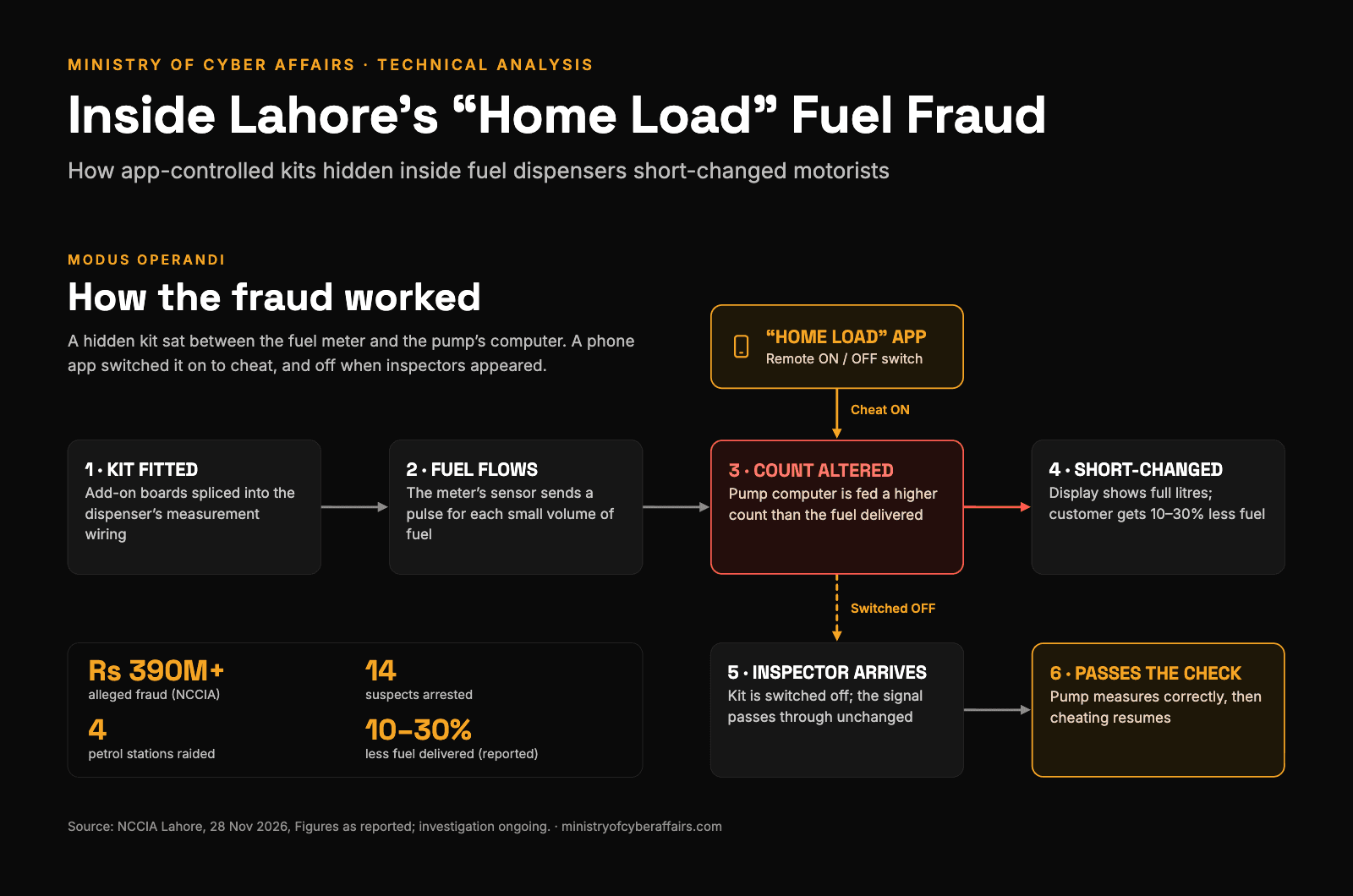
How app-controlled kits hidden inside fuel dispensers short-changed motorists, what the seized hardware does and does not show, and how regulators everywhere can catch it.
What: Pakistan's National Cyber Crime Investigation Agency (NCCIA), Lahore Zone, says it uncovered digital tampering at four Lahore petrol stations, put at more than Rs 390 million (officials also cite about Rs 400 million in a single year).
MO: Electronic "fuel control kits" were allegedly installed inside dispensers and switched on and off through a smartphone app called "Home Load", so the display showed the full quantity while customers received 10–30% less.
Why it matters globally: This is not a mechanical trick. It is an attack on the electronic side of a legal-for-trade measuring instrument, timed to stay invisible during inspections. Any market that relies on announced, can-based inspections is exposed to the same attack class.
On 28 November 2026, the NCCIA announced the arrest of 14 people in four operations in Lahore, conducted under Additional Director Atif Ameer. According to the agency,
- The suspects installed illegal digital kits in dispensers and altered the machines' electronic signals and programming, so less fuel was delivered than displayed.
- Arrests included pump owners, managers, a cashier, fuel attendants, and the people who made and installed the kits. Some reports also mention two app developers.

- Three cases were registered, and the NCCIA wrote to the Oil and Gas Regulatory Authority (OGRA) seeking suspension of the stations' licences.
- Reports say the kits were used on regular petrol and diesel dispensers, and that earlier checks by district officials had not detected the manipulation because the machines appeared to meet measurement standards.
Reported raid breakdown (NCCIA spokesperson):
Raid | Kits recovered | Arrested |
|---|---|---|
Wapda Town | 4 | Manager, cashier, four attendants, a technical installer |
Hadyara–Barki area | 4 | Three suspects |
Band Road (court search warrant) | 2 | Owner and manager |
Ravi Filling Station, Gulshan-e-Ravi | Not stated | Two suspects |
Analysis of the Evidence seized by NCCIA
The NCCIA released a photo of the seized items. Below is a component-by-component reading. Each item carries a confidence level, because a single press photo cannot replace a forensic teardown.

# | Item | What it appears to be | Confidence | Likely role |
|---|---|---|---|---|
1 | Large green PCB, centre | A dispenser controller ("CPU") board: power-supply section with three large electrolytic capacitors and a heatsinked regulator/driver bank, many keyed wire-to-board connectors, a coin-cell battery | High that it is a dispenser-class controller; make and model not identifiable from the photo | Either removed from a tampered dispenser as evidence, or a bench board the installer used to test and match connections |
2 | Small module plugged into a socket on that board | A daughter-module seated in a DIP-style socket | Medium | Could be a factory memory/processor module, or a replaced part carrying altered firmware. This is the single most important item for forensic examiners to check, given NCCIA's reference to altered "programming" |
3 | Coin cell on the main board | Backup battery for the clock and non-volatile memory (which typically keeps totals and settings) | High | Normal OEM part |
4–5 | Smaller green board, wired to a DC jack | An add-on controller with a D-sub (DB9-type) serial connector and an antenna connector at the board edge | Medium–high | The likely command hub: receives instructions over a radio link from the app and talks to the satellite boards and/or the dispenser's data port |
6–9 | Four small boards with one DIP chip each and plug-in harnesses | Low-cost interface boards; the chip type and markings are not readable | High on count and form; low on exact function | Inline modules on the dispenser's measurement wiring, likely one per hose or meter |
10–11 | Two phone-sized black enclosures | One is opened at one end, with wires and a small connector attached | Medium | Probably housings for kit electronics. Not demonstrably "pocket remotes" |
12 | MASTECH MS5910 | An RCD / earth-loop tester | High | A standard electrician's tool; its link to the fraud is not established |
13–16 | Power supplies and adapters | A laptop-style adapter, small wall adapters, and a power block labelled for case C-310/26 and "Hadiara Filling Station" | High | Bench power for testing boards away from a live dispenser |
17 | 14 seized phones (most visible) | Handsets tagged with case numbers 309/26, C-310/26 and C-313/26 | High | Devices allegedly running the "Home Load" app; numbers written on some labels look like unlock codes recorded by investigators |
What the hardware tells us overall: the photo shows one board that looks like it was produced in quantity (the add-on controller), cheap single-chip satellite boards, plug-in harnesses for fast fitting and removal, and bench power supplies. That is the profile of a small-batch commercial product made and installed by technicians, not a one-off hack. That matches NCCIA's statement that the makers and installers were arrested alongside station staff.
How a fuel dispenser measures fuel ?
Understanding the attack requires one piece of background:
- Fuel passes through a mechanical meter. As it turns, a sensor called a pulser (optical or magnetic) produces a stream of electrical pulses. Each pulse corresponds to a small, fixed volume of fuel.
- The dispenser's controller board counts those pulses, converts them to litres using a stored calibration factor, updates the display and price, and closes the valve when a preset amount is reached.
- The mechanical meter and its calibration are protected by Weights & Measures seals. The electronics in the dispenser head are usually less closely inspected in day-to-day checks.
The key point is that the customer is billed for whatever the controller counts, not for what physically flows. Anything that can influence the count, or the factor applied to it, controls the bill.
Where the kit attacks the dispenser
NCCIA says the kits altered "electronic signals" and "programming". The hardware is consistent with two pathways, which can also be combined:

Pathway A: Manipulating the measurement signal. The satellite boards, with their plug-in harnesses, fit the profile of devices placed in series between the pulser and the controller board. In "cheat" mode, the controller is fed a count that is higher than the fuel actually delivered, so the display reaches 10 litres before 10 litres have flowed. In "normal" mode, the device passes the signal through unchanged and the pump measures correctly.
Pathway B: Manipulating settings or firmware. The serial connector on the add-on controller and the socketed module on the main board point to a second possibility: changing calibration or behaviour through the dispenser's data interface, or replacing firmware. Only forensic examination of the boards and memory can confirm which was used.
In both cases, the decisive feature is the remote on/off switch. A pump that is accurate whenever someone is checking it and inaccurate the rest of the time will pass any announced inspection. That is consistent with reports that earlier district-level checks found nothing.
Editorial note: this analysis deliberately describes the mechanism at a conceptual level and leaves out implementation details.
A hidden safety problem
The theft is the headline, but the fire and explosion risk may matter more. Dispensers are certified for hazardous areas: their electrical parts are designed, separated and sealed so they cannot ignite petrol vapour. The certification covers the equipment as built and approved.
The seized boards are bare PCBs with exposed solder joints, loose jumper wires, unbranded adapters and a radio transmitter. Fitting them inside a dispenser, particularly anywhere near the hydraulic compartment or through cable glands and barriers, invalidates the hazardous-area certification and introduces uncontrolled ignition sources. Regulators should treat every tampered dispenser as electrically unsafe until it has been inspected and recertified, not just recalibrated.
How to detect this class of fraud
These measures apply in any jurisdiction:
- Unannounced test purchases. Use ordinary vehicles and calibrated test measures, without warning, across several hoses and times of day. A remote kill switch defeats announced inspections, but not inspections that cannot be anticipated.
- Stock reconciliation. If dispensers display more than they deliver, a station will appear to sell more litres than it received from its supplier, or its underground tanks will show unexplained surpluses against recorded sales. Oil marketing companies and regulators already have the delivery and sales data to flag outliers. Automatic tank gauging makes this continuous.
- Physical inspection of the electronics, not just the meter. Open the dispenser head and trace the pulser cable from the meter to the controller board. Any connector, splice or extra board in that path is a red flag. Compare the board, firmware version and memory modules against the manufacturer's approved configuration.
- Radio-frequency sweeps. An app-controlled kit has to communicate. Inspectors can scan forecourts for unexpected Wi-Fi, Bluetooth or other radio devices near the dispensers.
- Tamper-resistant measurement chains. Several manufacturers offer secure or authenticated pulsers and electronic seals with event logs, which make inline interference detectable. Regulators can require these in new approvals and retrofits.
- Accountability for technicians. The kits needed people who knew dispenser wiring. Licensing dispenser service technicians and keeping logs of every time a dispenser head is opened makes fitting a kit riskier.
For motorists: a quick 5-litre check at the station is likely to be defeated by a remote switch. Keeping track of fuel economy over time, and reporting stations that consistently seem to under-deliver to the Weights & Measures or consumer authorities, gives better evidence.