Malaysia Lost RM7.33 Billion to Online Scams Since 2023 — What the Home Minister Told Parliament
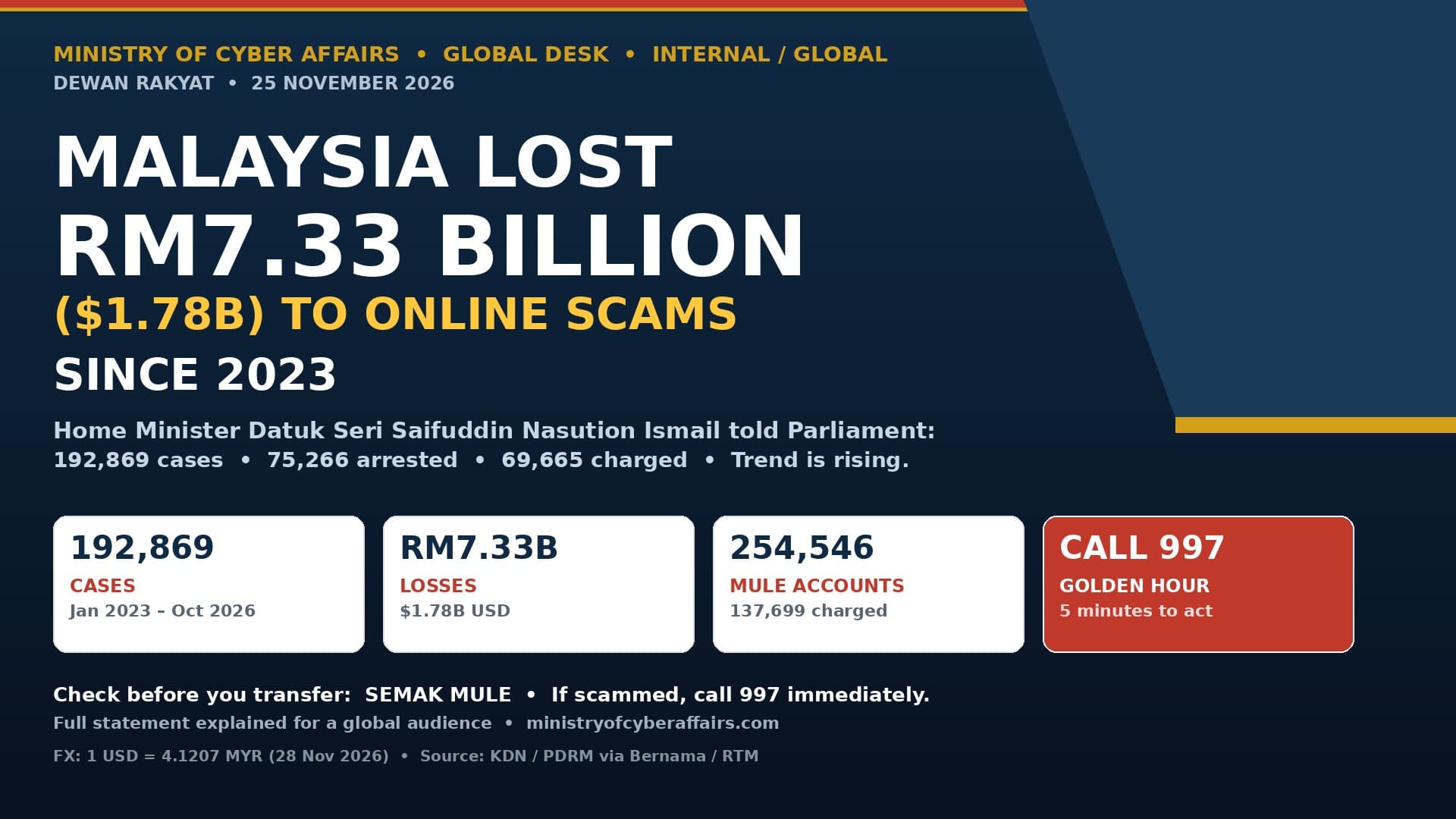
In a single oral answer in Malaysia's Parliament, Home Minister Datuk Seri Saifuddin Nasution Ismail laid out the full scale of online fraud — 192,869 cases, RM7.33 billion lost, 75,266 arrested. This is the statement, explained for readers outside Malaysia.
Executive Summary
- Total, 192,869 online scam cases and RM7.33 billion in losses from Jan 2023 to Oct 2026; 75,266 arrested, 69,665 charged.
- 2026 pace, 56,802 cases and RM1.56 billion lost in Jan–Oct 2026 alone, at ~5,680 cases and ~RM156 million per month.
- Mule accounts are the engine, 254,546 mule accounts detected; 137,699 people charged (54.1%) for allowing accounts to be used.
- Most cases ≠ most money, Investment scams are only 14.4% of top-3 cases but ~48% of top-3 losses (~RM122,000 average loss).
- Golden Hour, Money is cashed out in ~5 minutes via mules. Calling 997 (NSRC) immediately is the victim's best chance to freeze funds.

For a global audience, the starting point is scale. Between January 2023 and October 2026, Malaysia recorded 192,869 online scam cases with RM7.33 billion in losses. Police arrested 75,266 people and 69,665 were charged. The Malaysia online scam, online fraud Malaysia and Dewan Rakyat record that follows is drawn directly from the Home Minister Saifuddin Nasution oral answer on 25 November 2026.
 The statement's most important analytical point for international readers is the split between volume and value. Three categories have a published case-and-loss split:
Category | Cases | Losses | Avg. loss / case* |
|---|---|---|---|
Telecom | 73,043 | RM2.132B | ~RM29,200 |
E-commerce | 50,749 | RM509M | ~RM10,000 |
Investment | 27,863 | RM3.4B | ~RM122,000 |
* Average loss calculated from the Minister's figures (loss ÷ cases). Derived, not stated in Parliament.

Investment scams account for just 14.4% of the top-3 case total but roughly 48% of top-3 losses.
For global readers, the pattern is familiar: investment scams are low-volume, high-value, a victim is groomed over weeks and persuaded to transfer large sums, while e-commerce scams are high-volume, low-value, many small fake listings, each costing the victim around RM10,000. Telecom sits in between: impersonation of police, banks and delivery firms, averaging ~RM29,200 per case.
Mule Accounts, The Infrastructure Syndicates Cannot Operate Without
A mule account in Malaysia, mule account Malaysia in the Minister's terminology, is a bank account that a person lends or sells to criminals so stolen money can be received and then layered onward. Without mules, syndicates have nowhere to land the money. With them, funds can be moved and cashed out within minutes.
The scale is stark: 254,546 mule accounts detected, with 137,699 people charged (54.1%). The law cited in Parliament is the Penal Code §§424A–424D, amended two years ago, which criminalises allowing one's account or payment instrument to be used for crime.

Students frequently allow their accounts to be used as mules, “alarming.”
, Datuk Seri Saifuddin Nasution Ismail, Home Minister, Dewan Rakyat, 25 Nov 2026
The Minister singled out students: small payments to rent a bank account can appear harmless to a young person, but under §§424A–424D the account holder is criminally liable. That is why enforcement has shifted from only chasing the overseas syndicate to also prosecuting the local account holder.
2026 Alone, The Pace Is Not Slowing
If the full-period figures show scale, 2026 shows pace. From January to October 2026: 56,802 cases, RM1.56 billion in losses, 20,842 arrested, 18,369 charged, and 17,985 investigation papers opened.
That is roughly 5,680 cases per month and RM156 million per month. At this pace, full-year 2026 would exceed ~68,000 cases, the highest annual total in the period. The Minister's warning that the trend is rising rests heavily on this monthly run-rate.
Victim Profile and Real Cases Cited in Parliament
The victim profile overturns a common assumption. 6 in 10 victims are women, 4 in 10 are men. The largest occupational group is private-sector employees, not, as often assumed, only retirees or the elderly. The Minister cited real cases to make the profile concrete:
- Pasir Mas retired teacher, lost life savings while looking for a rental in Kuala Terengganu (a classic fake rental / parcel-style lure).
- Johor pilot, lost RM700,000.
- Woman, lost RM6,000,000 in a love scam.
- WhatsApp group of 200 members, 199 fake, 1 real victim, a social-proof tactic: the victim sees apparent “success” from 199 personas before transferring.

For global readers: a love scam is a long-term romance deception in which a persona builds trust, often over months, before asking for money for an emergency, parcel or investment. A parcel scam claims a package is held by customs or a courier and demands a fee to release it. Both rely on emotion and urgency, not technical hacking.
The Golden Hour, Why the First Call Saves the Money
Syndicates layer money through mule accounts and cash out in ~5 minutes. That window is the “Golden Hour”, in practice, the first minutes matter most. The flow described to Parliament is:
- Victim transfers funds.
- Victim calls 997 immediately, the National Scam Response Centre (NSRC).
- Police system logs the report.
- National Fraud Portal (Bank Negara Malaysia) triggers alerts.
- Banks earmark / block victim and suspect accounts before cash-out.

The NSRC effect is measurable: 30,000 calls in October alone, ~1,000 per day, compared with 300–400 per day before NSRC/997. Prevention sits alongside response: Semak Mule (Check Mule), check a phone number or bank account before transacting, recorded 78 million visitors from Oct 2020 to Oct 2026.
“The victim's first call is very important.”
, Datuk Seri Saifuddin Nasution Ismail, Home Minister, Dewan Rakyat, 25 Nov 2026
“We must be 2–3 steps ahead of syndicates.”
, Datuk Seri Saifuddin Nasution Ismail, Home Minister, Dewan Rakyat, 25 Nov 2026
Six Modus Operandi
The Minister listed six modus operandi:
- Telecom
- E-financial
- Love scam
- E-commerce
- Non-existent loan
- Non-existent investment
Three, telecom, e-commerce and investment, have a published case-and-loss split in this statement (Section 2). The other three are tracked without a separate loss split here. Internationally, Malaysia works through Interpol and the FBI, and regionally through the ASEAN Cybercrime Cooperation Programme (ACCP), intelligence sharing and joint operations against hubs that move across borders faster than any single police force.
What To Do, For Readers, Banks, and Investigators
For the public
Check before you transfer (Semak Mule / CekRekening equivalent). Never transfer under pressure. Call 997 / your local equivalent immediately.
For banks
Earmark fast. Share mule data across institutions via the National Fraud Portal before cash-out completes.
For investigators
Trace within the Golden Hour, target mule networks, use §§424A–424D-type laws, and secure cross-border evidence early.
The through-line from the Minister's answer is simple: speed is the intervention. A check before transfer (Semak Mule) prevents the loss; a call within minutes (997) may still recover it.