India's Central Bank Hands Banks a New Weapon Against Money Mules: The Debit-Hold SOP
India now has a single SOP for freezing fraud money in mule accounts, with deadlines, customer notice and a direct line to the police. Here is what changed, why it matters, and what the rest of the world can learn from it.
On 27 November 2026, the Reserve Bank of India (RBI) issued amended Know Your Customer (KYC) Directions that give banks a uniform, time-bound Standard Operating Procedure (SOP) for placing a debit hold on highly suspicious transactions and accounts, including money mule accounts.
Parallel amendments were issued the same day for commercial banks, urban co-operative banks and payment banks.
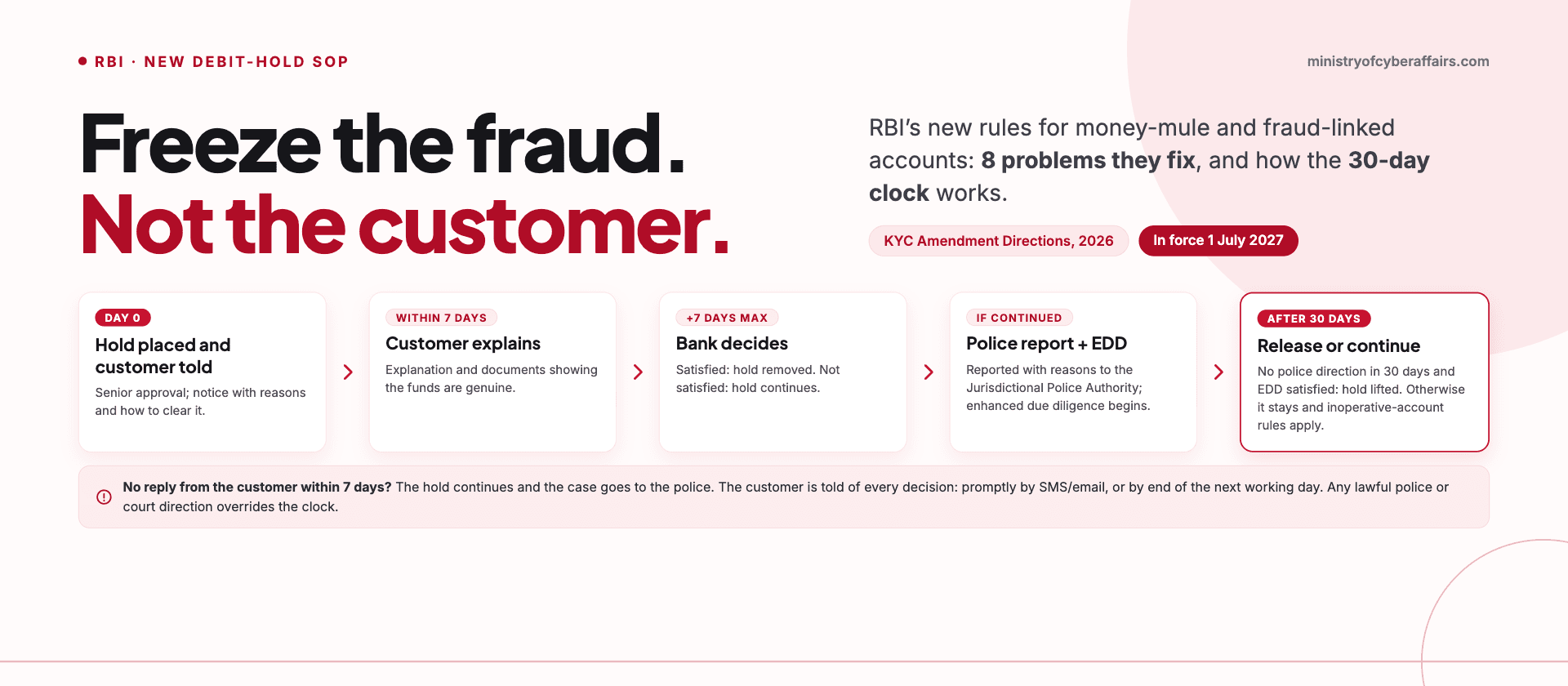
Banks must place holds only on a high degree of suspicion, with senior approval. They must tell the customer why and give them 7 days to explain, then decide within 7 days.
Unresolved cases go to the jurisdictional police. If no lawful direction arrives within 30 days, the hold is lifted on day 31, provided the bank is satisfied with its enhanced due diligence.
The rules take effect on 1 July 2027, or earlier if a bank chooses.
Every large online scam, from fake investment platforms to law enforcement impersonation calls, needs bank accounts to receive and move stolen money. These money mule accounts belong to people who lend, rent or sell their accounts to criminals, sometimes knowingly and sometimes not. Mules let fraudsters break the money into small amounts and pass it through many accounts within minutes, until it is withdrawn as cash, turned into crypto or sent abroad.
India's scale is striking:
- The Indian Cyber Crime Coordination Centre (I4C) told the government that about 4.5 lakh (450,000) mule accounts were frozen in a single year.
- A July 2026 industry report cited government efforts that have identified 27.37 lakh mule accounts. The same report described a shift by scam syndicates towards India-based mule networks as crackdowns on Southeast Asian scam centres intensified.
- Union Home Minister Amit Shah has publicly called mule accounts one of the biggest hurdles in curbing cybercrime.
Until now, banks used different and often ad-hoc approaches. Some froze whole accounts at the first alert and trapped genuine customers. Others acted too slowly, and the money was gone before anyone moved. There was no common clock, no common definitions and no common route to the police.
Banks empowered by the SOP
The RBI amended its 2025 KYC Directions under Section 35A of the Banking Regulation Act, 1949. The Payment Banks version (RBI/2026-27/316) changes paragraphs 5, 49 and 67. Similar amendments were issued for urban co-operative banks (RBI/2026-27/315) and commercial banks on the same day.
The final rules follow a draft SOP published in September 2026 and a Supreme Court direction in August 2026 asking the RBI to frame an SOP for mule accounts and fraud-linked accounts.

1. Clear legal definitions
For the first time, the KYC Directions define:
- Debit hold: not allowing any debit from an account, or from an amount placed under hold.
- Money mule account: an account used on behalf of another person, knowingly or unknowingly, to receive, layer or transfer proceeds of crime, financial fraud or terrorist financing.
- Highly suspicious account: a mule account, or an account used on one's own behalf in the same way, that the bank assesses as needing action such as a debit hold.
- Highly suspicious transaction: a suspicious transaction that the bank, on its own assessment, decides to hold, or that a competent authority directs it to hold.
- Jurisdictional Police Authority: the police or cyber police station to which the case is routed through the national cyber-fraud portal (NCRP-CFCFRMS), or the station covering the bank branch.
The Directions also clarify that not every suspicious transaction is "highly suspicious". That distinction is the first safeguard for genuine customers.
2. A uniform SOP - acting in a time bound manner
Step | What happens | Deadline |
|---|---|---|
Detection | Bank identifies a highly suspicious transaction or account using objective parameters | Ongoing |
Debit hold | Placed on the transaction amount or the account, with approval at a higher level | Day 0 |
Customer notice | Reasons, how to get the hold removed, officer contact, request for explanation | Promptly by SMS or email; otherwise by end of the next working day |
Customer response | Explanation and documents | Within 7 calendar days |
Bank decision | Remove the hold, or continue it and report to police | Within 7 calendar days of the explanation |
No response | Hold continues; case reported to police | After 7 days |
Police stage | Bank conducts enhanced due diligence (EDD) and follows any lawful direction | Ongoing |
Automatic review | No police direction within 30 days and EDD satisfied: hold lifted. Otherwise it continues and inoperative-account rules apply | Day 31 after the police reference |
3. Safeguards for genuine customers
- Detection must use objective parameters and reduce the risk of flagging genuine customers by mistake.
- Holds require a high degree of suspicion and senior approval. Mechanical account-level holds must be avoided, so a bank can hold only the suspect amount.
- Customers must be told every decision quickly.
- Banks must name Nodal Officers on their websites and in branches, acknowledge complaints, resolve them within 30 days and track them in an MIS.
- Every hold must be documented for five years, including dates, reasons and correspondence with the customer and the police.
Why this is a game-changer
It closes the speed gap
Fraudsters move money in minutes, while investigations take days. A debit hold lets a bank stop the outflow as soon as it has strong grounds, without waiting for a complaint to work its way through the system. Holding funds early is the main thing that gives victims a realistic chance of recovering their money.
It replaces discretion with a standard
A uniform SOP across commercial, co-operative and payment banks means criminals can no longer move to the bank with the weakest controls. It also gives every bank the same legal cover and the same obligations, which reduces both over-freezing and under-reacting.
It protects the innocent by design
Many mule accounts belong to students, gig workers and rural customers who were deceived or paid a small fee. Indiscriminate freezes punish them and erode trust in digital banking. Requiring proportionate, time-limited holds, written reasons and a grievance route treats fraud prevention and customer rights as one design problem, not a trade-off.
It plugs banks into India's cyber-crime grid
Anchoring police reporting to NCRP-CFCFRMS, the national system operated by I4C, links each hold to a case that law enforcement can act on. This builds on existing infrastructure: the government reported that, as of 30 June 2026, the system had helped save more than ₹11,158 crore across more than 32.8 lakh complaints.
It completes a layered strategy
The SOP is the enforcement layer on top of India's detection tools:
- MuleHunter.AI, the RBI Innovation Hub's AI/ML model for spotting mule accounts, launched in December 2024 and reportedly used by more than 26 banks.
- The I4C–RBIH agreement of May 2026, which feeds data from I4C's Suspect Registry into AI-driven fraud detection.
Detection without a clear legal power to act was the missing piece. The SOP supplies it.
How India compares globally
Other countries are tackling the same problem from different angles:
- United Kingdom: since 7 October 2024, payment firms must reimburse most victims of authorised push payment (APP) fraud under a mandatory scheme, with liability shared between sending and receiving firms. The government also gave banks more time to delay payments for up to 72 hours where fraud is suspected. The UK model puts pressure on banks through liability after the loss.
- Singapore: the Anti-Scam Centre works with banks, seven of which have staff based at the centre, and can typically freeze accounts within a day. Since October 2025, a Facility Restriction Framework has limited access to banking, phone lines and Singpass for convicted or warned mules. A new anti-scam bill tabled in August 2026 would let police order suspected scam accounts frozen.
- India: the RBI's approach centres on bank-initiated holds under a statutory clock, with built-in customer notice, automatic review on day 31 and direct routing to the police through a national portal.
India's model stands out for standardising the bank's own power to freeze, while capping how long a hold can last without legal backing. For high-volume real-time payment systems such as UPI, that combination of speed and due process is likely to be studied by other regulators.
What could limit its impact
A balanced assessment should note the open questions:
- Timing: the rules apply from 1 July 2027. Syndicates have months to adapt, unless banks adopt the SOP early.
- Execution: the outcome depends on detection quality. Weak models will either miss mules or trap genuine customers.
- Police capacity: day-31 release depends on police responding within 30 days. Uneven capacity across states could lead to funds being released too early or held too long.
- Insiders: recent arrests of bank staff in fraud-syndicate cases show that rules on paper need strong internal controls.
- Cross-channel flows: mules increasingly cash out through crypto and other channels outside the banking system, which a bank-level SOP cannot reach alone.
What it means for the customer
For customers: if your account is put on hold, you must be told why. You have 7 days to explain, and the bank must decide within 7 days of your reply. Keep proof of the source of large or unusual credits. Never lend, rent or sell your bank account: "knowingly or unknowingly" means unwitting mules can still have their accounts frozen.
For banks: build detection that uses objective parameters, set up approval workflows, design notice templates, publish Nodal Officer details, set up the complaints MIS and keep five-year records. Starting before July 2027 gives you a head start.
For policymakers worldwide: India shows that a regulator can give banks real power to freeze fraud money while writing due process into the same rule.
Frequently asked questions
What is a debit hold under the RBI's new rules? A debit hold stops any money from leaving an account, or a specific held amount. Banks can place one on a highly suspicious transaction or account linked to money-mule activity, financial fraud, a scheduled offence or terrorist financing.
What is a money mule account? An account used on behalf of another person, knowingly or unknowingly, to receive, layer or transfer the proceeds of crime or fraud. The rules also cover accounts misused on the holder's own behalf.
When do the RBI debit-hold rules come into force? On 1 July 2027, or earlier if a bank decides to implement the SOP sooner.
How long can a bank hold my money? You have 7 days to explain, and the bank must decide within 7 days of your explanation. If the case is reported to police and no lawful direction is received within 30 days, the hold is lifted on day 31, provided the bank is satisfied with its enhanced due diligence. Otherwise the hold continues and inoperative-account rules apply.
Will the bank tell me if my account is frozen? Yes. The bank must notify you promptly by SMS or email if it has your details, or otherwise by the end of the next working day. The notice must give the reasons, the removal process and the officer's contact details.
Where can I complain? To the Nodal Officer named on your bank's website and at its branches. Complaints must be acknowledged and resolved within 30 calendar days.
Which banks do the rules apply to? The RBI issued parallel amendments on 27 November 2026 for commercial banks, urban co-operative banks and payment banks.