Natraj Pencil Packing Job Scam and Extortion Racket busted in Operation Mule Hunter by Rajasthan Police
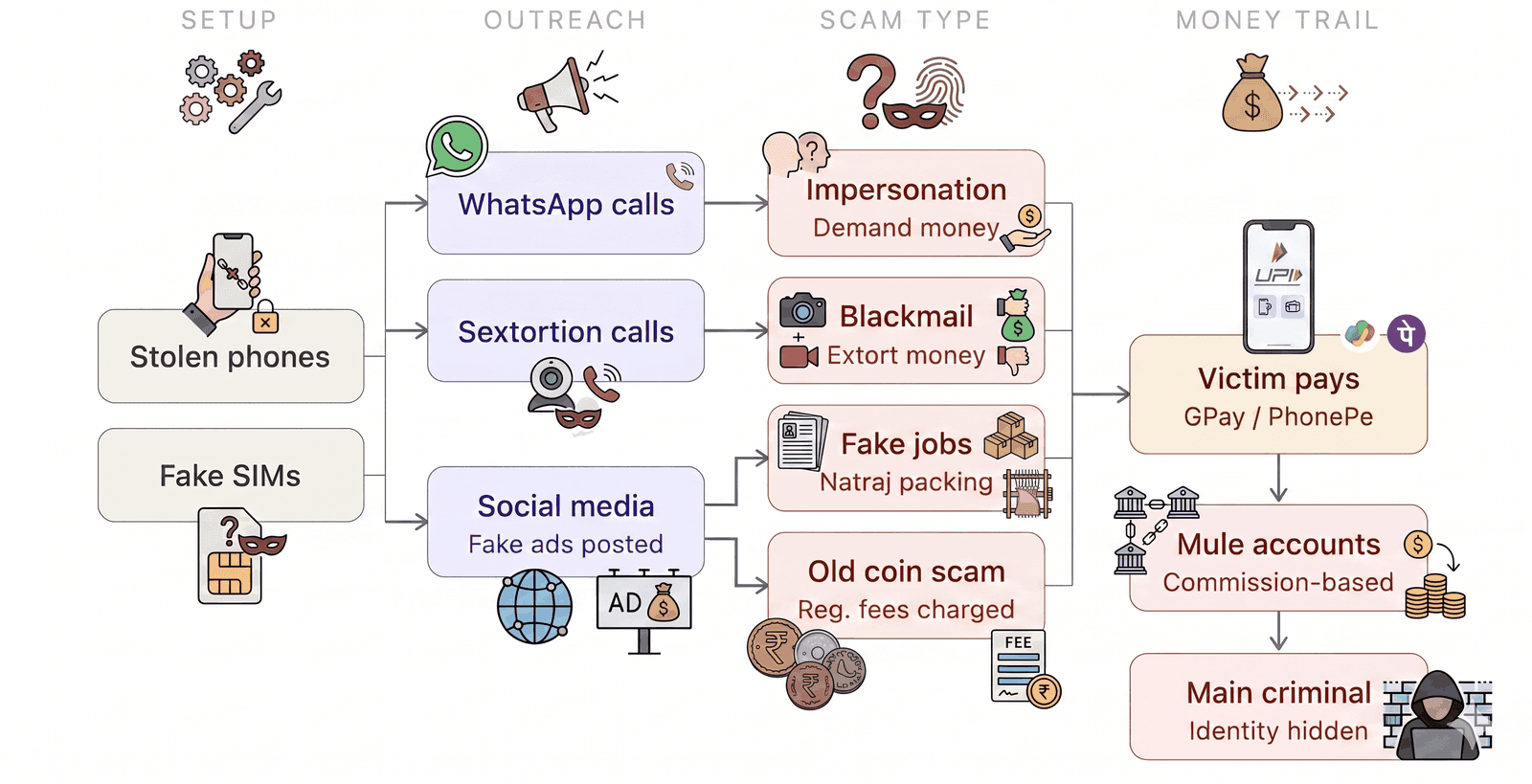
Deeg District of Rajasthan is one of prominent hostpot of cybercrime in India. Strategic "Operation Mule Hunter" led to crackdown of multiple scamming modus operandi like Natraj Pencil Packing Job Scam, Sextortion, Old Coin and Impersonation Scam through Facebook / Google Ads
Deeg, Rajasthan | May 1, 2026
District Police has arrested 103 accused and registered 34 FIRs under Operation Mule Hunter, a special month-long campaign that ran from April 1 to April 30, 2026. The operation targeted not just the masterminds behind the frauds but also the network of mule account holders who provided the financial cover enabling these crimes.
Modus Operandi: Facebook and Google Ads, WhatsApp & Stolen Phones
Scammers used stolen or looted mobile phones, loaded them with fraudulently obtained SIM cards, and then impersonated known contacts of victims via WhatsApp calls to demand money. In another strand, sextortion was deployed, victims were lured and then blackmailed.
Sitting in Deeg - Technology made it possible to reach out to all India victims. Using Google and Meta advertisements - victims were scammed in the name of pencil packing at "Natraj Company," to extract advance registration fees from job-seekers. Others were cheated through schemes involving the sale or purchase of old coins and currency notes at inflated prices.
To 'layer' the money trail, all fraudulent proceeds were quickly routed through commission-based mule accounts, Google Pay, PhonePe wallets, and bank accounts rented from willing or unwitting participants, ensuring the identity of the principal criminals remained hidden.
Arrests
The campaign operated on a tri-level strategy. The first pillar, Operation Mule Hunter, focused on the arrest of both primary fraudsters and the mule account holders who facilitated the financial pipeline.
Station-level teams across 12 police stations, Kaithwada, Pahadi, Sikri, Kaman, Khoh, Gopalgarh, Nagar, Jurhehra, Junthar, Kumher, Deeg Kotwali, and Deeg Sadar, participated in the operation.
Kaithwada led with 6 FIRs and 28 arrests, followed by Pahadi (4 FIRs, 15 accused) and Sikri (4 FIRs, 14 accused).
District SP himself visited cybercrime hotspot villages for awareness drive
SP Sharan Gopinath K. personally visited villages identified as cyber crime hotspots, engaging directly with youth and warning them about the severe legal and social consequences of involvement in cyber fraud. Awareness drives were conducted through schools, colleges, public spaces, and social media handles, supported by CLG members, Police Mitras, the Cyber Thana team, Kalika Patrolling unit, Anti-Romeos unit, and the Social Media Cell.
Seizure & Infrastructure blocking
The seizures included 108 Android mobile phones, 158 fake SIM cards, 20 ATM cards, 18 bank passbooks, 9 chequebooks, one Thar vehicle, and ₹2,32,000 in cash. To cut off the digital infrastructure sustaining these operations, Deeg Police blocked approximately 1,074 SIM cards and 1,056 IMEI numbers linked to fraudulent activities.
The team behind the operation
The cyber cell team executing operation mule hunter campaign comprised:
- Shri Ramkesh Meena (Police Inspector, In-charge Cyber Cell)
- Constable Netram (No. 214)
- Constable Munesh Kumar (No. 580)
- Constable Naresh (No. 693)
- Constable Anil (No. 702)
- Shri Saurav Khandelwal (Information Assistant, Cyber Cell) and district police.
The campaign was launched under the direction of Shri Kailash Chandra Bishnoi, Inspector General of Police, Bharatpur Range, and Shri Sharan Gopinath K. (IPS), Superintendent of Police, Deeg, as part of a zero-tolerance policy against cyber crime in the district.
*******