How Indian States Are Ranked on Cybercrime Performance: The 9 Key Parameters Explained
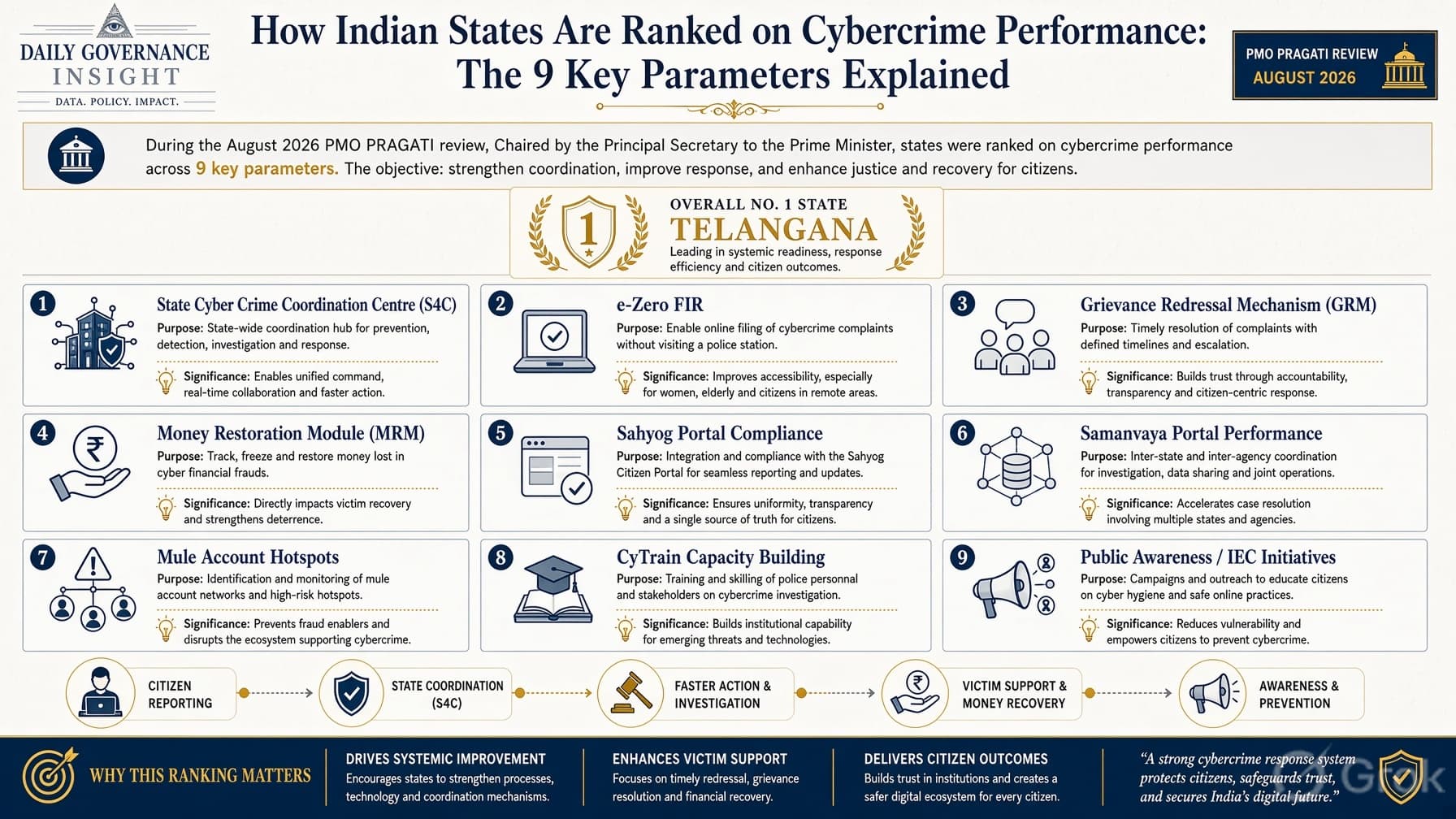
Telangana led the rankings with near-complete green performance across most metrics, followed closely by Maharashtra, while several others such as Puducherry, Ladakh, and Uttarakhand also featured among the top performers, highlighting varied progress in building a coordinated national response to cyber threats.
In August 2026, the Prime Minister’s Office (PMO) conducted a nationwide PRAGATI review of state and Union Territory performance on cybercrime.
The review, chaired by the Principal Secretary to the PM and attended by senior officials from the Cabinet Secretariat, Ministry of Home Affairs (MHA), and PMO, assessed all states on nine key parameters.
These parameters focus on institutional readiness, use of I4C (Indian Cyber Crime Coordination Centre) platforms, victim support, inter-state coordination, capacity building, and public awareness, not on the raw number of registered cybercrime cases.
Telangana emerged as the overall No. 1 state in this assessment, a sharp improvement attributed to focused coordination through its Cyber Security Bureau and district/unit officers.
This ranking system is designed to drive systemic improvements rather than merely count complaints.
Here is a clear, practical explanation of each parameter, its purpose, and why it matters for police officers and the public.
1. Establishment of the State Cyber Crime Coordination Centre (S4C)
What it measures: Whether the state has set up a dedicated State Cyber Crime Coordination Centre (often called Cyber Security Bureau or similar) aligned with the national I4C framework.
Significance: S4C acts as the nodal hub for cybercrime data, coordination between districts/commissionerates, and seamless exchange with I4C. Without a functional S4C, efforts remain fragmented. Telangana was recognised as the first state to establish one. Strong S4C capacity improves data feeding into national systems and ensures consistent action across units.
2. Implementation of e-Zero FIR
What it measures: Operational status of the e-Zero FIR system for high-value cyber frauds (typically ₹5 lakh and above), including the number of FIRs registered through it.
Significance: e-Zero FIR allows registration of cases without the complainant being physically present at the police station, speeding up response in financial frauds where time is critical for freezing funds. It reduces jurisdictional friction and ensures early formal investigation. Live implementation with actual FIRs registered shows the system is working on the ground.
3. Grievance Redressal Mechanism (GRM)
What it measures: Percentage of grievances acted upon regarding freezing/unfreezing of bank accounts, debit freezes, liens, or holds imposed during investigations.
Significance: Many citizens face hardship when accounts are frozen during probes. GRM tracks and ensures timely action on these requests. High action rates (e.g., 88% in the recent review) demonstrate citizen-centric policing and reduce unnecessary distress while maintaining investigative integrity.
4. Money Restoration Module (MRM)
What it measures: Percentage of eligible cases where law-enforcement orders are issued for restoration of defrauded money, and the amount facilitated for refund.
Significance: Recovering money is the most tangible outcome for victims of financial cyber fraud. MRM standardises the process of identifying restorable transactions and pushing orders to banks. Strong performance here directly improves public trust and victim satisfaction. (Note: Smaller amounts may be claimable without FIR/court order under simplified rules; larger claims require formal process.)
5. Sahyog Portal Compliance
What it measures: Utilisation of the Sahyog Portal for issuing notices to intermediaries (social media platforms, service providers, etc.) for content removal/blocking or data disclosure, and the compliance/removal rate.
Significance: Sahyog (under Section 79(3)(b) of the IT Act) streamlines takedown of unlawful content and requests for data. High request volume and high compliance rates show proactive disruption of scam infrastructure (phishing pages, fake profiles, malicious links) and effective interfacing with tech platforms.
6. Samanvaya Portal Performance
What it measures: Level of inter-state coordination, number of criminal profiles uploaded, and linkages established through the Samanvaya platform (and related modules such as Pratibimb for location mapping).
Significance: Cybercrime is rarely confined to one state. Samanvaya serves as a shared repository and analytics platform for mapping interstate linkages of suspects, mule accounts, mobile numbers, and crime infrastructure. High upload and linkage numbers enable pattern detection, multi-state operations, and faster arrests. Strong performance here breaks silos between police forces.
7. Mule Account Hotspots
What it measures: Whether the state appears among the list of states flagged for significant mule account activity (typically the top 15 flagged states).
Significance: Mule accounts are the backbone of money laundering in cyber fraud. Avoiding the “flagged” list indicates effective monitoring, disruption of mule networks, and collaboration with banks/financial institutions via systems such as the Suspect Registry. Being absent from the hotspot list is a positive performance indicator.
8. CyTrain Capacity Building
What it measures: Number of police and judicial officers trained and certified through the national CyTrain (Massive Open Online Courses) platform on cybercrime investigation, forensics, and prosecution.
Significance: Technology and tactics evolve rapidly. Standardised, certified training ensures officers across ranks have updated skills. Higher numbers of certified officers translate into better quality investigations, stronger charge sheets, and improved conviction prospects.
9. Public Awareness / IEC Initiatives
What it measures: Reach of Information, Education and Communication campaigns on cybercrime prevention, including specific campaigns against high-impact threats such as Digital Arrest scams.
Significance: Prevention is more effective than investigation alone. High citizen outreach reduces victimisation rates and encourages timely reporting (via 1930 or the National Cyber Crime Reporting Portal). Awareness metrics reflect the state’s investment in community engagement.
Why This Ranking Framework Matters
This nine-parameter model shifts focus from “how many cases were registered” (an NCRB incidence metric that can rise with better reporting) to “how effectively is the state building systems, supporting victims, coordinating across borders, training its officers, and preventing crime.”
It rewards institutional strength, data discipline, and citizen outcomes.
For police officers, the ranking provides a clear checklist: strengthen the S4C as coordinator, ensure every unit feeds data into GRM/MRM/Samanvaya/Sahyog, prioritise training, disrupt mule networks, and sustain public awareness.
Consistent performance across these areas, rather than isolated excellence, determines overall rank.
The August 2026 PRAGATI review demonstrated that focused leadership, inter-unit coordination, and rigorous use of I4C platforms can produce rapid, measurable improvement.
States that treat these nine parameters as operational priorities will not only improve their ranking but, more importantly, deliver faster justice and better protection to citizens in the digital age.