Telangana Tops the Nation in Cybercrime Fight: A Motivating Milestone at the PRAGATI Review
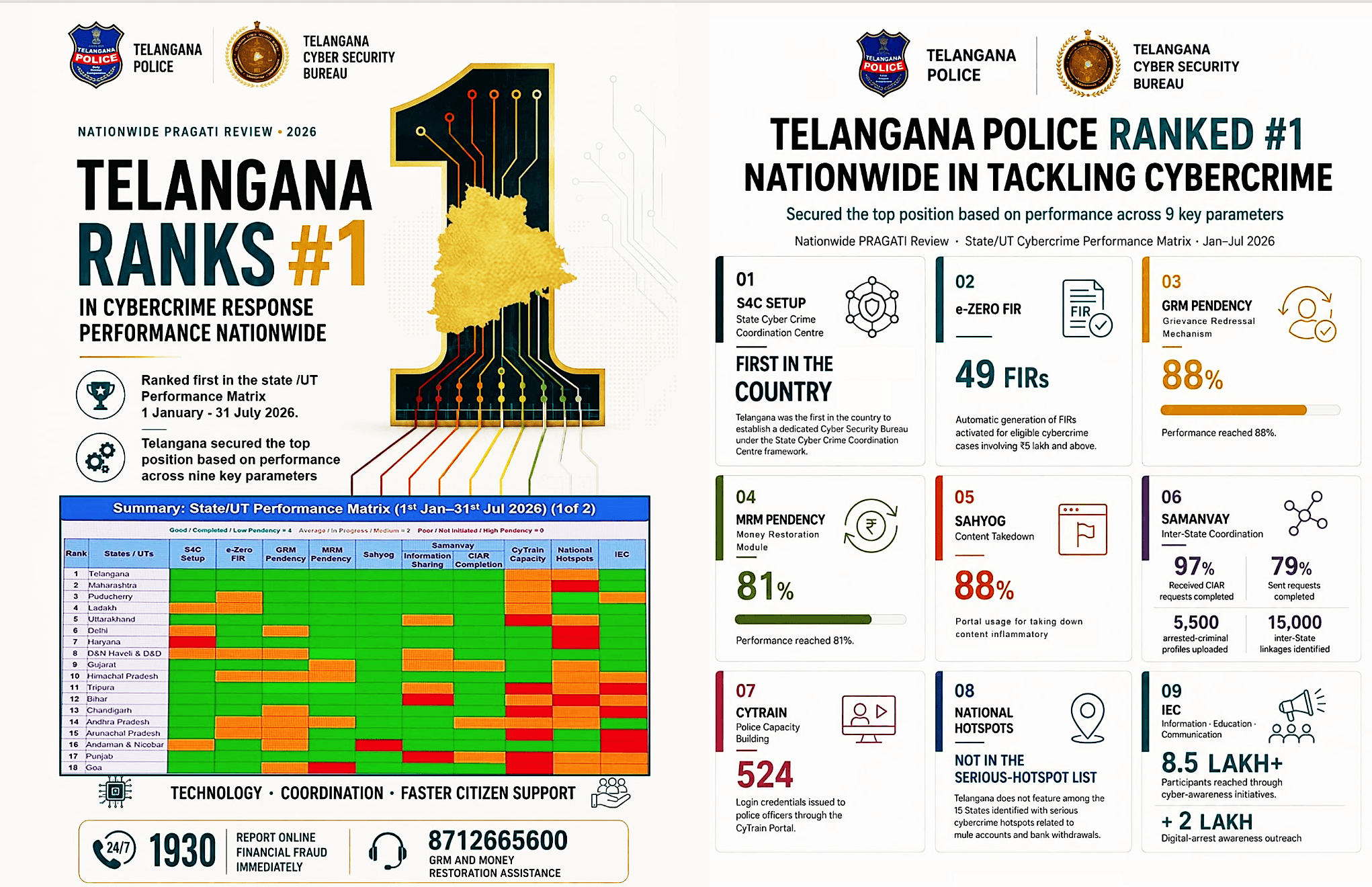
Chief Minister A. Revanth Reddy warmly congratulated the Telangana Police, the Cyber Security Bureau, and every officer involved for securing the top national rank in cybercrime performance at the PMO’s PRAGATI Review.
In a powerful demonstration of focused leadership and technological resolve, Telangana has emerged as India’s number one state in overall cybercrime performance.
The recognition came during the nationwide PRAGATI Review video conference held on August 6, 2026, chaired by the Principal Secretary to the Prime Minister, Shri P.K. Mishra, in the presence of the Union Cabinet Secretary, Home Secretary, and senior officials from the PMO and Ministry of Home Affairs.
What is PRAGATI?
PRAGATI, Pro-Active Governance And Timely Implementation, has long served as a high-level platform under the Prime Minister’s Office to monitor critical national priorities and push for measurable outcomes across states and Union Territories.
With cyber frauds, digital arrest scams, and online financial crimes rising sharply and affecting ordinary citizens’ savings and trust in the digital economy, the latest review zeroed in on nine key parameters of cybercrime response.
These included institutional setup, rapid FIR registration, victim support systems, content takedown, inter-state coordination, capacity building, hotspot monitoring, and public awareness.
Just two months earlier, Telangana’s position was far less competitive.
What changed was deliberate action.
Director General of Police C.V. Anand personally reviewed operations at the Cyber Security Bureau within the Integrated Command and Control Centre.
Gaps in data feeding and coordination between the specialised bureau and district units and commissionerates were identified.
Clear instructions followed: the Cyber Security Bureau would act as the central coordinator, with every Commissioner of Police and Superintendent of Police aligning their efforts.
Continuous monitoring by Director Shikha Goel and her team turned individual efforts into a cohesive state-wide system.
The results were swift and decisive.
Parameters of Performance
- Telangana became the first state in the country to establish a dedicated State Cyber Crime Coordination Centre (S4C) through its pioneering Cyber Security Bureau.
- The e-Zero FIR mechanism for high-value cyber frauds (₹5 lakh and above) is live, with 49 such FIRs already registered.
- On the Grievance Redressal Mechanism, the state achieved an 88 percent disposal rate.
- The Money Restoration Module delivered an impressive 81 percent performance, helping restore substantial funds to victims.
- Sahyog Portal compliance for content takedown stood at around 88–89 percent.
- Samanvay Portal inter-state coordination reached 97 percent, with thousands of criminal profiles and linkages uploaded.
- Telangana is not among the 15 states flagged for mule account hotspots.
- Through CyTrain, 524 officers have been trained and certified.
- Public awareness campaigns have reached 8.5 lakh people on general cybercrime risks and another 2 lakh specifically on digital arrest scams.
These numbers are more than statistics, they represent real protection for families, recovered hard-earned money, faster justice, and a safer digital environment for citizens.
Fostering Cooperative Federalism & Competitiveness
What makes this achievement particularly inspiring is the larger federal context.
Cybercrime falls under the domain of policing, a State Subject under the Constitution.
States retain primary responsibility for law and order on the ground.
Yet the Centre, through the Indian Cyber Crime Coordination Centre (I4C), has created shared digital platforms, standardised tools, and performance benchmarks.
Telangana’s success shows how healthy competition and willing adoption of these central initiatives can elevate performance without diluting state ownership.
By embracing the common tools while strengthening local coordination and ownership, the state has turned a national review mechanism into a genuine driver of excellence.
This model of competitive federalism deserves applause.
When states treat national platforms not as external impositions but as opportunities to raise their own standards, the entire country benefits.
Telangana’s leap to the top in just two months proves that focused leadership, institutional innovation, and collaborative spirit can deliver rapid, measurable results against a complex modern threat.
Other states now have a clear benchmark and a motivating example.
The fight against cybercrime is far from over, but Telangana has shown the path forward, determined, data-driven, and citizen-centric.