Black Friday 2026: The Week Social Media Showed the Scam in Real Time
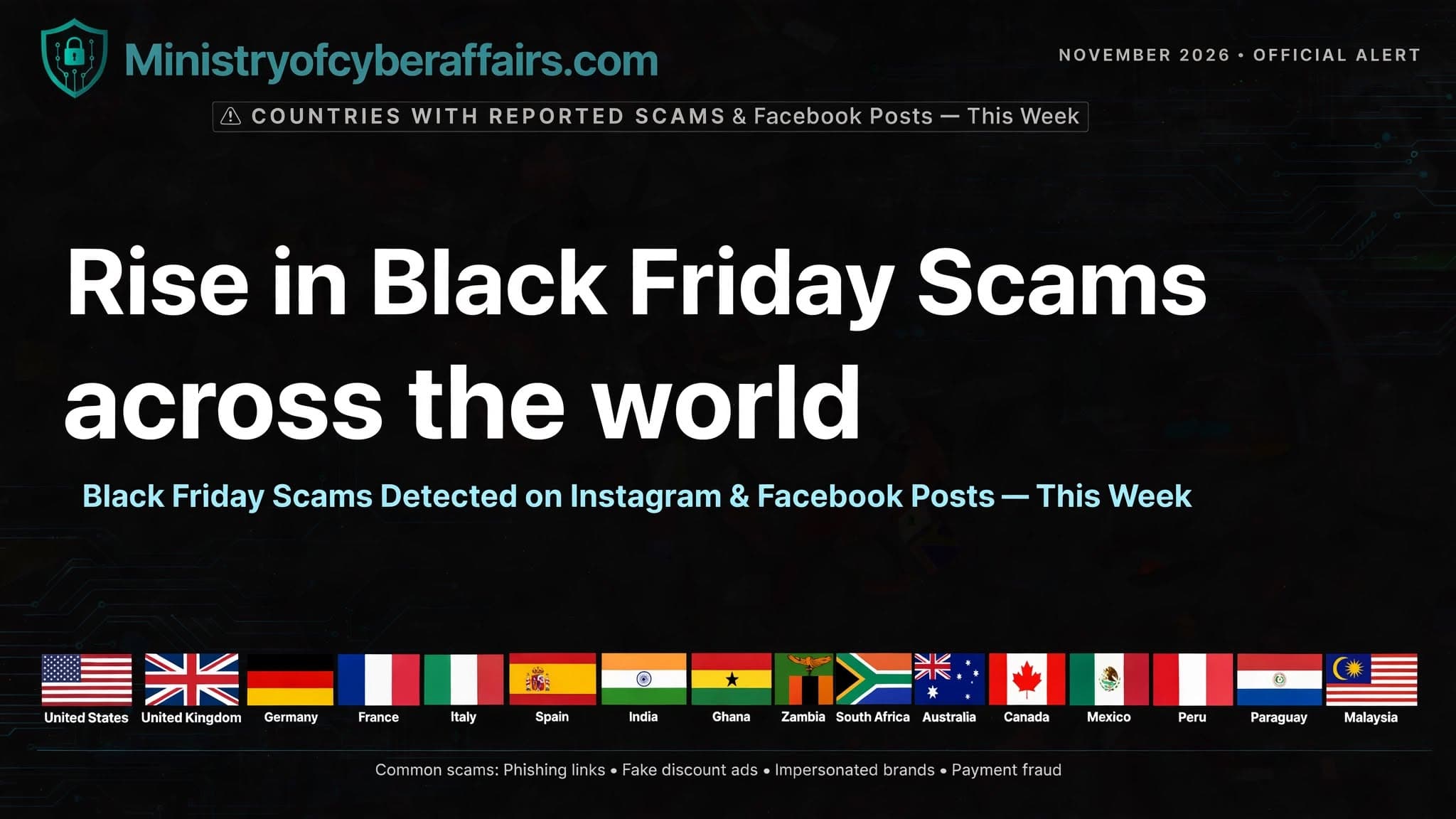
This was not a week of isolated warnings. Across every region, posts told the same story in different languages: the deal was the trap. The store looked real, the delivery message looked urgent, and the payment felt normal until the money was gone.
Shoppers in North America, Europe, Asia, Africa and Latin America reported a surge in fake online stores, fraudulent delivery messages and payment fraud during Black Friday week, according to posts reviewed on Instagram and Facebook between Nov. 21 and Nov. 28.
The posts described lookalike stores offering steep discounts, texts demanding a small fee to release parcels, and fake order confirmations directing victims to call numbers that sought passwords and remote access.
Shoppers were urged in the posts to type official addresses directly, avoid payment by gift card, wire transfer or crypto, and check order status only in official apps
1. The fake store is now the main scam
The most repeated pattern this week was not a fake product.
It was a complete fake store.
Posts from North America, Europe and Asia showed sites that copied logos, product photos, reviews and checkout flows from real retailers.
One widely shared explainer described how scammers no longer just sell fake goods, they build entire stores that look legitimate, then run them seasonally around shopping events.
Another post showed a sponsored search result for a household appliance at less than a third of its normal price.
Clicking it led to a convincing lookalike store, but the checkout address was a random domain that had nothing to do with the real retailer.
In Europe, a police awareness video told the same story in silent-film style: a shopper finds a flagship phone at more than 70% off on a store she has never heard of, pays, waits, and then finds the site has vanished with a 404 error.
She is left with only a printed order confirmation.
A separate post from Germany described a fake shoe shop operating under 75 different web addresses, harvesting contact details from the moment a visitor started typing.
The tell was consistent across continents: no real contact page, no verifiable address, no returns policy, and reviews that exist only inside the site itself.
One creator in North America showed a fake sportswear site with large discount tags and clean product images.
The advice that followed was repeated in almost every region: if the contact page is missing, do not shop there.
If it exists, verify the address independently.
2. The delivery text that asks for a tiny fee
The second global pattern was the delivery message.
In the US, UK, South Africa, Australia and Canada, posts showed almost identical texts: parcel on hold, parcel could not be delivered, pay a small fee to reschedule.
The amounts were deliberately small, often around one to two dollars or the local equivalent.
The goal was not the fee.
It was the card details entered on the fake courier page.
One explainer broke it into a 10-second test: unexpected text, urgency, a payment request, and a strange link.
Another post showed a simulated message from a random international number claiming a parcel was on hold because of an incomplete address, with a 12-hour deadline to act.
The warning was the same everywhere: real couriers rarely text a payment link to reschedule, and they do not ask for card details to release a parcel.
A separate first-person post circulating this week described a doorstep variant: an unexpected gift of flowers and wine, a request for a small card payment for verification, and days later, thousands withdrawn from the account after the card was cloned.
Commenters debated whether the story was old, but the lesson that travelled with it was current: never hand over a card or PIN for a delivery you did not order.
3. The order you never placed
A third pattern relied on panic, not greed.
Posts in North America showed fake order confirmations for expensive laptops and other electronics, with a phone number to call to cancel.
The warning was direct: real retailers do not ask you to call to cancel this way.
Calling connects you to someone who asks for computer access and passwords.
The correct check is to open your real account in the official app, not through the message.
The same logic applied to fake account verification messages, fake customer support numbers promoted through paid search ads, and fake charity appeals around the giving season.
One post listed fake charities as a distinct Black Friday trap, urging shoppers to verify through the charity's official channel before donating, not through a link in a message.
4. Payment pressure is the red flag
Across all regions, the payment method was the clearest signal.
Posts from West Africa described fake shops on social media demanding advance payment through mobile money before delivery, plus brand impersonation through search engines and phishing through email and messaging apps.
An official alert from that region cited hundreds of cases and significant losses between January and October 2026, and advised insisting on payment after delivery where possible and shopping only with verifiable stores.
In Latin America, a Spanish-language awareness post listed four traps: unrealistic discounts, suspicious links, fake stores or profiles, and fake payment receipts.
A separate post from Peru warned of three traps: fake stores copying famous brands, fake influencer videos using cloned faces and voices, and false SMS messages asking for codes or passwords.
The advice was consistent: banks and wallets never ask for codes by message, and you should always open the official app directly.
In South Asia, a carousel flagged three red flags that matched posts from every other continent: discounts of around 60% on the latest phones, a misspelled domain with an unusual ending, and a product page with missing information and no real contact details.
In Southeast Asia, a central bank awareness post warned of fake QR codes, phishing links and cloned payment pages asking for cardholder name, card number, PIN, one-time password and security code.
The global rule that emerged was simple: gift cards, wire transfers, crypto-only payment, direct bank transfer to a personal account, or advance mobile money to an unverified seller are not payment options.
5. Not every scam is a fake site. Some are fake discounts.
A second, quieter story ran alongside the fraud posts this week: prices being manipulated to look like deals.
In Zambia, shoppers posted that a fridge consistently priced at one level was advertised during Black Friday as reduced from a much higher, inflated original price to a price still above its normal price.
In France, commenters agreed that many sale prices had been raised before the event.
In Paraguay, a crowd waited for hours for a promotion advertising deep discounts on TVs, phones and appliances, only to find that only around 99 products were available and almost no one received the advertised items.
In North America, creators filmed in-store tags showing the same price on both the regular sale sign and the Black Friday sign.
One video reverse-engineered major retailer sites and showed prices raised days before the sale, inflated savings claims, and fake urgency badges despite large stock.
Another post cited price-tracking research finding that a large share of items were the same price or cheaper at other times of year.
In the UK, a post about a knitted cardigan that arrived as a printed polyester T-shirt captured the other version of this: the product in the photo is not the product that arrives.
The victim's line quoted in the post, that it is not about being unintelligent, but about painting the red flags green, was shared widely as a reminder to slow down.
6. What victims actually reported
The victim posts this week were not dramatic.
They were ordinary.
One shopper in North America bought from what looked like a legitimate retailer offering a Black Friday deal, received no order confirmation, contacted the real retailer, and was told the site was fraudulent and had no record of the purchase.
She is now disputing the charge with her card provider.
Another shopper intended to buy Christmas gifts and instead received unrelated crafting supplies.
In Australia, an awareness post noted that shoppers were expected to spend billions over the weekend, making them prime targets for fake shipping notifications, fraudulent messages and fake stores with unbelievable discounts.
In the UK, a police post replaced the word sales with scams and repeated the line that has become the week's refrain: if it seems too good to be true, it probably is.
The 60-second check that worked everywhere
Posts from police, consumer authorities, creators and shoppers converged on the same checklist, regardless of country:
- Type, do not click: Open the store or courier app yourself or type the official address. Do not follow a link from an ad, SMS, email or social post to pay.
- Read the domain letter by letter: Look for misspellings, extra words and odd endings. A padlock icon only means the connection is encrypted, not that the site is legitimate.
- Search the store plus scam: Search the store name plus scam before you buy, and look for independent reviews outside the site.
- Ignore the timer: Countdowns, only a few left, and urgent alerts are designed to rush you. A real deal will survive a second check.
- Pay with protection: Use a card that allows disputes, not a direct transfer, gift card, crypto or advance payment to an unverified seller. Never share your PIN, password, one-time password or full card details to complete an order.
- Check tracking in the real app: If a delivery message says there is a problem, check in the retailer's or courier's official app. Do not pay from a text link.
If you already paid
The posts that gave the clearest recovery advice said the same thing: act in the first hour.
Contact your bank or card provider immediately, ask for the payment to be stopped or disputed, and ask for a case number.
Change passwords for the email and shopping account used and turn on two-factor authentication.
Preserve screenshots of the site, URL, checkout confirmation, messages and transaction ID.
Report to your national cybercrime portal or helpline and to the platform where you saw the ad.
And expect a second scam: fake recovery agents who promise to trace funds for a fee.
Bottom line from this week's posts: The global Black Friday scam in 2026 is a professional-looking store, a believable delivery text, and a payment page built to rush you.
If the discount is extreme, the timer is ticking, and the payment method is unusual, stop.
Check in the official app.
Do not click.