Maharashtra declares Maha Cyber Office as State Cyber Crime Coordination Centre (S4C)
In a major step to strengthen its fight against cybercrime, the state government has upgraded its existing cyber infrastructure. The State Cyber Crime Coordination Centre (S4C) is required in India to act as a localized, data-driven defense mechanism against the country's surging, localized, and sophisticated cyber-crimes
Mumbai, July 23, 2026: The Government of Maharashtra has formally declared the Maharashtra Cyber Office as the State Cyber Crime Coordination Centre (S4C), on the lines of the Indian Cyber Crime Coordination Centre (I4C). Earlier this year, Union Home Minister launched State Cyber Crime Coordination Centre (S4C) dashboard of I4C.
The decision was notified by the Home Department through Government Resolution No. संकीर्ण-०६२६/प्र.क्र.२६८/विशा-३(अ), issued from Mantralaya, Mumbai on 23rd July 2026. The GR is available on www.maharashtra.gov.in with token number 202607231251072329 and has been signed by Yamuna Dhananjay Jadhav, Under Secretary, Government of Maharashtra.
Why S4C, and Why Now?
The proposal traces back to the national framework. The Government of India had established the Indian Cyber Crime Coordination Centre (I4C) in New Delhi in 2018 to act as the national nodal point for cybercrime.
On 9th June 2026, the Ministry of Home Affairs, through its Cyber Crime and Information Security Division, directed all states to set up their own State Cyber Crime Coordination Centre (S4C) on the same model.
In Maharashtra, the matter was discussed in a meeting chaired by the Chief Secretary on 9th July 2026. Considering the existing technical, institutional and operational capacity of the Maharashtra Cyber Security Project, it was decided to declare the Maharashtra Cyber Office itself as the S4C.
Following a formal request from the Additional Director General of Police, Maharashtra State Cyber, Mumbai on 16th July 2026, the Home Department has now accorded approval.
From Maharashtra Cyber to S4C: What Changes?
The GR makes it clear this is not a new office, but a formal upgrade and integration. Maharashtra already has one of the most mature state cyber setups in the country, with dedicated units for investigation, forensics, threat intelligence and CERT.
By declaring it as S4C, the government gives it a statutory coordination mandate similar to I4C - to act as the single state-level hub for cybercrime investigation, cyber security incident response, fraud mitigation, training, and citizen assistance.
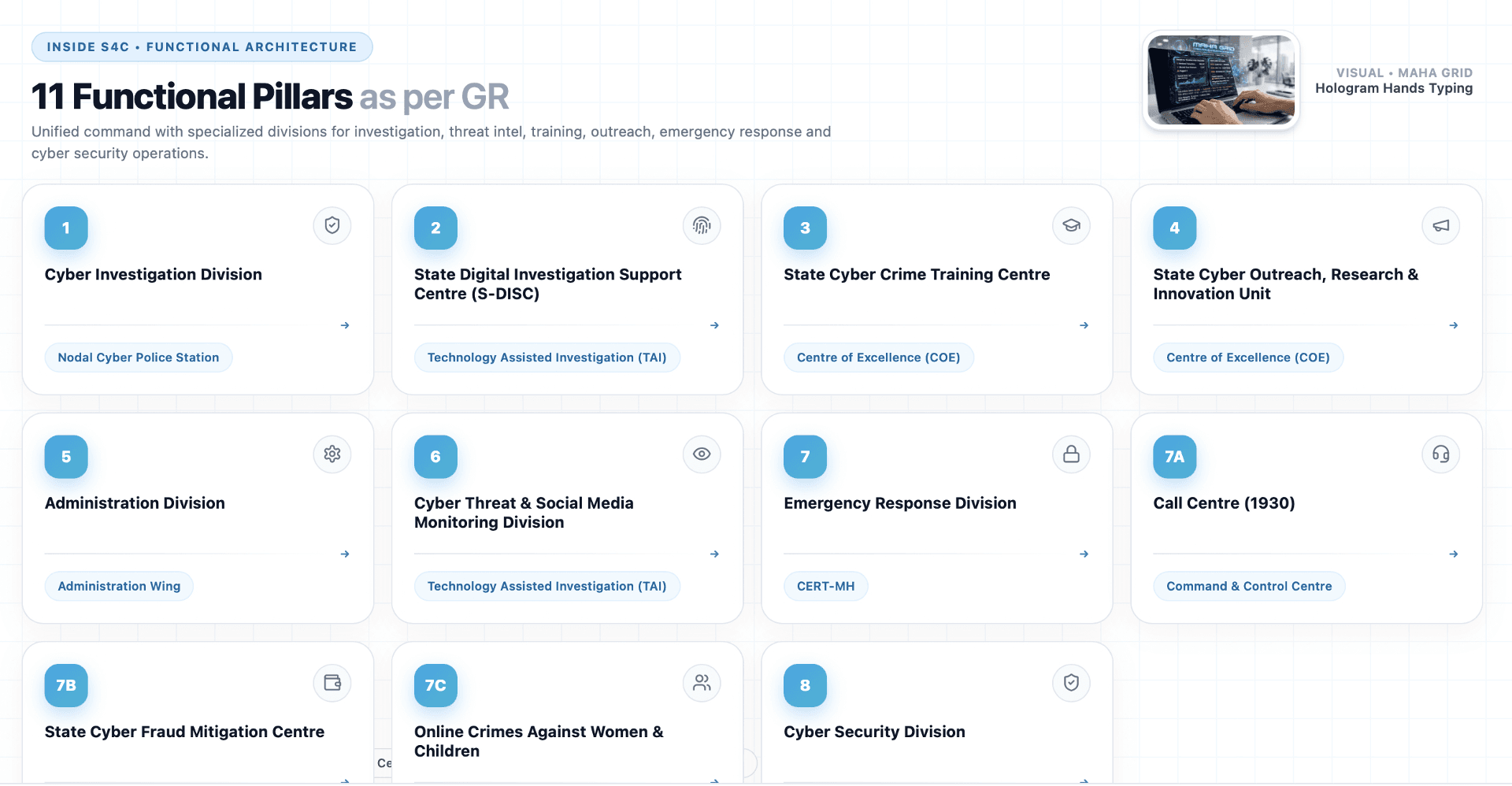
Inside Maharashtra S4C: The 11 Functional Pillars
The Maha Cyber Project is a flagship initiative by the Maharashtra State Cyber Department designed to build a world-class, integrated defensive infrastructure against the state's rising tide of digital crimes. Centered around India’s first integrated state-level Cyber Command and Control Center in Mahape, Navi Mumbai, the multi-hundred crore project streamlines cyber investigation, technology-assisted forensics, and real-time threat response under one roof.
All existing units of the Maha Cyber Project will now function as the core operational pillars of S4C:
1. Cyber Investigation Division - Nodal Cyber Police Station The investigative arm for complex, inter-district and inter-state cybercrime cases. It will act as the nodal police station for Maharashtra S4C and coordinate with I4C and other states.
2. State Digital Investigation Support Centre (S-DISC) - Technology Assisted Investigation (TAI) The scientific backbone. TAI provides digital forensics, data extraction, malware analysis, and advanced technical support to all cyber police stations across the state.
3. State Cyber Crime Training Centre - Centre of Excellence (COE) Focused on capacity building. It will train police officers, prosecutors, and judicial officers in cyber law, investigation techniques, and digital evidence handling.
4. State Cyber Outreach, Research & Innovation Unit - Centre of Excellence (COE) The outreach and R&D wing. Responsible for cyber awareness campaigns in schools, colleges and government departments, plus research on emerging threats like AI-based fraud and deepfakes.
5. Administration Division - Administration Wing Handles the administrative, financial and human resource management of the S4C.
6. Cyber Threat & Social Media Monitoring Division - Technology Assisted Investigation (TAI) The eyes and ears of the system. It monitors open-source intelligence, social media for rumour-mongering, extremist content, and early warning indicators of coordinated cyber attacks.
7. Emergency Response Division - CERT-MH The state's Computer Emergency Response Team. It will handle real-time incident response for government infrastructure and coordinate crisis management during large-scale cyber incidents.
7A. Call Centre (1930) - Command & Control Centre The citizen-facing helpline. The national cybercrime helpline number 1930 will now be integrated with the state's Command & Control Centre for immediate triaging and routing of complaints.
7B. State Cyber Fraud Mitigation Centre - MAHA GRID A critical unit for financial cybercrime. MAHA GRID tracks mule accounts, links fraud cases across districts, and works with banks, NPCI and telecom providers for rapid freezing and recovery of defrauded money.
7C. Online Crimes Against Women & Children - CCPWC, OCWC TRACE Dedicated to sensitive crimes. This includes the Centre for Cybercrime Prevention against Women & Children (CCPWC) and OCWC TRACE systems to track and act against child sexual abuse material (CSAM), cyberstalking, and sextortion.
8. Cyber Security Division - CERT-MH + Security Operations Centre (SOC) The defensive shield. A 24x7 SOC combined with CERT-MH to protect critical information infrastructure of the state government, monitor state data centres, and issue advisories.
What This Means For Citizens and Policing
For citizens, the change means faster coordination. A complaint filed on 1930 or on cybercrime.gov.in will now be routed through the S4C's Command & Control and MAHA GRID, improving chances of fund recovery in financial frauds.
For district police, it means formal access to S-DISC for forensics and to the Training Centre for skill upgrades, rather than depending on Mumbai for every complex case.
For the state, it creates a single-window coordination point for the directives, data sharing and national threat intelligence.