Lahore's call-centre problem won't go away: NCCIA arrests 37 more in Johar Town for defrauding Americans
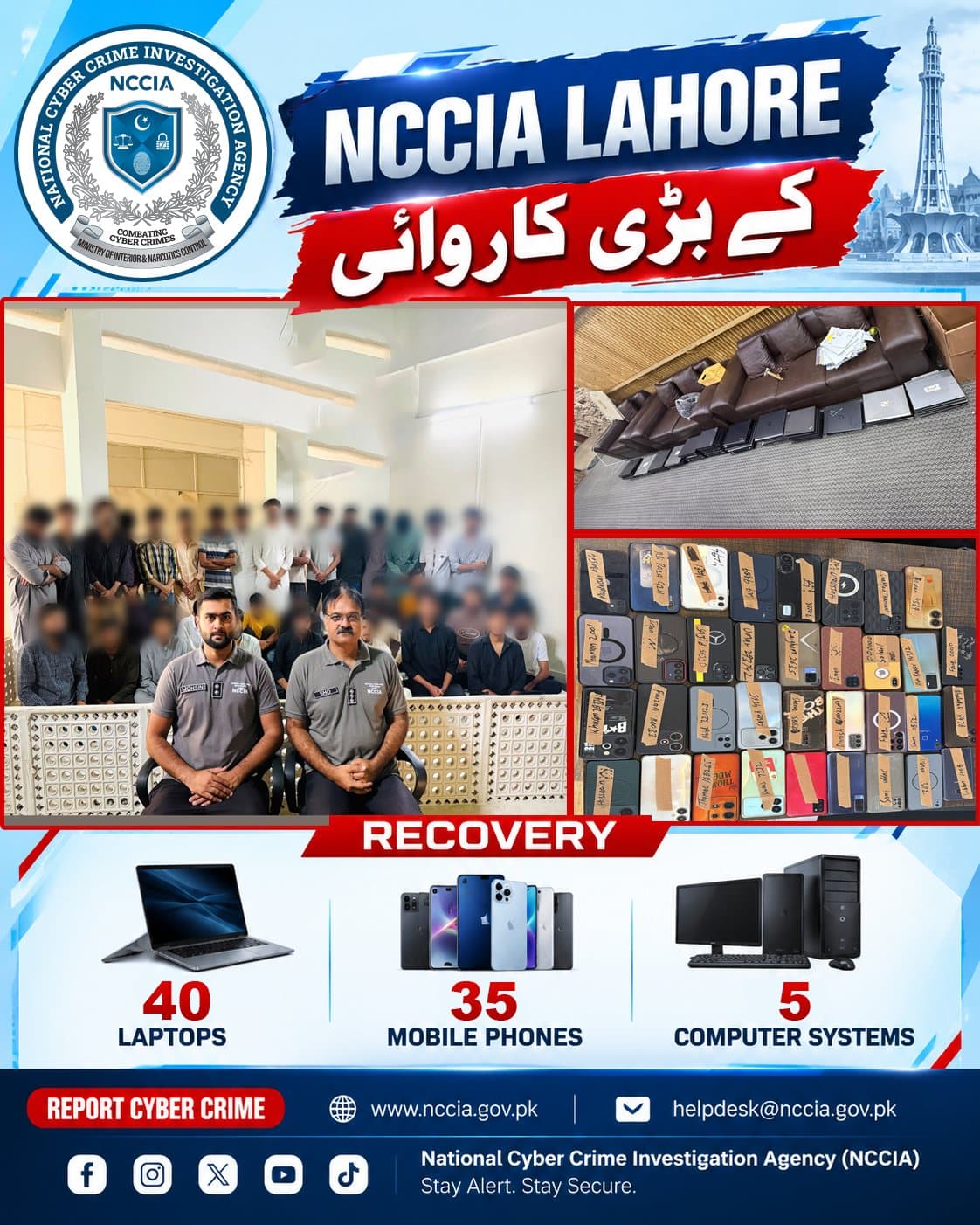
Pakistan's NCCIA has arrested 37 suspects at an alleged illegal call centre in Lahore's Johar Town that targeted US citizens. Operators allegedly posed as US mobile carriers selling phones to harvest card details, then used them for unauthorised transactions. The raid comes days after earlier busts in the same neighbourhood, raising hard questions about why Lahore's scam-centre industry keeps rebuilding faster than it is dismantled.
LAHORE: Pakistan's National Cyber Crime Investigation Agency (NCCIA) has raided yet another illegal call centre in Lahore's Johar Town and arrested 37 suspects accused of defrauding US citizens.
It is the latest in a run of raids that shows how deeply the city's scam-centre industry is entrenched, and how little each bust seems to slow it down.
Fake carriers, real card theft
The NCCIA says the operators posed as representatives of US mobile service providers and called American customers with offers to sell them mobile phones.
Victims were persuaded to hand over credit and debit card details, which were then allegedly used for unauthorised transactions.
The setup was built for volume.
Officers seized 40 laptops, 35 mobile phones and five computer systems.
The agency says a preliminary examination of the devices turned up software and data linked to the fraud.
A First Information Report (FIR) has been registered under the Prevention of Electronic Crimes Act (PECA) 2016 and the Pakistan Penal Code, and the investigation is ongoing.
Same neighbourhood, same playbook
Johar Town is not a new name in these announcements.
Earlier this month, NCCIA raids in Faisal Town and Johar Town netted dozens of suspects.
Raids on scam centres in Rawalpindi and other parts of Lahore have followed almost every week since.
Each raid ends with a lineup photo, a table of seized laptops and a promise of further investigation.
Then the next call centre appears.
The pattern points to a problem enforcement alone is not solving.
Rows of laptops and dozens of workers don't appear overnight.
These operations need premises, payroll, internet connections, foreign-facing scripts and a way to move stolen money out of the country.
Arresting the people on the phones does little if the owners, financiers and payment channels behind them stay out of reach.
The questions Pakistan must answer
For victims in the United States, Australia, Canada and the UK, the question is no longer whether these centres exist but why they keep operating at this scale.
Pakistan needs to show that its raids lead to convictions, asset seizures and action against the people who fund and protect these businesses.
Without that, each new lineup is less a crackdown than a sign of how big the industry has become.