Joint Disruption Week: 3.7 Million Scam Accounts Removed, Dozens Arrested Across West Africa
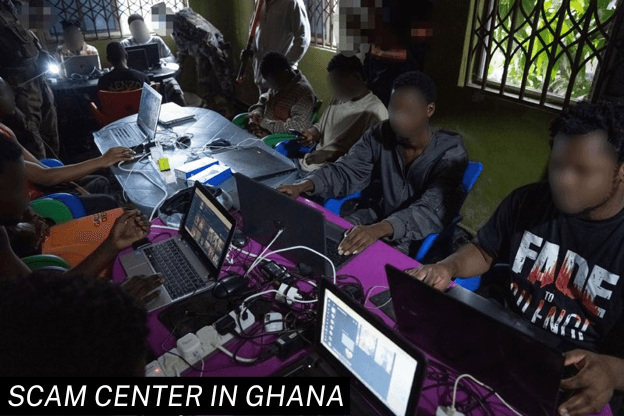
A US-UK-led "Joint Disruption Week" against West African scam centres led to 28 arrests in Ghana and Nigeria, the rescue of 117 trafficking victims and the removal of more than 3.7 million fraudulent social media accounts, Pages and Groups, the largest takedown of its kind. India joined the operation, which was hosted by the UK's National Crime Agency, and tech partners identified over $11 million in potentially freezable funds.
Transnational scam networks operating from West Africa were hit by a coordinated international "Joint Disruption Week" in the week beginning 6 October 2026, the US Department of Justice announced on 13 October.
The operation produced arrests and device seizures, and led to the largest-ever takedown of fraudulent social media accounts linked to scam centres in the region.
It was the first coordinated effort focused specifically on West Africa.
The UK's National Crime Agency (NCA) hosted it at its London headquarters.
Results
- 28 arrests: 19 in Sasaabi, a suburb of Accra in Ghana, where 303 electronic devices were seized, and 9 in Nigeria, where 53 devices were seized.
- 117 trafficking victims were identified in Ghana and are pending repatriation to Nigeria.
- 89 scam victims were identified in Ghana, with losses of about $8.3 million.
- 3.7 million+ fraudulent accounts, Pages and Groups were removed by tech companies.
- 30+ suspected scam centres were flagged to law enforcement.
- $11 million+ in potentially freezable funds was identified.
In the last week of September alone, Ghanaian authorities made scores of arrests at six locations, identified 34 trafficking victims and seized 129 devices.
Who Took Part
US agencies included the DOJ Criminal Division, the Scam Center Strike Force, the FBI, the Secret Service, the Treasury, Homeland Security Investigations and the Homeland Security Task Force.
They worked with the NCA, Nigeria's Joint Case Team on Cybercrimes, the Nigeria Police Force's National Cybercrime Center and Ghana's Cyber Security Authority.
Law enforcement agencies from Australia, Canada, Ghana, India, New Zealand and Nigeria joined, along with INTERPOL.
Private partners included Meta, which coordinated industry participation, along with Adobe, Binance, Coinbase, Cyjax, Elliptic, Chainalysis, Flashpoint, Google, Microsoft, OpenAI, Silent Push, Starlink and TRM Labs.
Schemes Disrupted
The targeted operations ran law enforcement impersonation scams, "digital arrest" extortion, cryptocurrency investment fraud (pig butchering) and other online fraud aimed at victims in the US, the UK and elsewhere.
The DOJ said West African scam centres now mirror those in Southeast Asia: organised enterprises that recruit workers, train them in social engineering and run multi-platform fraud campaigns.
"The millions of bogus social media accounts taken down and dozens of arrests that took place as part of Joint Disruption Week are just the beginning," said Assistant Attorney General A. Tysen Duva.
The Scale of the Problem
According to the FBI's Internet Crime Complaint Center, reported losses to crypto-linked investment scams rose 24 percent in 2025 to over $7.2 billion.
A government estimate put the annual value of funds stolen by scam syndicates worldwide at close to $64 billion as of the end of 2023.