India's Cybersecurity Curriculum: Why It Matters to the World, and How It Compares to the US, UK and Israel
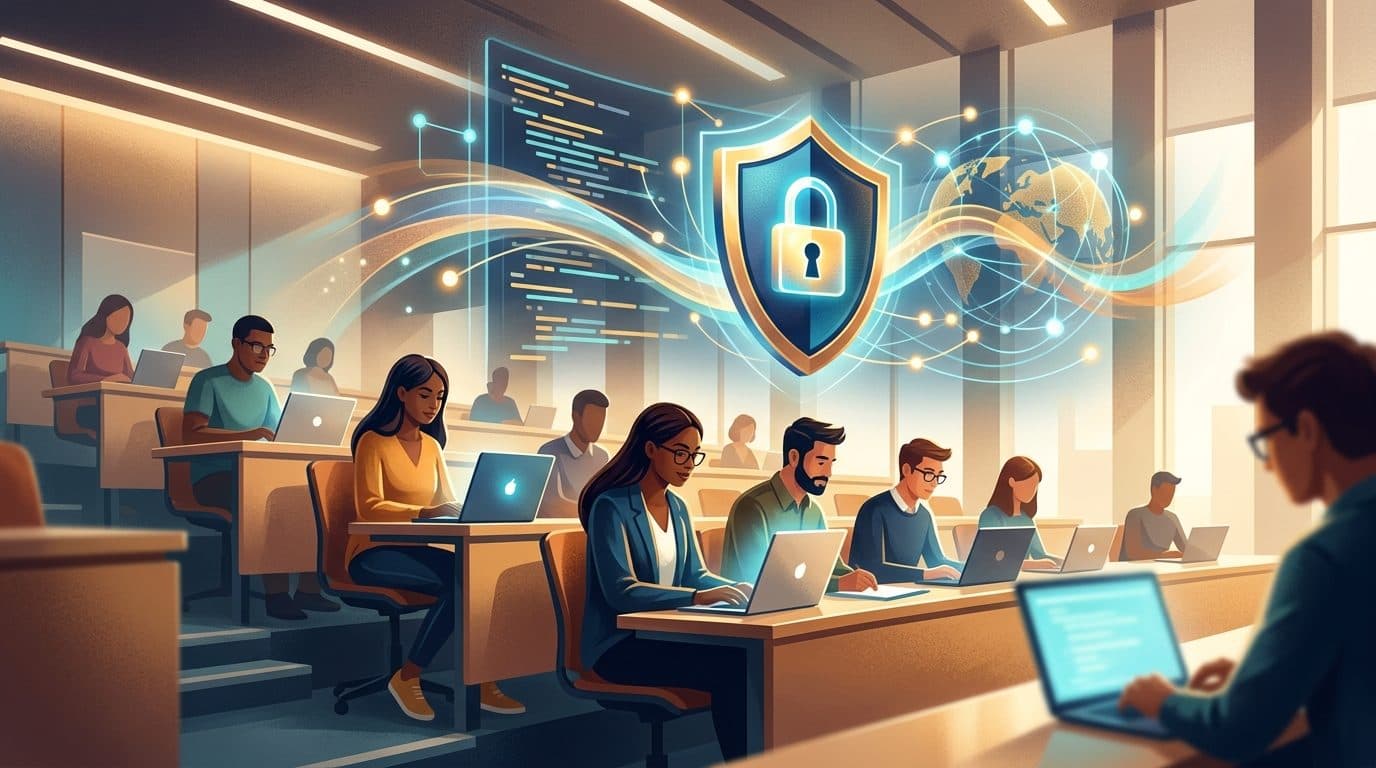
India is racing to build the cyber workforce the world will depend on, through ISEA, AICTE and the NEP. Here is how its curriculum works, why it matters globally, and how it compares with the national models of the US, UK and Israel.
Every day, organisations around the world discover they do not have enough people to defend themselves. The global shortfall of cybersecurity professionals was estimated at about 4.7 million in 2024, and no single country will close that gap alone. India, which already supplies a large share of the world's technology and IT-services workforce, is positioning its classrooms to help fill it. How well India teaches cybersecurity is therefore not only an Indian question. It is a global one.
How India builds cyber talent
India's effort runs on three tracks: a government skilling mission, a higher-education curriculum mandate, and a national education policy that pushes both.
The backbone is the Information Security Education and Awareness (ISEA) project, run by the Ministry of Electronics and Information Technology (MeitY). Launched in 2005, ISEA is now in its third phase, which began in October 2023, and works through around 50 lead and co-lead institutes to deliver role-based, hands-on courses for students, faculty and working professionals, while pushing security awareness down to the undergraduate level.
On the academic side, the All India Council for Technical Education (AICTE) published a model curriculum and a Cyber Security minor-degree framework in December 2020, alongside a cyber-security strategy for higher-education institutions. The National Education Policy (NEP) 2020 reinforces the direction, promoting multidisciplinary, skills-first learning across universities.
The gap India still has to close
The policy scaffolding is ambitious, but the output is uneven. Industry bodies FICCI and NASSCOM have reported that roughly 70 percent of graduates lack job-relevant skills, a systemic gap that hits cybersecurity especially hard because the field moves faster than most syllabi. India is also one of only six markets that ISC2 singled out as having established or fast-growing cyber staffing needs, alongside the United States, the United Kingdom, Canada, Germany and Japan, a sign of how large the demand is and how far supply still has to travel.
How other countries do it
The clearest way to judge India's approach is to set it beside the national models widely regarded as leaders.
| Country | Lead framework or programme | Starts at | Defining feature |
|---|---|---|---|
| India | ISEA (MeitY) and AICTE model curriculum | University, awareness from undergraduate level | Government skilling mission spread across many institutes |
| United States | NICE Framework (NIST) | University and workforce | A common language that defines cyber work roles for schools and employers |
| United Kingdom | NCSC-certified degrees | School, with reforms since 2014, and university | Government certification of specific degree programmes |
| Israel | Magshimim | High school, grades 10 to 12 | A national school-level training pipeline into elite cyber units |
Three differences stand out. The United States built a common language first: the NIST NICE Framework, released in 2013 and updated in 2020, defines cyber work roles so that schools, employers and learners describe skills the same way. The United Kingdom leaned on certification, with the National Cyber Security Centre certifying specific bachelor's, integrated master's and master's degrees, and reforming its school curriculum since 2014 so the pipeline starts early. Israel starts earliest of all. Its Magshimim programme, launched in 2010, trains tenth to twelfth graders over three years across 27 centres, and more than 75 percent of its graduates go on to the cyber and intelligence units of the military.
Where India stands
India's advantage is scale and reach. No other country is trying to train cyber talent across as many institutions, languages and income levels at once, and ISEA's awareness mandate spreads basic security literacy far beyond specialists. Its disadvantage is consistency. A model curriculum only matters if colleges teach it well, and the 70 percent skills gap shows many do not yet. The lesson from the United States, the United Kingdom and Israel is not that India needs a new policy. It is that a shared skills framework, employer-recognised certification and an earlier start, ideally in school, are what turn policy into a workforce.
For the world, the stakes are direct. If India trains cyber defenders well, that talent does not stay home. It staffs security operations centres, product teams and incident-response units on every continent. India's curriculum is, in a real sense, part of everyone's defence.
Sources
- Information Security Education and Awareness (ISEA), MeitY
- AICTE: Cyber Security curriculum and strategy
- NIST: National Initiative for Cybersecurity Education (NICE) Framework
- UK NCSC: Certified degrees
- Rashi Foundation: Magshimim cyber education programme (Israel)
- ISC2 2025 Cybersecurity Workforce Study