Digital Professionalism in Medicine: What AIIMS’s New Social Media Guidelines Mean for You
By a fellow future doctor, for every MBBS, MD, DM, and MCh student navigating the wards and the web
Hey batchmates,
You’re already juggling 36-hour shifts, viva prep, thesis deadlines, and that one WhatsApp group that never sleeps.
Now add another layer: your Instagram story from the OPD, the reel you shot after a tough night in casualty, or the poster your club designed for the upcoming fest.
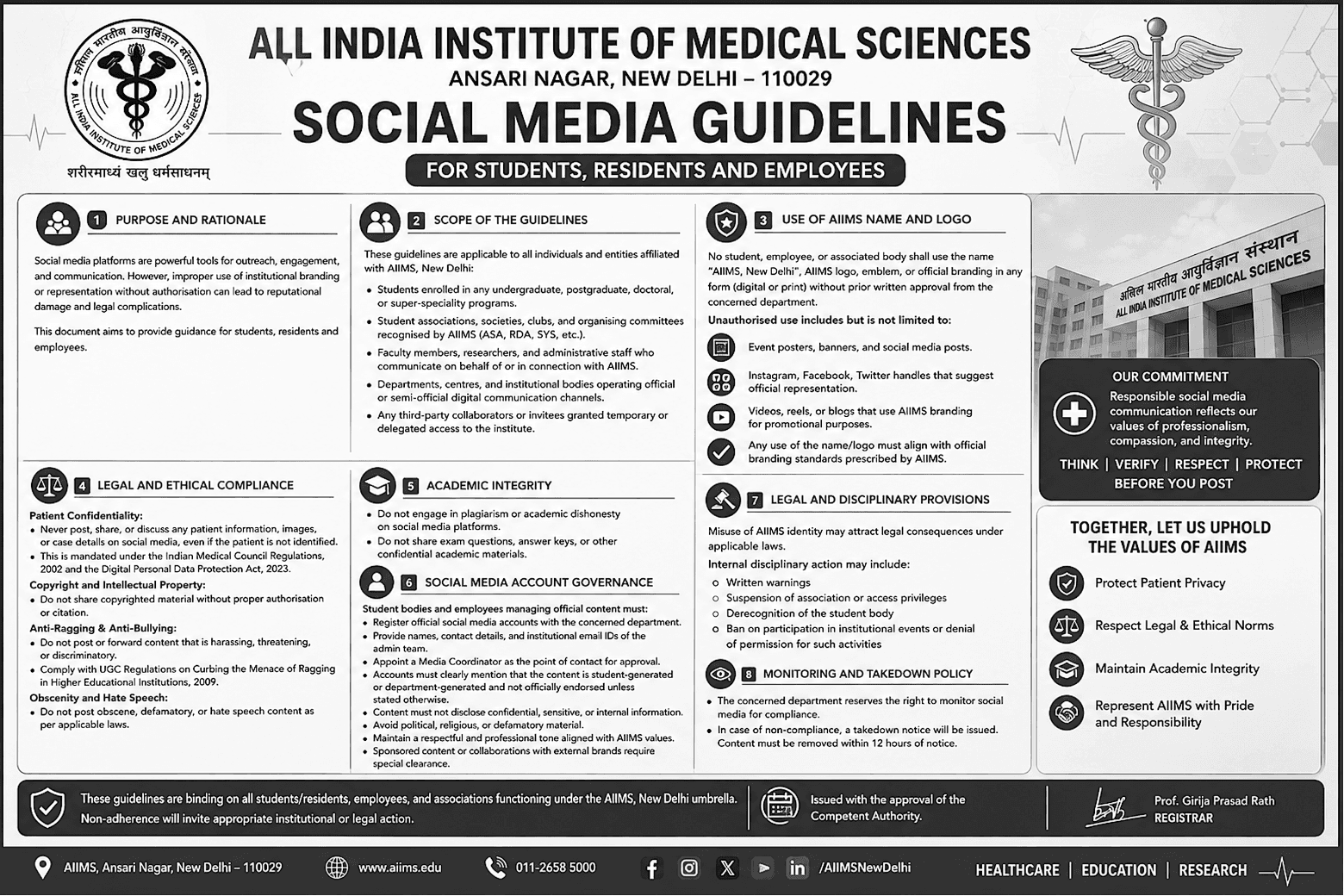
On 22 June 2026, AIIMS New Delhi released its Comprehensive Social Media Guidelines for students, residents, and employees.
These rules aren’t here to kill your vibe, they’re here to protect the one thing that actually matters in medicine: trust.
Why This Matters to You (Not Just “the Administration”)
As medical students, we live in two worlds at once:
- The clinical world, where every word and image can affect real human lives.
- The digital world, where one screenshot can travel faster than any referral letter.
The guidelines exist because social media is powerful, and power without guardrails damages patients, the institute, and ultimately your future career.
The Non-Negotiables (Read These Twice)
1. Patient Confidentiality – Non-negotiable, full stop
Never post, share, or even vaguely discuss patient information, images, or case details, even if the patient isn’t named or “looks anonymised”.
This isn’t just AIIMS policy.
It’s mandated under the Indian Medical Council Regulations, 2002 and the Digital Personal Data Protection Act, 2023.
Real talk: That “hilarious” story from the emergency room? It can identify someone.
That blurred X-ray you thought was safe? It might not be.
Future employers, medical councils, and patients themselves are watching.
Protect the trust they place in us.
2. AIIMS Name & Logo – Not Yours to Use Freely
You cannot use “AIIMS, New Delhi”, the official logo, emblem, or branding on:
- Event posters, banners, or social media posts
- Instagram, Facebook, or X handles that suggest official representation
- Reels, videos, or blogs for promotional purposes
Student associations (ASA, RDA, SYS, departmental clubs, organising committees) must now:
- Register official accounts with the concerned department
- Provide names, contact details, and institutional email IDs of admins
- Appoint a Media Coordinator as the single point of contact for content approval
- Clearly state that content is “student-generated and not officially endorsed” unless it actually is
This protects both you and the institute from misrepresentation.
3. Academic Integrity in the Age of “Leaks”
Do not share exam questions, answer keys, or confidential academic material.
Plagiarism or academic dishonesty on social platforms is explicitly prohibited.
Fairness matters, especially when you’re competing for limited seats and residencies.
4. No Toxicity, No Exceptions
- No ragging, bullying, harassing, or discriminatory content (UGC anti-ragging rules apply online too).
- No obscene, defamatory, or hate speech.
- Avoid political or religious material that could divide or defame.
- Keep a respectful, professional tone aligned with AIIMS values.
Med school is stressful enough.
Social media should be a space for support and learning, not another source of harm.
What Happens If You Slip Up?
- Written warning
- Suspension of association privileges or access
- Derecognition of your student body/club
- Ban from institutional events
- Legal consequences under applicable laws
The institute monitors compliance.
If a takedown notice is issued, content must be removed within 12 hours.
The Good News: You Can Still Shine Online
These guidelines don’t ask you to go silent.
They ask you to be intentional:
- Share evidence-based health awareness (with proper citations).
- Celebrate learning milestones without breaching privacy.
- Build professional networks (LinkedIn is perfect for this).
- Use your creativity for patient education campaigns, after getting necessary approvals for institute branding.
- Support your batchmates and juniors positively.
Responsible digital citizenship is actually a clinical skill in 2026.
Patients Google their doctors.
Residency programs and hospitals check online presence.
Your digital footprint is part of your professional CV.
Your Action Plan (Do This Today)
- Read the full official guidelines (English + Hindi versions available): https://www.aiims.edu/images/pdf/notice/Social%20Media%20Guidelines.pdf
- If you manage any club, society, or departmental account, register it and appoint a Media Coordinator now.
- Before posting anything AIIMS-related, ask: “Does this use the institute name/logo without approval?” “Does this risk patient identification?” “Would I be okay if this appeared on the front page of a newspaper or in front of the Director?”
- When in doubt, reach out to your department’s Media Coordinator or HoD before hitting “post”.
Final Word from One Med Student to Another
We chose this profession because we want to heal.
Every post we make either builds or breaks that healing power.
AIIMS has given us world-class training.
These guidelines are simply asking us to carry the same excellence into the digital space.
Let’s not just be good doctors in the wards.
Let’s be good doctors everywhere, including the spaces where the whole world can see us.
Stay curious.
Stay kind.
Stay professional.
Your future patients (and your future self) will thank you.
This article is based on the official Office Memorandum No. F.1-2/ASPT (SMG)/2026 dated 22 June 2026 issued by the Academic Section, AIIMS New Delhi. For complete and authoritative text, please refer to the official PDF linked above.