Singapore police outfit Digital Disruption Centre blocks VestoFX Trader Investment App
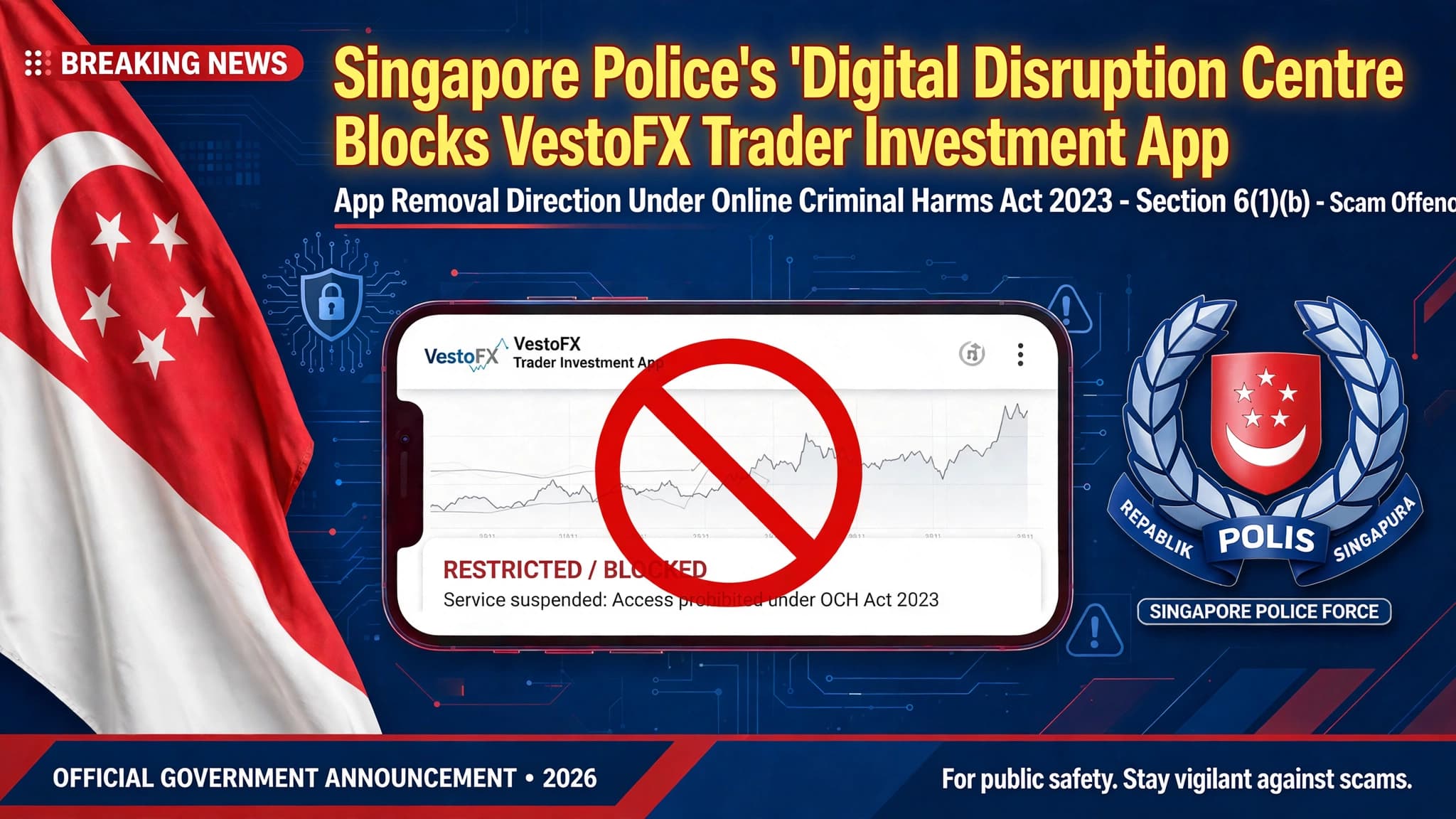
Singapore Police Force’s Digital Disruption Centre sits under the new Cyber Command, launched on 3 July 2026 at Police Cantonment Complex, and is the unit tasked with finding and taking down online threats before they reach the public—scam sites and other scam enablers, ransomware and malware, and content that is racially or religiously inflammatory—using tools such as AI-assisted detection and powers under the Online Criminal Harms Act rather than waiting for victims to report after the fact.
SINGAPORE, Sept 4 (Analysis), The most interesting thing about the letter Google LLC received on Aug 18 is at the bottom of the second page.
There is no name. There is a title: Officer-in-Charge, Digital Disruption Centre, Cyber Command, Singapore Police Force. The unit had existed, in that form, for six weeks.
Above the signature sat four pages ordering the world's largest app distribution service to stop supplying a specific Android application to anyone in Singapore by 7pm the following evening. The letter cited the section it acted under, the offence it was acting against, the penalty for ignoring it, and the two routes by which Google could challenge it. It attached photographic evidence. It ordered the evidence preserved for three months.
Takedown correspondence is not usually written this way. Across the Lumen Database, the Harvard-based archive where platforms deposit the removal demands they receive, government requests to Google run to hundreds of bulk URLs with a one-line legal assertion, or to scanned ministerial letters that argue at length and then ask politely. The Digital Disruption Centre does something narrower and harder. It builds a single instrument, aimed at a single object, that can be tested.
Where the Digital Disruption Centre came from
Singapore built the DDC out of a decade of learning that money recovery arrives too late.
The lineage starts with the Anti-Scam Centre, stood up in June 2019 with eight investigators and an arrangement with three local banks to freeze accounts fast. It worked. Since then the SPF says it has clawed back more than S$730 million for victims, and it now runs an anti-scam network of over 190 local and international partners. But recovery is downstream work. It begins after someone has already transferred their savings.
The upstream turn was announced on May 11, 2026, at the Anti-Scam Conference in Singapore, when Minister of State for Home Affairs Goh Pei Ming told delegates from more than 20 countries that the SPF would form a Cyber Command to take the fight "further upstream", proactively dismantling fraudulent sites, accounts and networks before they reach victims. It would start with roughly 200 officers and grow past 400. Police were already using artificial intelligence to identify suspected scam sites, he said, blocking around two-thirds of them.
Prime Minister Lawrence Wong toured the Command at the Police Cantonment Complex on June 26. Officers from the Anti-Scam Centre Cyber Specialist Team, the Crypto Tracing Team and the Online Disruption Team were at work; the SPF's digital disruption capabilities, which use machine learning to knock down scam websites, were among the things demonstrated. Commissioner of Police How Kwang Hwee inaugurated the Cyber Command on July 3. The Digital Disruption Centre sits inside it, and its remit, monitoring and removing online threats from scams and ransomware through to content inciting racial or religious hostility, is broader than scams alone.
Crafting the letter
The Aug 18 letter, reference OCHA/ASC/20260818/5001, shows the method.
It is an App Removal Direction issued under section 6(1)(b) read with section 12 of the Online Criminal Harms Act 2023. The offence is named, not gestured at: cheating and dishonestly inducing a delivery of property, section 420 of the Penal Code 1871. The target is named to the package level, com.vestofx.mobile.app, listed as VestoFX Trader, with the storefront URL reproduced in full, so there is no argument about what was ordered removed.

As per the notice, the app was used to perpetrate scams in which victims were asked for repeated payments toward investments on fake platforms. Under OCHA's scam provisions the threshold is suspicion, and the DDC does not pretend otherwise; the letter says "suspicion or reason to believe" and moves on.
Then the operative parts, each with a section number attached:
- Order. Stop distributing to Singapore persons, and stop enabling Singapore persons to download, by 7pm (GMT+8) on Aug 19. "Singapore person" is defined in a footnote by reference to section 2(1).
- Preservation. Under section 13(4)(b), keep information about the matters covered until Nov 18, three months, and notify the Anti-Scam Command by email once compliant. Evidence survives the takedown, which is what makes prosecution and mutual legal assistance possible later.
- Penalty. Non-compliance without reasonable excuse is an offence under section 50(5), punishable under section 50(8).
- Challenge. Reconsideration by a designated officer under section 16(1), within 30 days, via a published form. Then appeal to the Reviewing Tribunal under section 18(1), but only after reconsideration.
- Candour. Neither route suspends the direction. It stands until cancelled under section 14(1), substituted under section 17(1), or cancelled by the Tribunal under section 41(3).
What the annex proves
The evidentiary annex is where the DDC's investigators show their working, and it goes further than a compliance officer would expect.
The first screenshot is the live Play listing: category Finance, rated 18+, 100-plus downloads, last updated July 1, 2026. The developer block reads FAIRMONT FINANCIAL SERVICES (PTY) LTD, 5 Fagan St, Somerset West 7130, South Africa, with a telephone number beginning +357, the country code for Cyprus, and a support line in South Africa.

The second screenshot is the one that does the work. It shows the app's own privacy policy link, the one Google Play requires every developer to provide and keep reachable, returning a block page: the site is unavailable because it contains prohibited material, with a pointer to the Infocomm Media Development Authority's content standards.
Read the two together and the DDC has proved something a generic scam allegation cannot. At the moment Google Play was distributing this app into Singapore, the mandatory privacy policy the listing carried was unreachable from Singapore, because the domain hosting it had already been blocked in the country as prohibited material. The distributor's own storefront rules had failed, and the failure was visible from the outside, in one screenshot, to anyone who bothered to click.