Four Chinese Nationals Arrested in Nairobi Over SIM-Swapping and Money-Laundering Scheme
Recent months have also seen several cases involving Chinese nationals arrested in Kenya on cyber-related charges. In July 2026, detectives arrested 18 Chinese nationals in a Kilimani apartment described as a suspected cyber fraud workstation, recovering phones, passports and cash.
Four Chinese Nationals Arrested in Nairobi Over SIM-Swapping and Money-Laundering Scheme
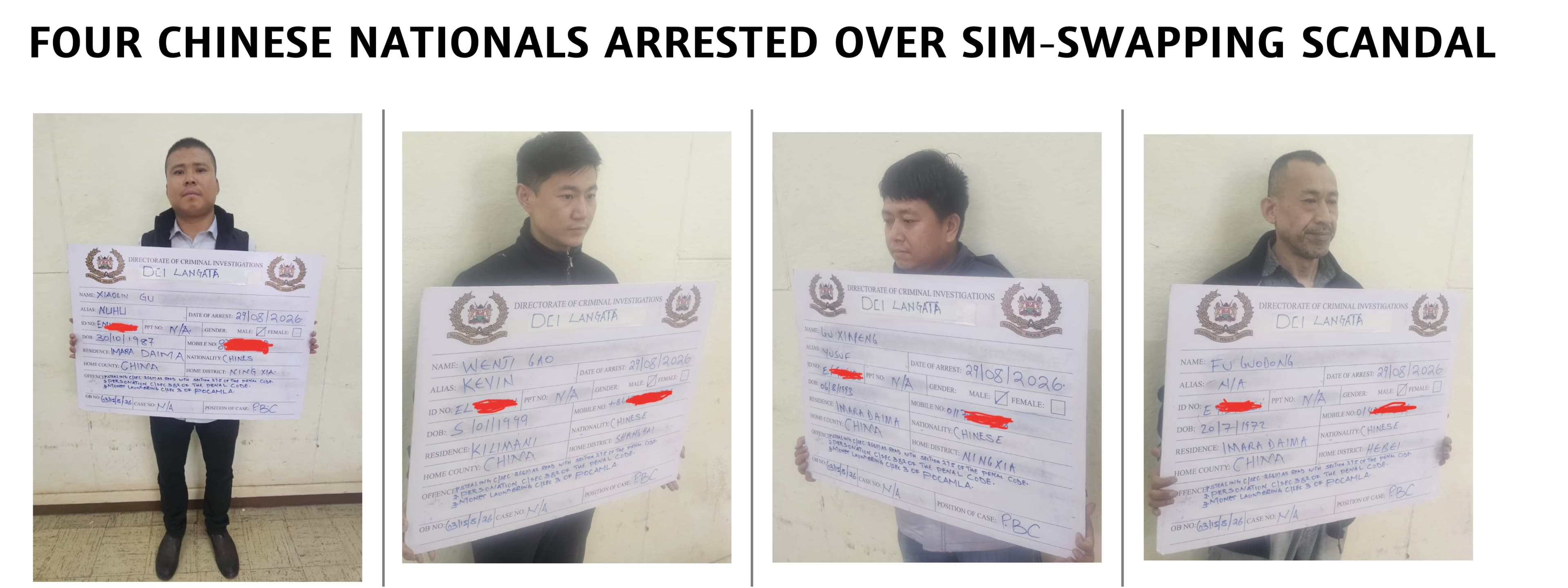
The Directorate of Criminal Investigations (DCI) has arrested four Chinese nationals in Nairobi after a businesswoman reported that her mobile lines had suddenly stopped working. Detectives say the lines were used to receive funds from a gaming and betting platform before the money was moved through other accounts linked to the suspects.
The four men, Xiaoling Gu, Guodong Fu, Wenji Gao and Gu Xiaopeng, were arrested following investigations launched by DCI Parklands detectives. The complainant discovered she could no longer make calls or access M-Pesa services on two Safaricom lines. She reported the incident, prompting officers to trace the activity. Detectives established that the lines had received money from a betting platform and that the funds were then transferred through mobile numbers and bank accounts connected to the suspects.

Following the arrests, officers searched premises linked to the suspects and recovered 15 Safaricom SIM cards and nine Airtel SIM cards registered under different names, six SIM cards belonging to foreign nationals, six mobile phones, laptops, three ATM cards belonging to different account holders, and KSh 1,125,800 in cash. The suspects were arraigned on 1 September 2026 before the Kibra Chief Magistrate’s Court on charges including stealing, personation and money laundering. They remain in custody pending a ruling on their bond application scheduled for 4 September 2026. Detectives say they are still following the money trail and looking for additional suspects.
The case occurs against a backdrop of rising SIM-swap incidents in Kenya. An Interpol African Cyberthreat Assessment Report cited in local coverage recorded a 327 per cent increase in SIM-swap fraud investigations in 2025, involving more than 123,000 fraudulent SIM cards and an estimated USD 3.8 million (about KSh 492 million) taken from mobile wallets. Kenya has been flagged as having notable digital vulnerabilities in mobile money systems.
Recent months have also seen several cases involving Chinese nationals arrested in Kenya on cyber-related charges. In July 2026, detectives arrested 18 Chinese nationals in a Kilimani apartment described as a suspected cyber fraud workstation, recovering phones, passports and cash. Similar operations have been reported in other African countries as some transnational groups shift activity from Southeast Asia. These incidents have prompted closer coordination between Kenyan police and Chinese authorities in some cases.
To address this type of fraud, authorities and operators need stronger, consistently enforced Know Your Customer (KYC) rules for SIM registration and replacement, real-time identity verification between telecom companies and banks, faster reporting channels for sudden loss of service, and tighter information-sharing between Kenyan agencies, Interpol and counterpart authorities in China. Improved public alerts about unexpected network outages and clearer liability rules for operators when basic safeguards fail would also help reduce the scale of losses.