Pakistan nabs 110 Suspects in Transnational Invsetment Scam, 11 of them foreign nationals
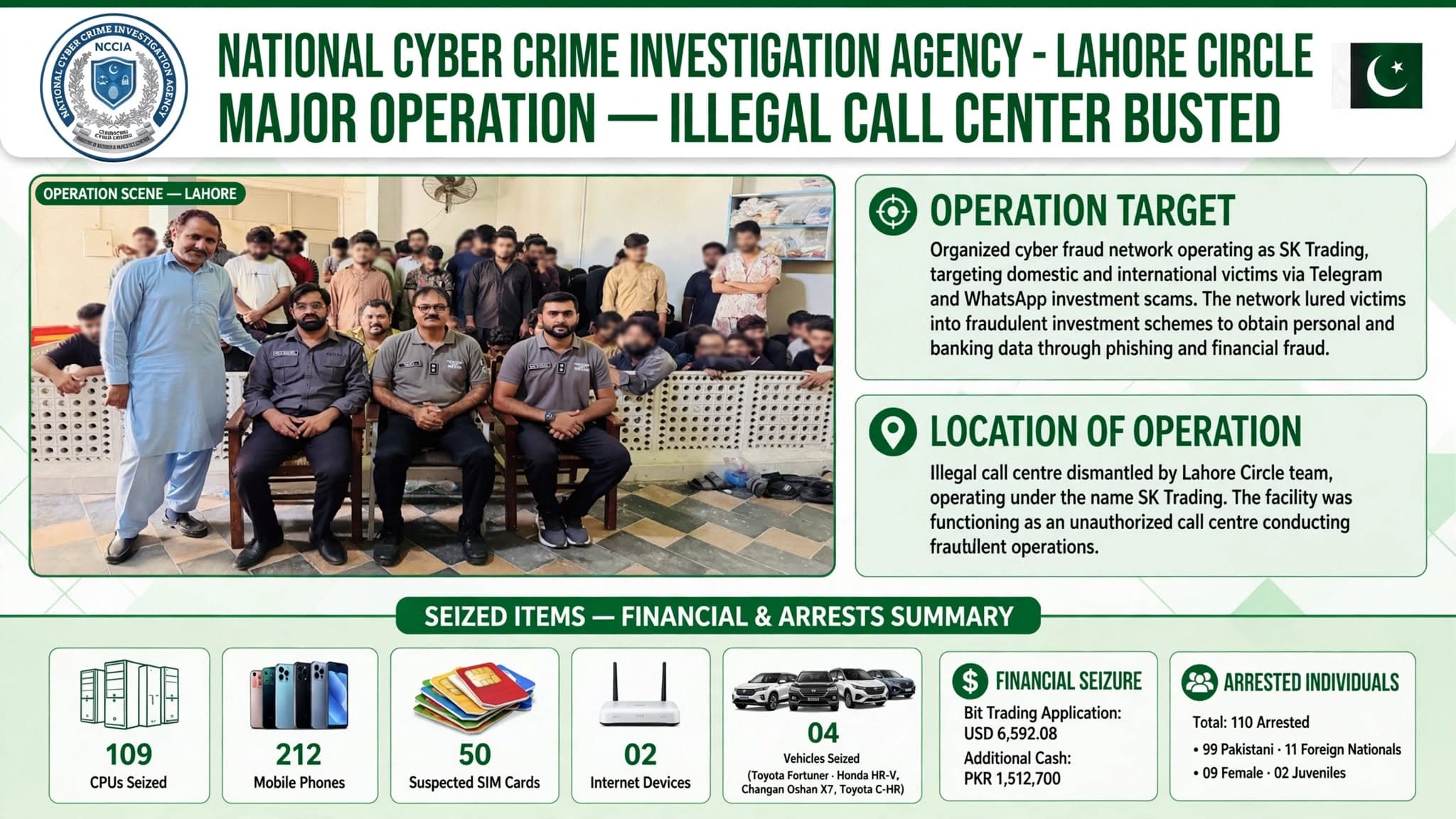
Pakistan’s NCCIA Lahore arrested 110 people (99 Pakistani, 11 foreign - 9 men & 2 women) in a Telegram/WhatsApp investment call-centre raid on SK Trading, seizing 109 CPUs, 212 phones, vehicles, and suspected proceeds. The bust lands amid Cambodia’s scam-compound crackdown — and raises hard questions about whether Pakistan is becoming a relocation hub for transnational fraud floors.
Pakistan’s National Cyber Crime Investigation Agency (NCCIA) Lahore Circle has arrested 110 people after raiding an illegal call-centre network operating as “SK Trading.”
Officials say the group targeted domestic and international victims with fraudulent investment schemes on Telegram and WhatsApp.
Of those held, 99 were Pakistani nationals and 11 were foreigners.
NCCIA says the head of the setup tried to flee and was later arrested at another location.
Seizure
- 109 CPUs
- 212 mobile phones
- 50 suspected SIM cards
- 2 internet devices
- 4 vehicles: Toyota Fortuner, Honda HR-V, Changan Oshan X7, Toyota C-HR
- Bit Trading application showing USD 6,592.08
- PKR 1,512,700 in suspected proceeds of crime
- Digital evidence from the floor
Investigation Officer who led the operation was SI Nabeel Hussain of NCCIA Lahore.
Cambodia’s crackdown, and where the industry goes next
For years, Southeast Asia’s mega-compounds, especially in Cambodia, were the public face of industrial online fraud: fake investment desks, romance and “pig-butchering” pipelines, and transnational call-centre floors often linked to Chinese-led criminal networks.
Under pressure from China and other partners, Phnom Penh has pushed a high-visibility crackdown through 2025–2026, including mass raids such as the January 2026 Bavet operation that detained more than 2,000 foreigners (nearly 1,800 from mainland China).
Cambodian officials have claimed large compounds are under control or gone; investigators and rights groups counter that networks simply decentralise into apartments, guesthouses, shophouses, and smaller urban cells.
That pressure does not erase the scam economy.
It relocates it.
When fortified compounds become politically expensive, operators hunt cheaper labour, weaker oversight, chat-app distribution that needs no casino façade, and jurisdictions where “trading company” fronts can rent office floors and SIM stockpiles with less heat.
Is Pakistan becoming a global scam hub?
Lahore’s SK Trading raid sits in a worrying pattern: large call-centre floors, mixed Pakistani and foreign crews, Telegram/WhatsApp investment bait, and recoveries that look like scaled fraud infrastructure rather than street-level theft.
Similar NCCIA actions elsewhere in Pakistan have also pulled foreign nationals, majorly chinese origin out of loan-app and investment-fraud floors.
That combination, English-speaking operators, cheap connectivity, encrypted chat channels that reach victims worldwide, and corporate-style fronts, is exactly what displaced compound managers look for when Cambodia and neighbouring zones tighten.
If enforcement stays reactive while recruiters keep importing talent and SIMs keep arriving in bulk, Pakistan risks becoming a preferred relocation node for the same transnational fraud industry that outgrew Cambodia’s compounds.
Sustained disruption, not one-off headlines, is what separates a transit stop from a hub.
Why it matters
Telegram-based investment scams do not need a casino compound to steal internationally.
They need desks, phones, scripts, and a place to park.
NCCIA’s Lahore strike shows Pakistan is already on that map.
Whether it becomes a destination or a dead end depends on how hard and how fast the next floors are shut.