“Intelligence-as-a-Service”: The Corporate Insider Threat Fueling Cybercriminals
A new report from the UN Office on Drugs and Crime (UNODC) reveals how transnational organized crime is commodifying corporate and government data, turning rogue employees into critical nodes in the global cybercrime ecosystem.
When corporate security professionals think of the "insider threat," they typically picture a disgruntled employee exfiltrating proprietary code, or a negligent clerk falling for a basic phishing email. However, a recent landmark threat assessment by the United Nations Office on Drugs and Crime (UNODC) reveals a far more systemic and sinister evolution: the deliberate recruitment of corporate insiders and corrupt officials to fuel transnational organized crime.
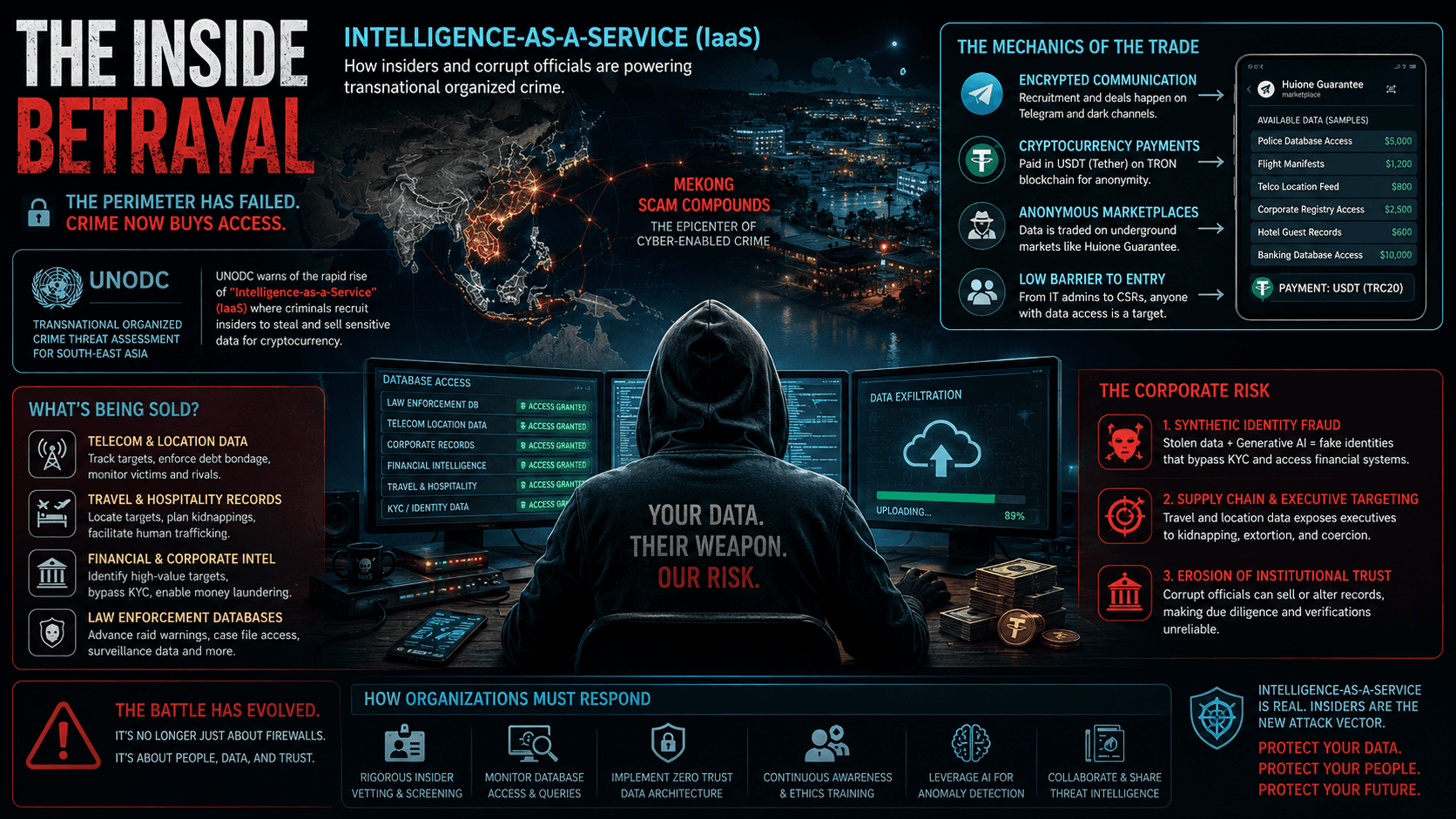
The UNODC’s Transnational Organized Crime Threat Assessment for South-East Asia highlights the rapid emergence of "Intelligence-as-a-Service" (IaaS). In this model, data brokers and corrupt insiders are actively recruited to sell surveillance data, corporate records, flight manifests, telecom location data, and access to law enforcement databases to criminal syndicates in exchange for cryptocurrency.
For Chief Information Security Officers (CISOs), risk managers, and compliance officers, the message is stark: the perimeter has failed. Organized crime is no longer just hacking systems from the outside; they are buying legitimate access from within.
The Commodification of Corporate and State Data
The UNODC report underscores how cyber-enabled fraud ecosystems, particularly the massive scam compounds operating out of the Mekong region, rely on a continuous stream of compromised data. Operating primarily on encrypted messaging platforms like Telegram and underground marketplaces such as the now-infamous Huione Guarantee, criminal networks are openly purchasing access to datasets that were previously thought to be highly secure.
Recruitment advertisements explicitly seek what criminals call “friends in government” or insiders with access to specific databases. But the threat extends well beyond government bureaucrats. The data being traded includes:
- Telecom and Location Data: Phone-location information used to track high-value targets, enforce debt bondage, and monitor the movements of potential victims or rival actors.
- Hospitality and Travel Records: Hotel records and flight manifests used to locate targets for kidnapping, extortion, or to facilitate the logistics of human trafficking across borders.
- Financial and Corporate Intelligence: Access to banking databases and corporate registries used to identify lucrative targets for investment fraud, bypass Know Your Customer (KYC) protocols, and facilitate money laundering.
- Law Enforcement Databases: Perhaps most alarmingly, criminals are purchasing advance warning of pending raids, case file access, and surveillance data, allowing scam compounds to disperse personnel and relocate operations before authorities arrive.
The Mechanics of the Trade
The IaaS economy is facilitated by the same technological innovations that have legitimized remote work: encrypted communications, decentralized finance, and anonymous marketplaces.
Transactions are settled almost exclusively in cryptocurrency, with the USDT (Tether) stablecoin on the TRON blockchain being the dominant medium of exchange. This allows insiders to receive payments pseudonymously, bypassing traditional financial institution controls and anti-money laundering (AML) reporting thresholds.
Furthermore, the barrier to entry for insider participation has lowered. As the UNODC notes, criminals are not just looking for IT administrators; they are targeting customer service representatives, hospitality staff, low-level compliance officers, and contractors, anyone with access to data that can be monetized.
The Corporate Risk: Beyond Data Exfiltration
For corporations operating in or adjacent to high-risk regions, the IaaS model presents a multifaceted threat that standard cybersecurity protocols are ill-equipped to handle.
1. The Facilitation of Deepfake and Synthetic Identity Fraud Criminals are combining stolen corporate data with Generative AI to bypass corporate KYC frameworks. By purchasing identity documents and facial biometric data from insiders, syndicates can create synthetic identities that fool financial institutions, open corporate bank accounts, and legitimize fraudulent transactions. The UNODC documented cases where malware was used to harvest facial biometric data from mobile devices, which was then used to bypass bank authentication systems.
2. Supply Chain and Executive Targeting When corporate travel itineraries and location data are sold on criminal marketplaces, corporate executives and high-net-worth individuals become physical targets. The UNODC report details how syndicates use this data to orchestrate kidnappings, extort ransoms, and coerce individuals into participating in scam operations.
3. Erosion of Institutional Trust The commercialization of law enforcement and government data means that corporate compliance teams can no longer implicitly trust state-issued verifications or background checks in certain jurisdictions. If a criminal syndicate can buy a clean police clearance or alter a corporate registry via a corrupt official, standard due diligence processes become obsolete.
The UNODC’s findings make it clear that transnational organized crime has industrialized the theft and sale of insider data. Intelligence-as-a-Service is not a future threat; it is a current operational reality that is directly enabling billions of dollars in fraud, human trafficking, and physical violence.
For the corporate sector, the implication is profound. The battle against cybercrime is no longer fought solely at the firewall. It is fought in the vetting of employees, the monitoring of database queries, and the rigorous protection of data that, in the hands of a criminal syndicate, becomes a weapon of mass deception.