Instagram Removed 1.7 Million Child-Abuse Posts — Then Approved Ads Selling It
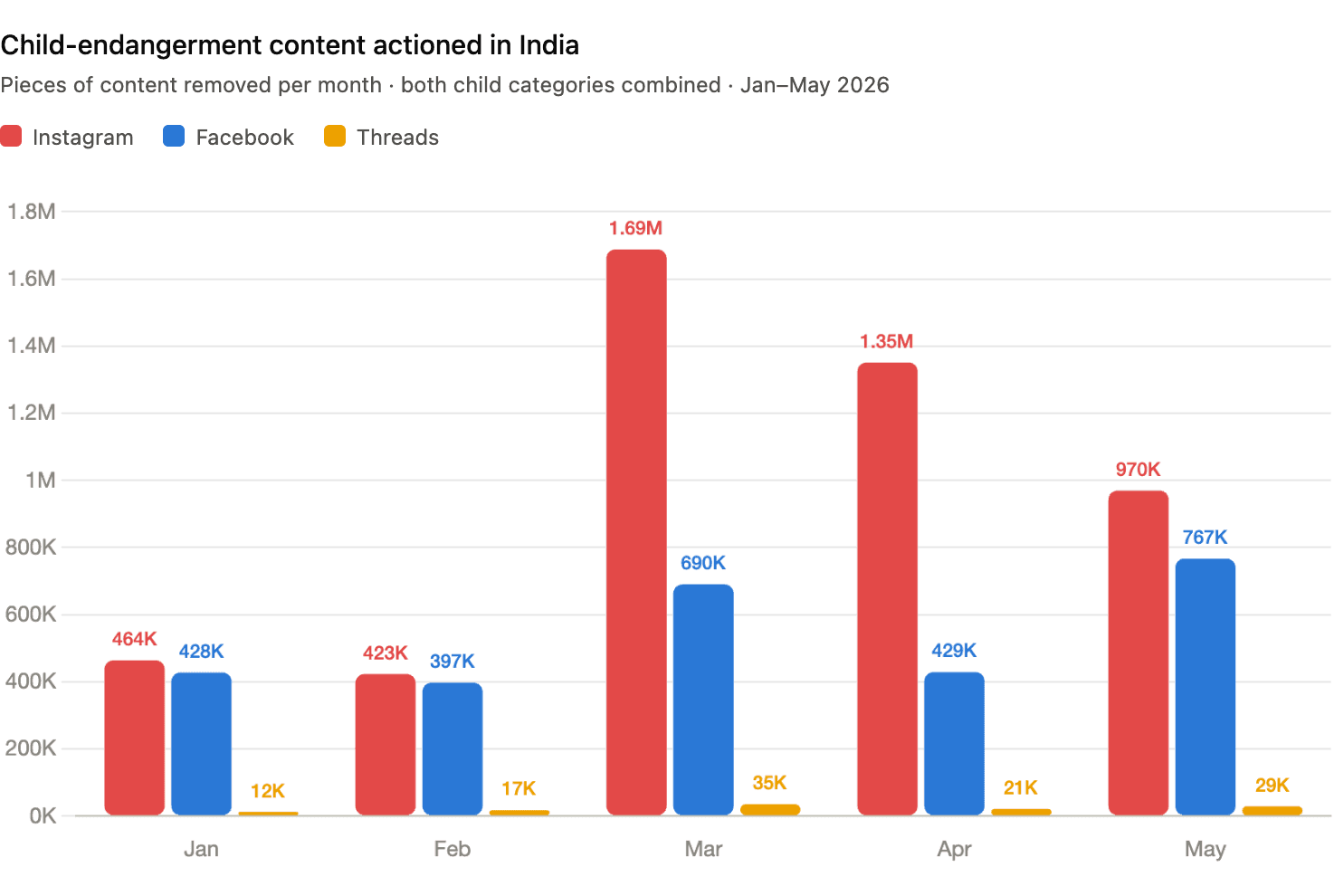
Meta removed nearly 1.7 million pieces of child-endangerment content from Instagram in India in a single month — then approved ads promoting it
Meta's monthly transparency filings show a dramatic surge in child-endangerment enforcement on Instagram in India this spring, peaking at almost 1.7 million pieces of content actioned in March 2026. The figures, published under India's IT Rules, land alongside a BBC investigation that found Instagram approving and displaying paid advertisements promoting child sexual abuse material to Indian users, a failure in the very pipeline the enforcement numbers are meant to reassure regulators about.
On this page
At a glance
What the BBC found
A BBC Eye investigation found that Instagram approved and displayed paid advertisements promoting child sexual abuse material (CSAM) to users in India, raising fresh questions about Meta's advertising-moderation systems. The ads used explicit terms such as "rape video" and "child video" and directed users to Telegram channels where illegal content was reportedly sold for as little as 99 rupees, roughly one US dollar. Around 30 unique advertisements promoting such material appeared over the course of the investigation, alongside roughly 20 featuring adult pornography.
The material surfaced through the platform's own recommendation behaviour rather than any search. The BBC created an alias Instagram account in India after noticing the platform had begun recommending sexually suggestive content despite the user never searching for it. Most damning was the response through official channels: when the BBC reported one advertisement directly to Instagram, the platform responded roughly 24 hours later stating it did not violate community guidelines. Only after the BBC approached Meta for formal comment did the company say it had disabled several advertisements, suspended the accounts responsible, removed additional adverts and blocked URLs linked to violating content.
The enforcement surge Meta reports
Across five monthly reports covering content created from January through May 2026, Meta records large and rising volumes of child-endangerment removals in India, spanning two categories, "Nudity and Physical Abuse" and "Sexual Exploitation." Combined, the totals are stark, and Instagram dominates.
| Month (content created) | Threads | ||
|---|---|---|---|
| January | ~427.7K | ~463.9K | ~12.3K |
| February | ~397.0K | ~423.1K | ~17.4K |
| March | ~690.1K | ~1.69M | ~35.1K |
| April | ~428.7K | ~1.35M | ~20.9K |
| May | ~766.9K | ~969.5K | ~29.1K |

Figure: Child-endangerment content actioned by Meta in India, January–May 2026. Source: Meta India Monthly Reports under the IT Rules, 2021.
The spike is almost entirely driven by Instagram's Sexual Exploitation category alone, which jumped from around 254,500 pieces in February to roughly 1.4 million in March and 1.1 million in April. Meta reports catching nearly all of it proactively, a self-reported detection rate of 98.7% or higher across the period.
The two-pipeline gap
That is the uncomfortable juxtaposition. The transparency figures measure organic posts, photos, videos and comments removed under Community Standards. The BBC's findings concern paid advertising, a separate channel that is supposed to be reviewed before an ad ever goes live. A near-perfect proactive rate on one pipeline does not describe what is slipping through the other.
Meta's response
Meta conceded the failure while rejecting the framing. On the advertisement that was initially left up, the company said "no system is perfect, and our review process may not detect all policy violations," adding that it runs proactive detection technology on ads once they are live. In a separate statement it called child exploitation "a horrific crime" that it works aggressively to fight, and described as "categorically inaccurate" any suggestion that it knowingly targeted adverts featuring children at users with an inappropriate interest in such material. Meta said it reports apparent cases to the US-based National Center for Missing and Exploited Children as required by law, and noted it had automatically disabled more than four million accounts in 2025 for signals of suspicious behaviour.
Not everything was cleaned up. Of two Telegram channels the BBC found selling the material, one was taken down while the other continued posting new content. Telegram said it had removed more than 274,000 groups and channels linked to such material in 2026.
CSEAM: a growing global concern
The BBC's findings sit within a problem that international bodies have flagged as escalating. Child sexual exploitation and abuse material (CSEAM) has expanded alongside internet access itself, and the reported volumes, already substantial, are still growing, according to a UNODC background paper prepared for a 2023 expert meeting in Vienna on removing such material. That paper notes the scale of the trend through NCMEC's CyberTipline, which received around 415,650 CSAM reports in 2012 and roughly 32 million a decade later, containing some 88 million individual files. UNODC has separately warned of the "growing threat" posed by self-generated material, in which children are coerced or manipulated into producing content that is then circulated and exploited, and its Trafficking in Persons reporting has tracked a rising share of children among detected victims. The broader UN picture is starker still: a UN Special Rapporteur estimated in a 2024 report to the General Assembly that more than 300 million children a year are affected by online sexual abuse and exploitation, warning that emerging tools, deepfakes, "nudifying" software, AI generation and voice cloning, are amplifying the ways offenders produce such material. Against that backdrop, the gap the BBC identified in Instagram's ad pipeline is not an isolated glitch but a live instance of a threat the UN has urged technology companies to confront through stronger age verification, child-safe moderation and clearer referral pathways.
Why transparency reporting matters
The episode is also a case study in why mandatory transparency reporting matters. Without India's IT Rules, none of the underlying enforcement figures would be public: the rules require platforms above a user threshold to publish monthly accounts of what they removed, how much of it they caught proactively, how many user grievances they received, and how they handled orders from the Grievance Appellate Committee. That disclosure is what makes the current contradiction legible. It is only because Meta must publish its Instagram child-exploitation numbers that its claimed 98%-plus proactive-detection rate can be set against a documented case of a reported advertisement being cleared by human review, a juxtaposition the company would otherwise never have to reconcile in public.
Transparency data does not fix moderation gaps on its own, and it carries real caveats: Meta itself describes the figures as directional "best estimates," notes that country-level attribution is unreliable because bad actors mask their location, and flags a technical issue affecting its per-category grievance breakdowns. But even imperfect, recurring, comparable numbers do three things a one-off scandal cannot. They establish a baseline, so a sudden swing, such as Instagram's roughly six-fold jump in exploitation removals between February and April, becomes visible and demands explanation. They create an accountability trail, giving regulators, journalists and child-safety organisations a documented record to question rather than a corporate assurance to accept. And they expose the seams between systems: the reports cover organic content, so the BBC's finding that the advertising pipeline was failing highlights precisely the blind spot that aggregate removal statistics leave unlit, a gap that is itself a finding worth acting on.
Why other countries should require the same
India is not alone in mandating this kind of disclosure, the European Union's Digital Services Act imposes comparable transparency and risk-assessment duties on large platforms, but much of the world still relies on whatever companies choose to publish voluntarily. The case for wider adoption is straightforward. CSEAM is a borderless problem: the ads the BBC found in India pointed to Telegram channels that could be accessed from anywhere, and the same recommendation systems and ad-review pipelines operate globally. A platform that under-detects harmful advertising in one market is very likely doing so in others where no reporting regime exists to reveal it.
Mandatory, standardised reporting would let regulators compare enforcement across jurisdictions, spot where a platform's proactive-detection rates or grievance-resolution figures lag, and identify the categories, such as paid advertising, that aggregate content-removal numbers tend to obscure. It would also create pressure toward consistency: companies that must answer for their numbers in India or the EU have an incentive to raise their standards everywhere rather than maintain a patchwork of protections that depends on which government happens to be watching. International bodies have made the same point in principle. The UN Special Rapporteur's 2024 recommendations called on states to strengthen legal frameworks and establish national mechanisms for regulatory oversight of online child safety, and on companies to adopt child-safe content moderation and clearer referral pathways, obligations that are far easier to verify, and to enforce, when platforms are required to report against them on a regular, public schedule. Transparency is not a substitute for effective moderation. But as India's reports have just demonstrated, it is often the mechanism that reveals when moderation is failing, and reveals it in time to demand a fix.
Regulatory fallout
The Indian government has moved quickly. The Ministry of Electronics and Information Technology has been directed to summon Meta, with IT Minister Ashwini Vaishnaw asking officials to seek an explanation over the findings, adding to existing friction, as Meta was already under scrutiny over a separate WhatsApp feature issue.
The scale of the underlying problem is significant: India received 1.9 million tipline reports in 2025 through NCMEC's system, second only to the United States. Former Facebook executive Brian Boland, who helped build the company's advertising business before leaving in 2020, told the BBC he was "horrified and unsurprised," warning that recommendation systems built to maximise engagement can amplify increasingly extreme content without stronger safeguards.
Meta describes its monthly metrics as "best estimates." The spring surge in its own numbers, and the ads the BBC found running through the gap, are a reminder that those estimates capture what the company caught, not what it missed.
Frequently asked questions
What did the BBC investigation find? That Instagram approved and displayed paid advertisements promoting child sexual abuse material to users in India, and that a reported ad was cleared by human review as not violating guidelines. Roughly 30 such ads ran, linking to Telegram channels selling illegal content for about ₹99 (US$1).
What is CSEAM? Child sexual exploitation and abuse material. It is a global problem the UN describes as escalating, with NCMEC's CyberTipline reports rising from about 415,650 in 2012 to roughly 32 million a decade later.
How does this square with Meta's 98%+ detection rate? That rate covers organic content (posts, photos, videos, comments). The BBC's findings concern paid advertising, a separate pipeline the transparency numbers do not measure. A high proactive rate on one does not describe what slips through the other.
What did Meta say? That "no system is perfect," that it runs proactive detection on live ads, that it reports cases to NCMEC as required, and that it disabled more than four million accounts in 2025. It called the idea it knowingly targeted such ads "categorically inaccurate."
What is the Indian government doing? MeitY has been directed to summon Meta, with IT Minister Ashwini Vaishnaw seeking an explanation, on top of separate existing scrutiny of a WhatsApp feature.
Sources
- Meta India Monthly Reports under the Information Technology (Intermediary Guidelines and Digital Media Ethics Code) Rules, 2021 (content created January–May 2026).
- BBC Eye investigation into Instagram advertising and CSAM in India (refer to the original BBC report for full findings).
- UNODC background paper on removing online child sexual abuse material (2023 Vienna expert meeting); UNODC reporting on self-generated material and trafficking in persons.
- NCMEC CyberTipline report volumes.
- UN Special Rapporteur on the sale and sexual exploitation of children, 2024 report to the UN General Assembly.
- European Union Digital Services Act (transparency and risk-assessment duties for very large online platforms).
Enforcement, grievance and GAC figures are drawn from Meta's India Monthly Reports under the IT Rules, 2021, covering content created January–May 2026. Details of the BBC Eye investigation are as reported by the BBC and corroborating coverage; readers should refer to the original BBC report for its full findings.