Timor-Leste Raids Expose Growing Transnational Cyber-Fraud Network: Hundreds of Foreigners Detained as Scam Centers Relocate
Prime Minister Kay Rala Xanana Gusmão said on Thursday that the Government will apply a zero-tolerance policy towards illegal online activities to protect national security and Timor-Leste's reputation. The government is now fast-tracking a cybersecurity package, including a new criminal code for digital crimes, blocking powers, and digital evidence rules. Between raids, police are working with community leaders for intelligence — the same method that led to the Comoro and Bazartete raids.
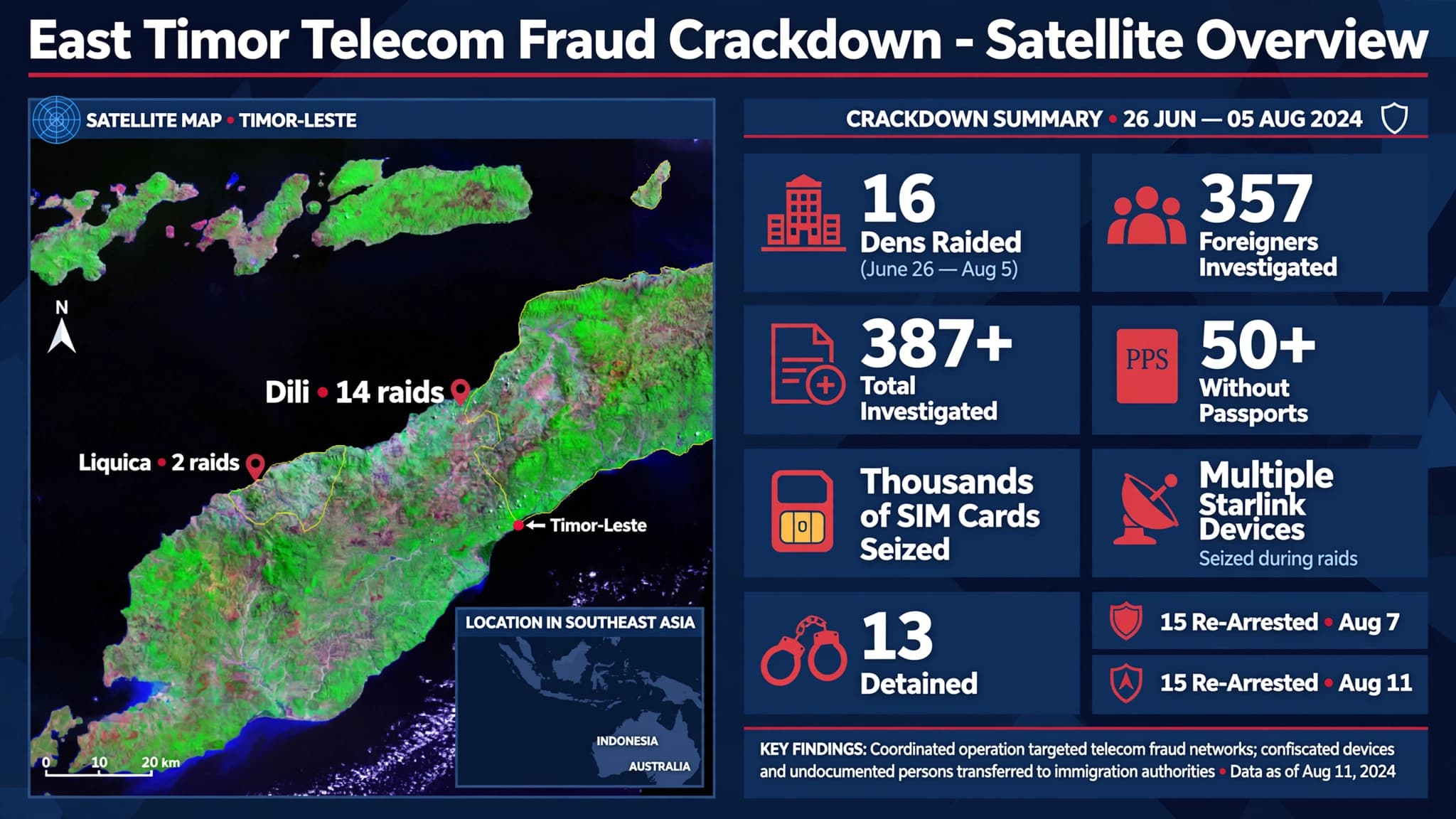
DILI, Timor-Leste, Timor-Leste’s national police have dismantled at least 16 alleged online fraud and illegal gambling dens in a sustained crackdown, detaining hundreds of foreign nationals who entered the country largely on tourist visas and operated from ordinary residential and office buildings using satellite internet and thousands of SIM cards.
According to official figures released by the National Police of Timor-Leste (PNTL), between 26 June and 5 August 2026 authorities dismantled 16 facilities, 14 in the capital Dili and two in Liquiça municipality, and detained 357 foreign citizens from China, Indonesia, the Philippines, Vietnam, Cambodia, Myanmar, India and Japan. Thirteen of those detainees were ordered into pretrial detention at Becora prison; the majority of the others were placed under judicial measures including periodic reporting, travel bans and bail.
Subsequent operations continued the pressure. On the evening of 11 August, police raided three locations in Dili’s Santa Cruz, Bebonuk and Vila Verde areas, detaining 15 more foreigners, including two women, and seizing computers, mobile phones and network equipment. Combined with earlier August detentions, the cumulative figure of foreigners checked in connection with the operations stood at least at 387 by mid-August.
Tourist Visas, Confiscated Passports and Everyday Locations
Investigators found that the majority of those detained had entered Timor-Leste on tourist visas before moving into rented houses or offices that were quietly converted into operational centres. In multiple sites, more than 50 people were found without their passports on them, a pattern consistent with organised control of workers’ documents by higher-level operators.

The dens were not always large, fortified compounds. Many operated inside ordinary residential buildings or commercial spaces. One local landlord later told authorities that the Chinese tenants who rented his property claimed they were in Dili to help build a new conference centre. Only after police contacted him and showed him the interior did he learn the true purpose of the occupancy.
Police also seized large quantities of equipment: hundreds of computers and laptops, thousands of SIM cards, and multiple Starlink satellite terminals. The satellite internet devices were critical in a country with limited and relatively slow terrestrial connectivity, allowing the operations to maintain reliable links for voice and data communications used in fraud and online gambling schemes.
A Regional Shift in Transnational Organised Crime
The Timor-Leste raids form part of a wider regional pattern. After successive crackdowns in Cambodia, Myanmar and Laos, organised cyber-fraud networks have sought new jurisdictions with weaker regulatory frameworks and developing law-enforcement capacity. The United Nations Office on Drugs and Crime (UNODC) had already flagged the risk of such infiltration in Timor-Leste’s Oecusse-Ambeno special administrative region as early as September 2025, noting the use of foreign investment vehicles and the characteristic presence of Starlink terminals and bulk SIM cards at suspected sites.
Earlier operations in 2025 and the first half of 2026 had already netted hundreds of foreign suspects in Oecusse, Dili neighbourhoods including Colmera, Manleuana, Metiaut, Bebonuk and elsewhere, as well as in Liquiça. Many of those detained face investigations for cyber fraud, illegal online gaming, money laundering and criminal association. Some workers are themselves potentially victims of trafficking or deception, a distinction authorities say will be clarified through ongoing investigations.
Government Response and the Stakes for Timor-Leste
Timor-Leste’s government has responded with both operational pressure and policy measures. In early August it approved an Integrated National Plan for 2026–2031 aimed at combating online scam networks, organised cybercrime and human trafficking. Officials have repeatedly stressed a zero-tolerance stance, citing damage to the country’s international reputation and risks to national security and financial integrity. Prime Minister Kay Rala Xanana Gusmão has underscored the need for stronger legislation and closer regional cooperation.
The scale of the problem is significant. Regional estimates place the annual proceeds of Southeast Asian scam centres in the tens of billions of dollars. The networks frequently combine forced or coerced labour, sophisticated social-engineering scripts, and technical infrastructure that can be rapidly relocated. For a young democracy still building its institutions and preparing deeper regional integration, the sudden appearance of these operations represents both a law-enforcement challenge and a test of institutional resilience.
As raids continue and judicial processes advance, Timor-Leste’s experience illustrates a broader reality of transnational cybercrime: when pressure is applied in one jurisdiction, the networks migrate rather than disappear. The hundreds of detentions, the seized Starlink terminals and SIM cards, and the quiet conversion of ordinary houses into fraud hubs show how quickly that migration can occur, and how determined the response must be to contain it.