India's Enforcement Directorate Seizes $1.5 Million in HashPe Crypto Ponzi That Promised 1% Daily Returns; Four Promoters in Custody
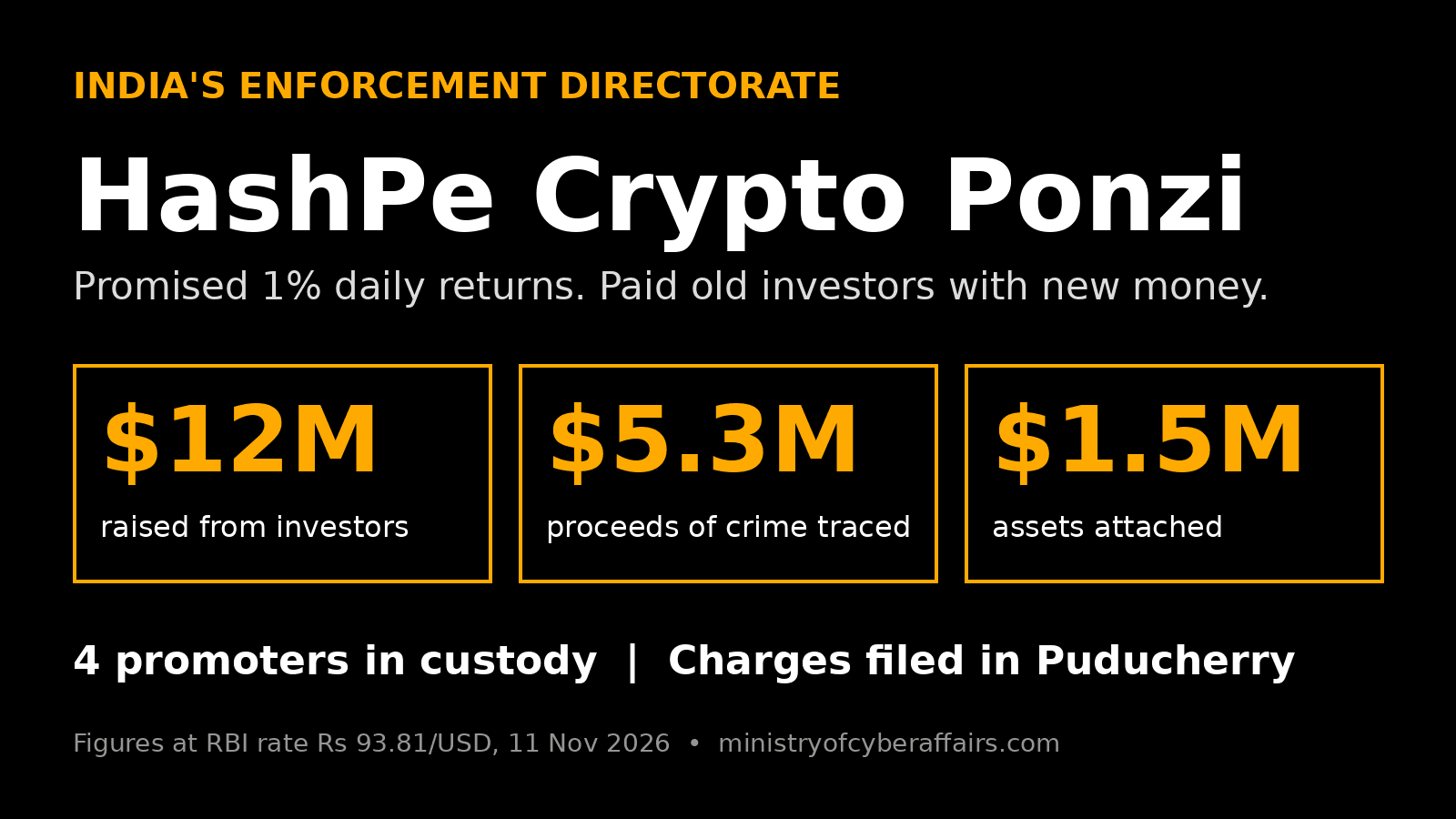
India's Enforcement Directorate has provisionally attached assets worth about $1.5 million (Rs 14.16 crore) in the HashPe cryptocurrency investment case and filed charges before a special money laundering court in Puducherry. Run through hashpe.io and a multi-level marketing network, the scheme raised about $12 million by promising 1% daily returns, trading fictitious coins and paying earlier investors with new money. Four accused are in judicial custody.
India's Enforcement Directorate (ED), the country's financial crimes agency, has provisionally attached assets worth about $1.5 million (Rs 14.16 crore) linked to HashPe, a cryptocurrency investment scheme that promised investors a 1% return every day.
The attachment order was issued on 30 October 2026 under the Prevention of Money Laundering Act (PMLA), 2002, by the agency's Chennai Zonal Office-II. ED has also filed a prosecution complaint, the equivalent of a charge sheet, before the Special PMLA Court in Puducherry. The case concerns M/s Pan India Crypto Currency, which operated as HashPe.
The attached assets include real estate in Tamil Nadu, Haryana and New Delhi, a BMW car and bank balances.
The promise
ED's money laundering probe stems from a case registered by the Puducherry Cyber Crime Police under India's criminal code, the Bharatiya Nyaya Sanhita, 2023, and the Information Technology Act, 2000.
Investors were promised a 1% daily return, payouts of up to three times their stake, referral commissions, and rewards such as luxury cars and foreign trips.
How it worked
HashPe ran through the website hashpe.io and a multi-level marketing network. ED names its promoters as Imran Basha, Hitesh Kumar and Syed Usman alias Babu, who, with Dhamodaran and other associates, drew investments in cash, bank transfers and crypto assets.
The platform listed fictitious tokens, including TCX and HashPe, and showed profits without any actual trading. New deposits paid earlier investors and commissions to recruiters styled as "leaders". Withdrawals were then frozen and the platform went dark, leaving investors with losses.

Money trail
The scheme raised about $12 million (Rs 112.91 crore), part of which was paid back to investors. The rest moved to bank accounts of M/s HIFY Circle and other related persons and entities, and through crypto wallets. It funded personal spending, loan repayments, large commissions, promotional events and property purchases.
ED has so far traced about $5.3 million (Rs 49.54 crore) in proceeds of crime.
Arrests
ED searched premises linked to HashPe, its promoters and associates on 1 September 2026. Imran Basha, Hitesh Kumar, Syed Usman alias Babu and Dhamodaran were then arrested under Section 19 of the PMLA and remain in judicial custody.
The investigation is continuing.
Red flags
Fixed daily returns, payouts tied to recruitment, in-house tokens that trade nowhere else and luxury rewards are classic signs of a crypto Ponzi scheme. In India, suspected fraud can be reported at cybercrime.gov.in or on the 1930 helpline.
Dollar figures are converted at the Reserve Bank of India reference rate of Rs 93.81 per US dollar on 11 November 2026.