India's ED arrests two more in ₹146 crore Hashpe cryptocurrency fraud probe
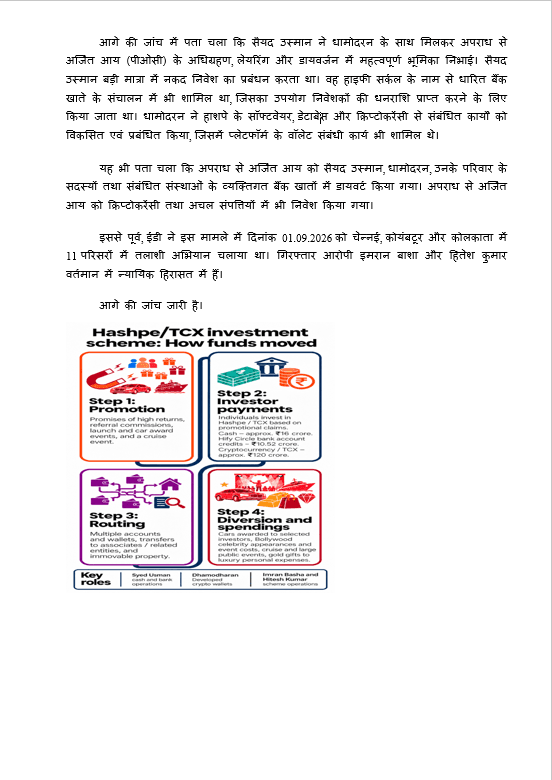
India’s Enforcement Directorate arrested Syed Usman alias Babu and Dhamodharan Balachandran in the Hashpe cryptocurrency fraud PMLA probe. Alleged proceeds ~₹146 crore via cash, Hify Circle bank credits and purported TCX tokens. Source: ED.
India’s Enforcement Directorate (ED) has arrested two more people in its money-laundering investigation into the alleged Hashpe cryptocurrency investment fraud, a case in which investigators say about ₹146 crore was raised from investors through cash, bank transfers and a purported digital token called TCX.
ED’s Chennai Zonal Office-II arrested Syed Usman alias Babu and Dhamodharan Balachandran on 22 September 2026 under Section 19 of the Prevention of Money Laundering Act (PMLA), 2002. Both were produced before the Special Court (PMLA), which remanded them to three days’ judicial custody, the agency said in a 24 September press release amplified on its official X account.
Hashpe and “TCX”
According to ED, the predicate investigation began from an FIR at the Cyber Crime Police Station, Puducherry, under provisions of the Bharatiya Nyaya Sanhita, 2023, and the Information Technology Act, 2000.
ED says Syed Usman, Imran Basha and associates floated an investment scheme under the name Hashpe, marketed as a cryptocurrency trading platform. Investors were allegedly induced with promises of high returns through a purported cryptocurrency named TCX. Promotion included launch events and car-award ceremonies featuring Bollywood celebrities, referral commissions, social-media marketing, and a cruise-ship event in Mumbai, tactics designed to project credibility around what investigators treat as a crypto-branded fundraising vehicle rather than a transparent, regulated exchange product.
How the money allegedly moved
ED’s own fund-flow graphic breaks the alleged ₹146 crore proceeds of crime into three channels:
- Cash: about ₹16 crore
- Bank: about ₹10.52 crore credited to an account in the name of Hify Circle
- Crypto/token form: about ₹120 crore represented as TCX coins
Investigators allege funds were then routed through multiple accounts and digital wallets, moved to associates and related entities, and partly parked in cryptocurrency and immovable property, with spending on celebrity appearances, events, cruises, cars awarded to select investors, gifts and luxury personal outlays.
Alleged roles
- Syed Usman: handled large cash intakes and operated the Hify Circle bank channel used to receive investor funds.
- Dhamodharan Balachandran: developed and managed Hashpe’s software, database and cryptocurrency-related operations, including wallet functions.
- Imran Basha and Hitesh Kumar: already in judicial custody; ED links them to scheme operations. Searches on 1 September 2026 covered 11 premises in Chennai, Coimbatore and Kolkata.
ED says the investigation into acquisition, layering and diversion of the proceeds remains ongoing.
Why it matters for global crypto audiences
Hashpe sits in a familiar pattern for international crypto-fraud watchers: a branded “trading” or “token” storyline, aggressive offline and influencer-style promotion, multi-rail collection (fiat cash + bank rails + purported crypto), then layering through wallets and related accounts into personal and real-estate assets. The PMLA arrests underscore that Indian authorities are pursuing not only the underlying cheating case but also the laundering of crypto-linked fundraising, including value held as an in-scheme token (TCX) that ED treats as proceeds of crime.
Investors and compliance teams should treat high-return crypto pitches tied to celebrity launches, referral trees and opaque tokens as high-risk until independent custody, audit and licensing claims can be verified.