Disaster Relief Scams: How to Spot Fake FEMA Agents and Charities
After storms and wildfires, scammers pose as FEMA staff, charities and contractors. The FTC's warning signs, how to verify help, and where to report fraud.
September is National Preparedness Month, and it caps a summer of storms, wildfires and flooding across the country. The Federal Trade Commission is repeating a warning that holds every disaster season: scammers move almost as fast as the emergency responders. In a consumer alert this month, the FTC says that after severe weather and other emergencies, scammers "often pose as government officials, charities, or contractors" to steal money and personal information from people who already have enough to deal with. If a disaster has touched your area, or you are donating to help someone who was hit, here is what those scams look like right now and how to keep your money and your identity safe.
Primary sources: FTC, National Preparedness Month consumer alert (September 2026) · ReportFraud.ftc.gov · FEMA, Disaster Fraud
On this page
The scams that follow a disaster
The tactics repeat from storm to storm, wildfire to wildfire. Knowing them ahead of time is most of the protection you need.
Charity scams
Fake charities and crowdfunding pages appear soon after a disaster hits the news, often with names that sound almost identical to well known relief organizations. They push you to give right away, over the phone or through a social media post, and ask you to pay by gift card, wire transfer or cryptocurrency, all of which are hard to trace and nearly impossible to get back. A legitimate charity never pressures you to decide on the spot. Before you give, look the organization up through the IRS Tax Exempt Organization Search (and the IRS's disaster relief search for qualified charities) or your state's charity regulator, and go to the charity's own website directly rather than a link in a text or post.
FEMA and government impersonation
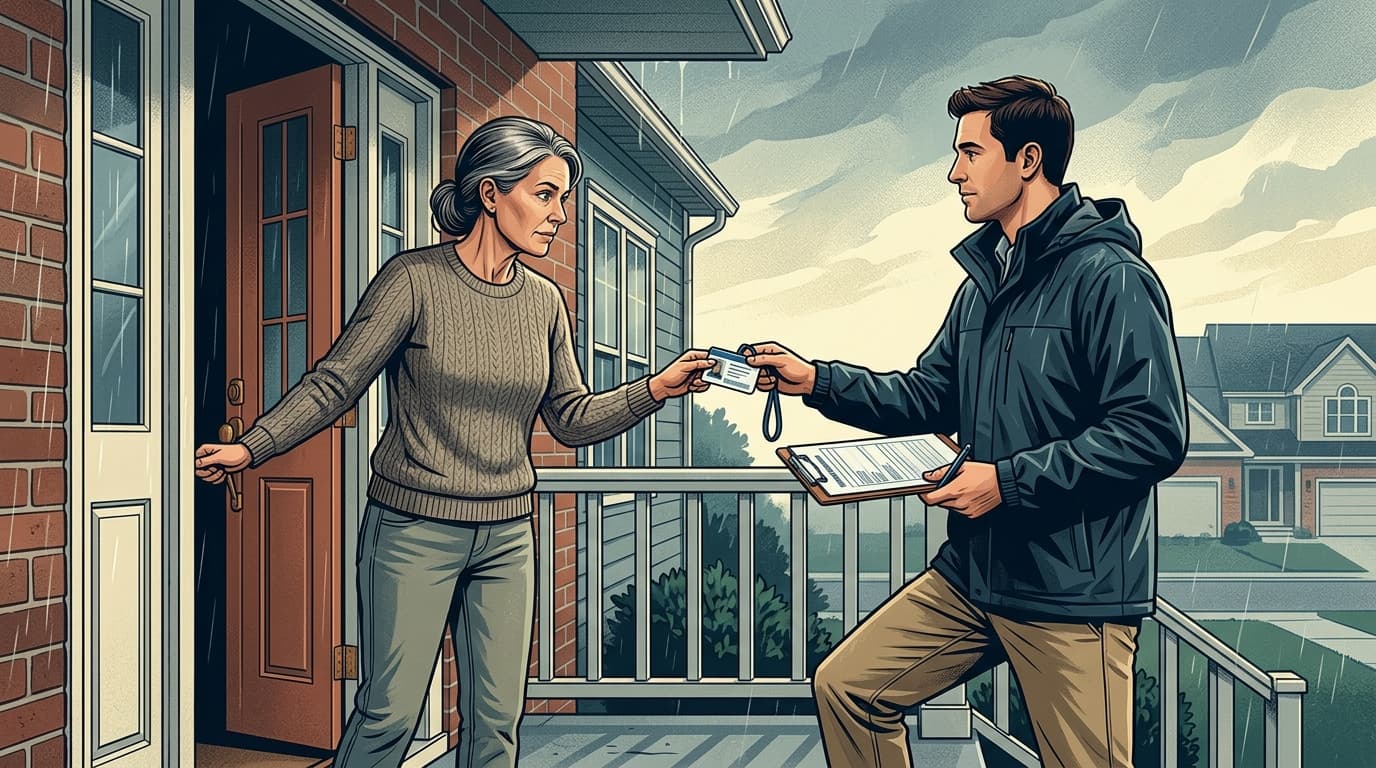
As the FTC's government-impersonation guidance puts it, "The FTC will never threaten you, say you must transfer your money to 'protect it,' or tell you to withdraw cash or buy gold and give it to someone." If a call, text or email claiming to be from the FTC, FEMA, the IRS or Social Security tells you to do any of that, it is a scam. FEMA impersonators call, text or show up in person claiming you must pay an "application fee," "processing fee" or "inspection fee" to receive disaster assistance or speed up a claim. DHS, FEMA, SBA and other federal agencies will never charge applicants for disaster assistance or help filling out applications, and FEMA never charges a fee for an inspection. FEMA will only call or email you if you've contacted FEMA first or applied. FEMA teams may knock on doors in disaster areas, but they carry an official FEMA ID badge and never ask for money; a FEMA shirt or jacket is not proof of identity. If you are unsure whether someone is legitimate, hang up and call FEMA directly at 1-800-621-3362 (7 a.m. to 11 p.m. ET daily).
Contractor and repair fraud
After a storm, wildfire or flood, unlicensed contractors go door to door or call people directly, offering fast repairs for roof damage, water damage or tree removal. As the FTC explains in its guide on preparing for a weather emergency while avoiding scams, these operators "will make promises, ask you to pay upfront, and insist you pay in ways that make it hard to get your money back." Red flags include no written contract, pressure to sign or pay immediately, and a demand for full payment in cash before work starts. Ask people you trust for recommendations, then search the company's name online alongside words like "scam" or "complaint," verify the license with your state or county, and pay by credit card after the work is done whenever you can. Our chargeback guide explains how to dispute a payment if a contractor takes your money and disappears.
Fake relief texts and links
Expect texts and emails claiming to be from FEMA, the Red Cross or your bank, urging you to click a link to "register" for disaster assistance, "verify" your account, or track a relief payment. These are phishing messages dressed up as disaster relief, and the link usually leads to a page built to steal your login details or card number. Legitimate disaster assistance is applied for at DisasterAssistance.gov or by calling FEMA directly, never through a link texted to you out of nowhere. See our explainer on how phishing works and how to stop it for a closer look at how these messages are built to fool you.
How to protect yourself and your money
- Treat urgency as a warning sign. Real charities, contractors and government agencies do not need an answer in the next five minutes.
- Never pay by cash, gift card, wire transfer, payment app or cryptocurrency for a donation, a contractor, or anything tied to a FEMA application. Scammers ask for these because they are hard to trace and hard to reverse.
- Verify before you give or hire. Check a charity through the IRS Tax Exempt Organization Search, and check a contractor's license through your state or county.
- Do not click links in unsolicited texts or emails about disaster relief or FEMA registration. Go directly to DisasterAssistance.gov, FEMA.gov or the number on your own paperwork instead.
- Protect your personal information. Do not give your Social Security number, bank details or insurance policy number to anyone who calls or texts you first. FEMA will only call or email you if you've contacted FEMA first or applied. FEMA teams may knock on doors in disaster areas, but they carry an official FEMA ID badge and never ask for money; a FEMA shirt or jacket is not proof of identity.
How to report a disaster scam
Reporting will not always get your money back, but the FTC shares reports with law enforcement to track and stop scams.
| Where to report | Contact | What it covers |
|---|---|---|
| Federal Trade Commission | ReportFraud.ftc.gov | Charity, government/FEMA impersonation, contractor fraud, phishing |
| DOJ National Center for Disaster Fraud | 866-720-5721 (24/7) or [email protected] | Any disaster-related fraud |
| FEMA Investigations and Inspections Division | [email protected] | Anyone posing as FEMA staff or filing fake claims in your name |
| DOJ Disaster Complaint Center | justice.gov, NCDF Disaster Complaint Form | Any suspected disaster fraud |
| Your state Attorney General | Search "[your state] Attorney General consumer complaint" | Unlicensed contractors, deceptive charities, price gouging in your state |
If you already paid, contact your bank or card issuer right away and keep every text, email and receipt as evidence.
FAQ
Does FEMA ever charge a fee for disaster assistance?
No. FEMA, the SBA and other federal agencies never charge a fee to apply for assistance, to schedule or complete a home inspection, or to have a claim approved. Anyone asking for money tied to a FEMA application is impersonating the agency.
How can I tell if a charity collecting for disaster relief is real?
Check the organization's status through the IRS Tax Exempt Organization Search (or the IRS's disaster relief search for qualified charities) or your state's charity regulator before giving, and go to the charity's own website directly rather than a link in a text or post. Be wary of names that sound almost identical to well known charities, and never give under pressure to decide immediately.
A contractor is asking for full payment in cash before starting repairs. Is that normal?
No, it is one of the clearest warning signs of contractor fraud after a disaster. Ask for a written contract, verify the license with your state or county, and pay by credit card after the work is complete whenever possible so you have a way to dispute the charge if something goes wrong.
Sources: FTC, National Preparedness Month consumer alert · FTC, How To Avoid a Government Impersonation Scam · FTC, How To Prepare for a Weather Emergency While Avoiding Scams · FEMA, Disaster Fraud · U.S. Department of Justice, NCDF Disaster Complaint Form · IRS, Disaster Relief: Search for Qualified Charitable Donees
If you have been targeted, you are not alone. See our country-by-country cybercrime help hub for step-by-step reporting and recovery guides.