Fraudsters turn Google's free web hosting against Indian bank customers, takedown notices show
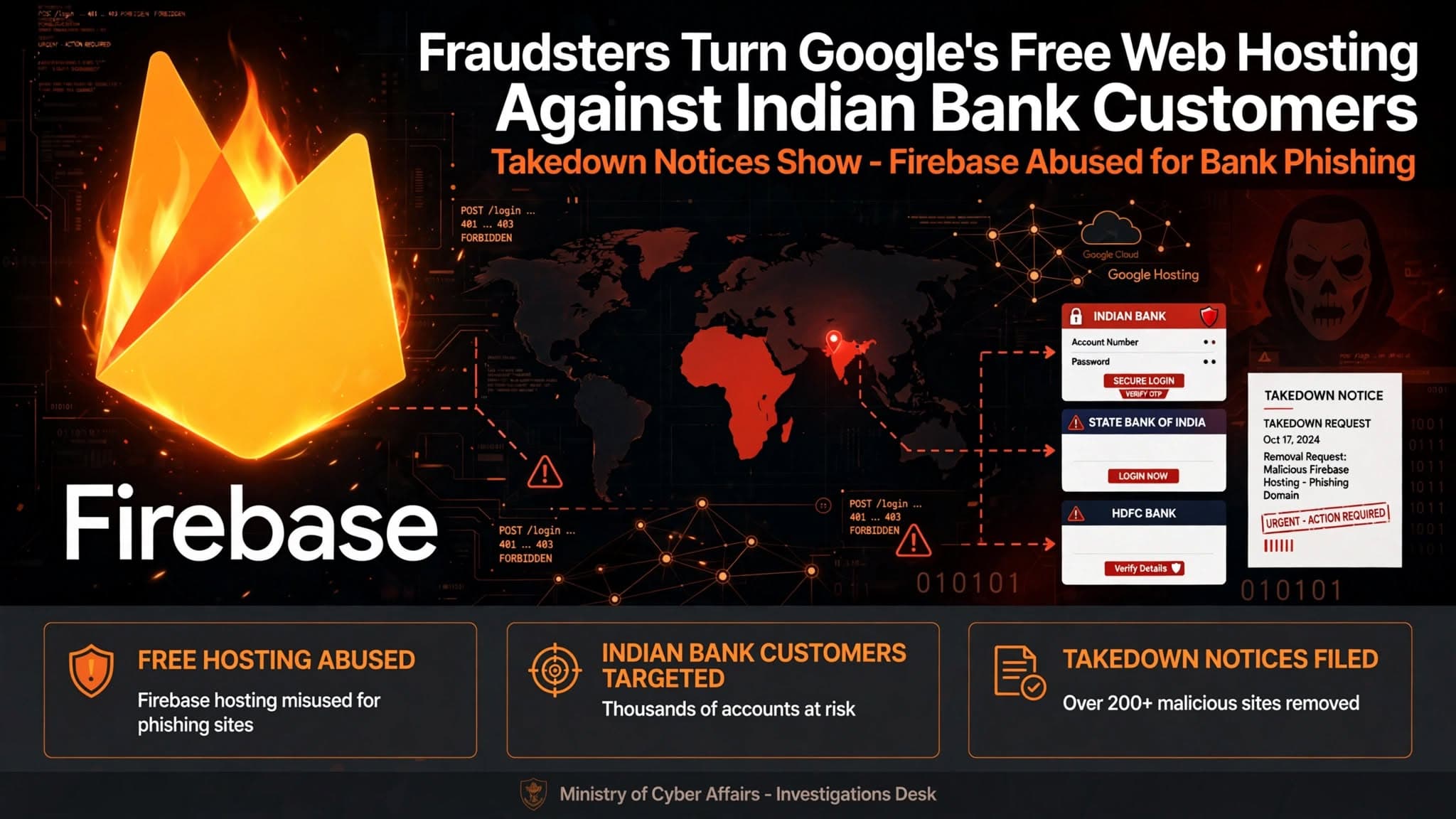
Free web page hosting providers make cybercrime a low cost affair. Research analyst reviewed notices sent to Google, from Lumen DB and its prompt removal.
NEW DELHI, Nov 21 - India's federal cybercrime agency asked Google twice this month to take down websites built on its free Firebase hosting service that impersonated Axis Bank, IndusInd Bank, RBL Bank and what appears to be Bank of Baroda, according to takedown notices made public in the Lumen database.
The two requests, sent on Nov. 2 and Nov. 13 by the Indian Cyber Crime Coordination Centre (I4C) under the Ministry of Home Affairs, list 11 web addresses. All are subdomains of web.app, the free domain Google gives every Firebase Hosting project. The notices were reportedly sent through Sahyog Portal, which Government built it to automate unlawful content intimation notices that central and state authorities, including police officers, send to platforms under Section 79(3)(b) of the IT Act, 2000, and Rule 3(1)(d) of the Intermediary Guidelines, 2021. It was rolled out in October 2024. Google, Meta, and ShareChat have joined the portal, but X has so far refused.
Axis Bank, IndusInd Bank and RBL Bank Customers at Risk
Seven of the 11 carry Axis Bank's name. Two use IndusInd Bank's and one RBL Bank's. One carries "bob", the shorthand commonly used for Bank of Baroda.
The notices do not describe what each page contained. Lumen, an archive of takedown requests run from Harvard University's Berkman Klein Center, withholds the full URLs from public view.
The addresses lean on credit-card language such as "rewards", "points", "card offer" and "login". That is the vocabulary of a long-running scam in which Indian bank customers are told their reward points are about to expire and are sent a link to claim them.
Hostname | Notice sent | Brand it imitates | Lure it suggests |
|---|---|---|---|
axiscardsbanking.web.app | 13 Nov 2026 | Axis Bank | Card banking |
loginopenaxis.web.app | 13 Nov 2026 | Axis Bank | Login portal |
induscardoffer.web.app | 13 Nov 2026 | IndusInd Bank | Card offer |
axishelpcards.web.app | 2 Nov 2026 | Axis Bank | Card helpdesk |
axismycarduser.web.app | 2 Nov 2026 | Axis Bank | Card account |
axisstorepoints.web.app | 2 Nov 2026 | Axis Bank | Reward points |
myaxisrewards.web.app | 2 Nov 2026 | Axis Bank | Reward points |
openaxiscards.web.app | 2 Nov 2026 | Axis Bank | Card opening |
indusindmycredit.web.app | 2 Nov 2026 | IndusInd Bank | Credit card |
rblmycc.web.app | 2 Nov 2026 | RBL Bank | Credit card |
bobhelps.web.app | 2 Nov 2026 | Likely Bank of Baroda ("BoB") | Helpdesk |
The two batches hint at how quickly the sites are replaced. The Nov. 2 notice named openaxiscards.web.app. Eleven days later, the Nov. 13 notice named loginopenaxis.web.app, built from the same words in a different order. The public notices alone do not establish that the same group is behind both.
The requests follow a wider crackdown. In August, I4C flagged at least 57 websites and databases hosted on Firebase, Reuters reported, including seven phishing pages that copied State Bank of India, ICICI Bank and Axis Bank.
Google said at the time it has "strict policies prohibiting the use of our services for phishing, malware, or financial fraud", and that it works with law enforcement, including I4C, to evaluate and act on notices.
Exploitation of Google's Trust
Firebase is one of several developer platforms, alongside Cloudflare Pages, Vercel, Netlify and GitHub Pages, that let anyone publish a website in minutes at no cost. Security researchers say that convenience has made them a favoured home for phishing.
The appeal is largely borrowed reputation. A page on web.app inherits Google's name and arrives with a valid HTTPS padlock. Email security tools tend to treat such shared domains as safe because they also host millions of legitimate projects, according to research by PhishFort and Forescout.
A subdomain also has no registration record and no registration date. That removes the "newly registered domain" warning sign that many filters rely on.
HOW THE SCAM WORKS
Victims receive an SMS or WhatsApp message, sometimes after a call from someone posing as bank staff, warning that their reward points are expiring. The link leads to a cloned bank page asking for card details, and often to an app installed from outside Google's Play Store. The app reads incoming text messages and forwards one-time passwords (OTPs) to the fraudsters.

Free cloud services can sit at both ends of that chain. I4C's August notices said malicious apps sent victims' data to Firebase databases controlled by scammers, according to media reports.
RECYCLED NAMES
The 11 addresses follow a simple template: a bank's short name, a portal-style word such as "my", "open" or "login", and a lure such as "cards", "rewards", "points" or "offer".
The template is not new. A 2022 Zscaler analysis listed malicious app downloads hosted at addresses such as sbi-kyc-points.web.app, on the same Google domain. Four years on, mostly the bank's name has changed.
Because the same words are reshuffled, as with openaxiscards and loginopenaxis, banks watching for abuse of their brand need to match combinations of words in any order rather than fixed addresses.
Creation vs Blocking - Why blocking is expensive affair
For the fraudsters, a new subdomain costs nothing. For the authorities, each removal needs detection, evidence, a formal notice and a review by the platform. I4C's August action went further than individual pages, asking Google to shut down hundreds of Firebase accounts, Reuters reported.
WHAT CAN BE DONE
Banks can also watch public certificate logs for new subdomains carrying their names on web.app, pages.dev, vercel.app and similar platforms. Researchers at Warsaw University of Technology examined how well that method works on free hosting platforms in a 2026 paper.
For customers, cardholders should check and redeem reward points only through its official website or helpline numbers. Banks do not ask customers to install apps sent over SMS or WhatsApp.