Meta Reports 2.06 Billion Facebook Fake-Account Removals and 52 Million Fraud Content Actions
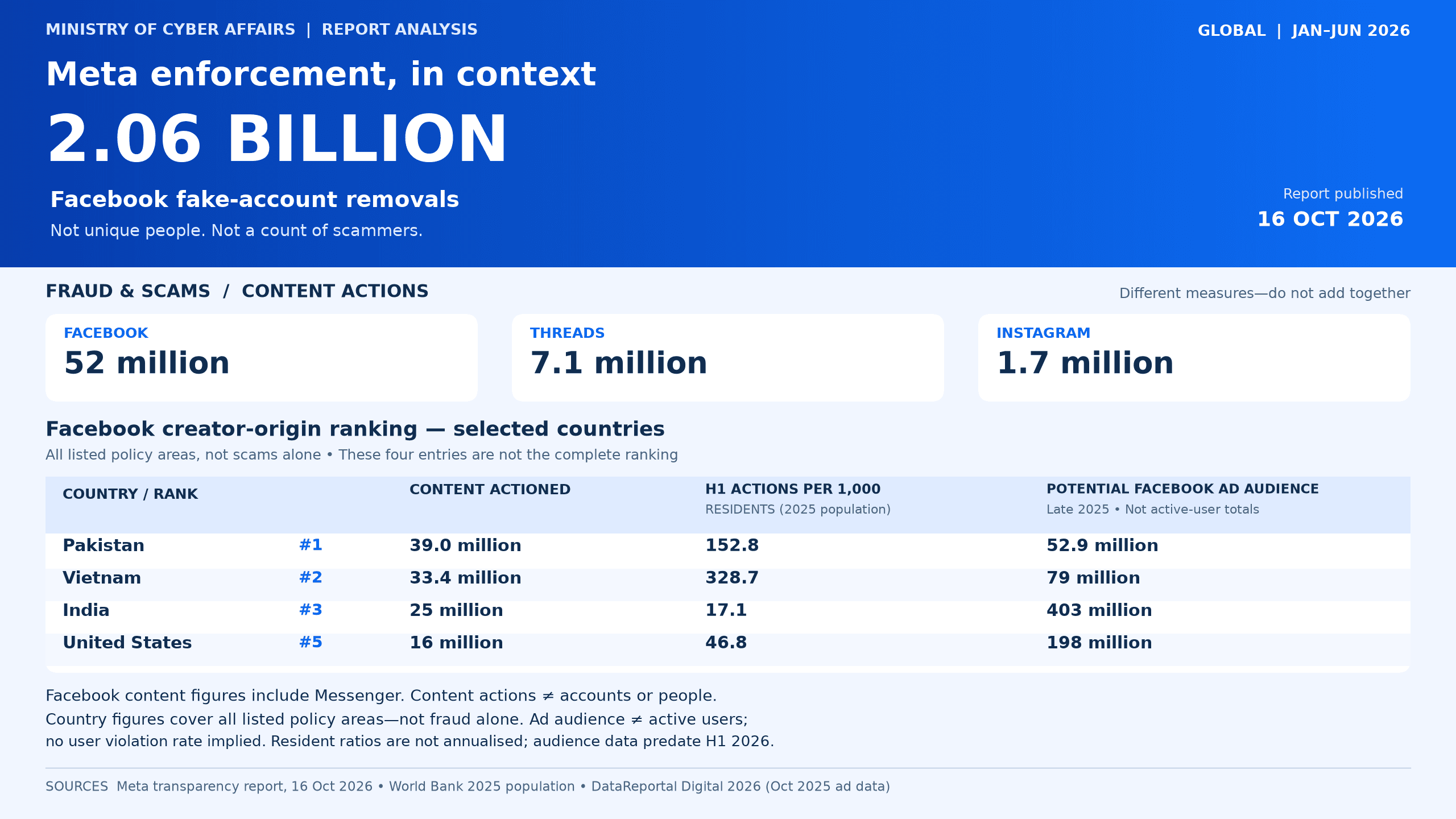
Meta reported 52 million Facebook fraud-and-scam content actions and 2.06 billion fake-account removals in January–June 2026. The figures measure different enforcement activities—not victims or unique people—and cannot be added together. Its global transparency report leaves important questions about fraud exposure and protection unanswered.
Meta reported action against 52 million pieces of Facebook content under its fraud-and-scams policy during the first half of 2026, according to a transparency report published on 16 October.
In a separate account-enforcement table, the company recorded 2.06 billion Facebook fake-account removals for the same period, 1 January to 30 June 2026.
Although issued under Section 120.053 of the Texas Business and Commerce Code, the report presents global figures rather than a tally confined to Texas.
The disclosures provide a measure of the scale of Meta's enforcement against fraud-related content.
They do not establish how many people were protected from scams or how much money was prevented from reaching criminals.
What the Facebook figure measures
The 52 million figure appears in the report's Community Standards “Content Actioned” table.
It is not labelled as a count of scam advertisements, accounts removed, victims or financial losses.
Nor does the table establish that every action represented a distinct scam or a different perpetrator.
Meta describes its broader approach to enforcement as “remove, reduce, and inform”.
The fraud-and-scams table does not break its figure down by intervention, so describing the entire volume as 52 million removals would go beyond the disclosure.
The scope also matters: a footnote says the Facebook tables include Messenger, while the Instagram tables include Instagram Direct.
The figures should therefore not be presented as applying only to public posts.
Fake-account removals are not a count of people
The 2.06 billion figure measures removals recorded under Facebook's fake-account policy.
It is not a count of 2.06 billion people, active users or unique scammers.
The report does not establish how many individuals were behind those accounts or quantify repeat creation and evasion patterns.
Nor does it identify all removed fake accounts as fraud operators.
Fake-account enforcement and fraud-and-scam content enforcement are distinct categories, measured in different units.
Their overlap is not quantified: adding 2.06 billion account removals to 52 million content actions would not produce a meaningful combined measure of scams disrupted.
Different platforms, different enforcement volumes
Meta also recorded 1.7 million fraud-and-scam content actions on Instagram and 7.1 million on Threads, both below Facebook's reported volume.
That comparison does not show that Facebook users faced a greater likelihood of fraud or that one service was more effective at detecting it.
The figures lack the fraud-specific exposure and detection measures needed for such conclusions.
They also do not identify how much of the actioned content was paid advertising, how many users encountered it before intervention, or how often encounters led to financial harm.
Those distinctions are particularly important for cyberfraud coverage: enforcement volume and victimisation describe different stages of a scam's lifecycle.
A large number of actions can demonstrate substantial enforcement activity without establishing the amount of fraud that remained available.
Pakistan and Vietnam: adding population context
Pakistan ranked first in Facebook’s creator-origin table with 39 million actioned content items, followed by Vietnam with 33.4 million.
India ranked third with 25 million, while the United States ranked fifth with 16 million.
These rankings cover the listed Community Standards policy areas, not fraud and scams alone.
Using the World Bank’s 2025 population estimates as a common-year reference, the first-half 2026 figures equate to approximately 328.7 actioned items per 1,000 residents in Vietnam, 152.8 in Pakistan, 46.8 in the United States and 17.1 in India.
The calculation divides each country’s reported content volume by its total population and multiplies by 1,000; it is not annualised.
Vietnam therefore has a higher population-normalised figure than Pakistan despite its lower absolute total.
But population is only a contextual proxy, not a Facebook-user or content-production denominator.
These are rounded content-action counts, not unique people or a percentage of residents violating rules, and they do not establish relative violation rates.
The ranking records creators’ countries of origin, not government takedown requests or criminal suspects.
With no country-by-policy breakdown, it cannot identify which countries contributed most to Facebook’s 52 million fraud-and-scam actions or had the highest scam prevalence.
Facebook audience size adds a different perspective
Comparable active-user totals for these four countries were not verified.
A separately labelled reference is Facebook’s potential advertising audience, reported in DataReportal’s Digital 2026 country reports from Meta’s advertising tools:
These are late-2025 estimates, with the reports referencing October 2025 data, not first-half 2026 monthly active users or unique people.
Meta explicitly warns that estimated advertising audience size is not a proxy for monthly or daily active users or engagement.
The audience figures help illustrate why national population alone is an imperfect reference: Vietnam’s estimated advertising audience was larger than Pakistan’s despite its smaller population.
But they still cannot supply a valid user-level violation rate.
Meta’s actioned-content figures include Messenger, classify creators by country of origin and count content rather than people; advertising reach uses a different geographic audience measure and predates the enforcement period.
Dividing one by the other would not show the proportion of Facebook users who broke its rules.
The policy question is protection, not just volume
For policymakers, the report offers a starting point for scrutiny rather than a standalone assessment of fraud prevention.
More informative analysis would link interventions to exposure, repeat offending and outcomes for affected users.
The report does not provide a fraud-specific breakdown of financial losses, conversion into successful scams or appeal outcomes.
Its broader disclosures cannot be treated as substitutes for those measures, and the absence of that detail here does not establish what information Meta may hold or publish elsewhere.
The defensible conclusion is narrower: Meta recorded substantial fraud-and-scam content enforcement alongside fake-account removals during the first half of 2026.
Whether that activity reduced victimisation, caught most violating content or improved on earlier performance cannot be determined from these figures alone.