Creator Economy Under Attack: Why India is Forcing Telegram to Fight Piracy
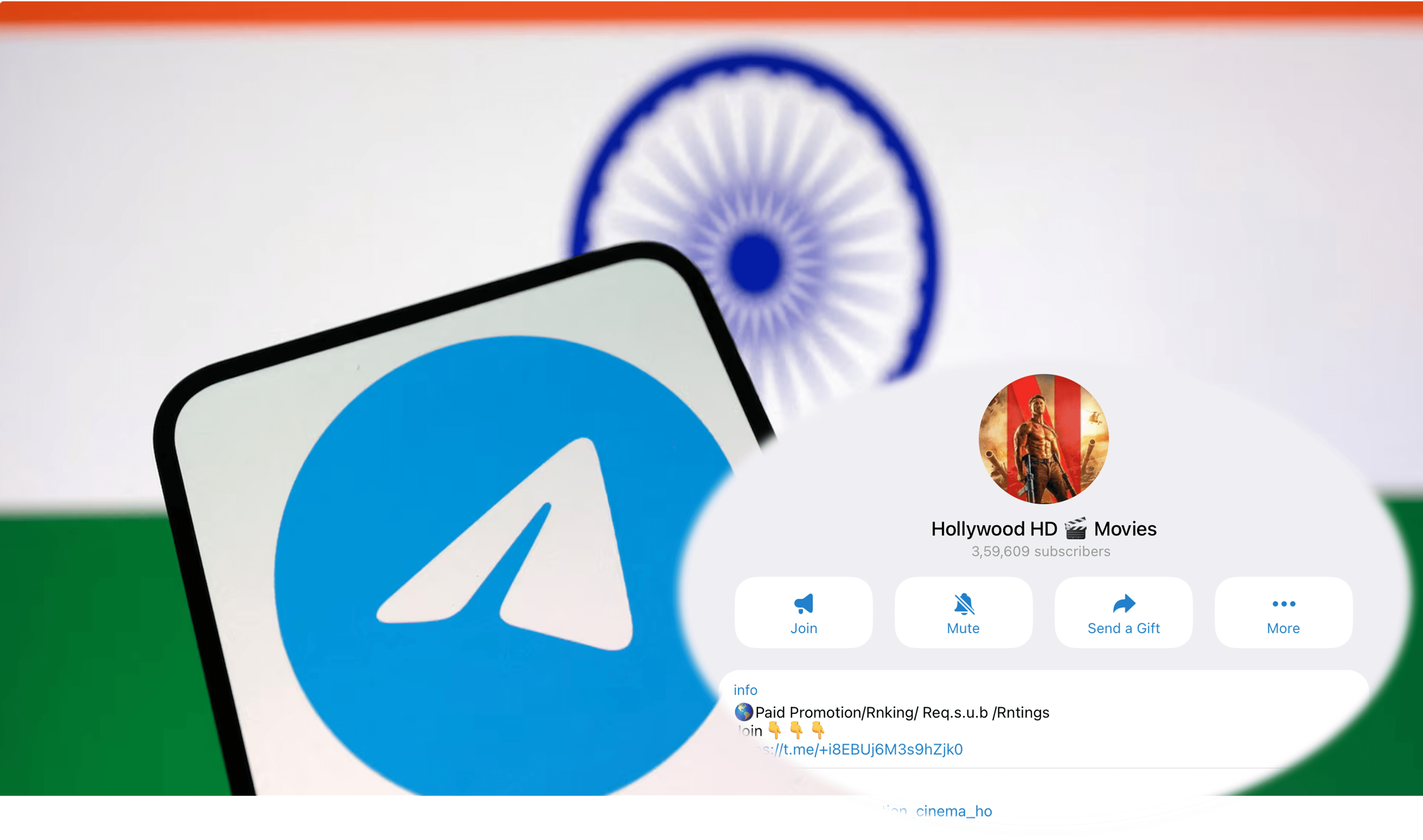
India 'proactively monitoring' Telegram over concerns about illegal content, as per Government's report. Copyright infringement on Telegram is not treated as a mere civil matter — it is a criminal offence under the Copyright Act, 1957 and Cinematograph Act, 1952.
In a decisive escalation that could redefine how the world’s biggest messaging platforms operate, India’s Ministry of Information & Broadcasting has put Telegram on notice. The government has demanded platform-level action against the rampant spread of pirated films, OTT content, and other copyrighted audio-visual material, giving the app just 15 days to submit a comprehensive Action Taken Report.
Subject matter experts on Telegram have revealed that merely a simple keyword like "Hollywood Movies", "Hindi Movies" will yeild channels which has millions of followers combined.
 Telegram screenshot on large number of subscribers, on-to pirated movie channels
This is no longer about blocking individual channels one by one. It is a fundamental demand for systemic change: stronger detection systems, proactive reporting, swift disabling of access, and decisive action against repeat infringers, including channels, groups, bots, administrators, and associated entities.
The 15-Day Ultimatum: What India Demanded
The Ministry’s communication, issued under the IT Act, 2000 and IT Rules, 2021, makes several non-negotiable points:
- Telegram must strengthen systems for detection, reporting, disabling access to, and removal of pirated films and infringing content.
- It must act aggressively against repeat infringers.
- The platform has been asked to share details of its grievance redressal system with producers, OTT platforms, and law-enforcement agencies.
- A purely reactive, channel-by-channel approach is no longer acceptable. The government has made it clear that due diligence requires proactive measures.
- Copyright infringement is not treated as a mere civil matter, it is a criminal offence under the Copyright Act, 1957 and Cinematograph Act, 1952.
- Continued availability of pirated content, evasive compliance, or incomplete response could invite further legal action.
The move follows complaints from major OTT players and aims to protect India’s creator economy, film industry, broadcasters, producers, and distributors. Earlier, the government had already acted against over 3,000 Telegram channels distributing pirated material. Now it wants the platform itself to take ownership.
The June 2026 Ban: A Reminder of Telegram’s Troubles in India
This piracy crackdown did not come in isolation. Just weeks earlier, in June 2026, India took the extraordinary step of temporarily banning Telegram nationwide (June 16–22) ahead of the NEET re-examination.
Telegram challenged the order in the Delhi High Court, but the ban stood for the critical period. The episode exposed how Telegram’s end-to-end encryption and minimal moderation can be exploited for serious fraud, reinforcing the government’s broader argument that “business as usual” is no longer tenable.
Global Ripple Effects: Telegram’s Troubled History Worldwide
India is not alone in confronting Telegram. The platform has repeatedly clashed with regulators across continents:
- Russia (2018): Attempted a nationwide block after Telegram refused to hand over encryption keys to security services. The ban largely failed due to technical workarounds, but it marked the first major state-level showdown.
- Iran: Repeatedly restricted or banned Telegram over protests and political content.
- Germany: Slapped Telegram with multi-million euro fines (€5+ million) under the NetzDG law for failing to set up proper reporting tools and a local legal entity for content moderation.
- France (2024): Founder Pavel Durov was arrested and investigated over alleged complicity in criminal activities on the platform, including fraud, money laundering, and distribution of abusive content. The episode forced Telegram to publicly commit to overhauling its moderation policies.
The Global Shift: From “Intermediary” to Accountable Platform
These actions reflect a worldwide transformation in how governments treat digital intermediaries:
- The European Union’s Digital Services Act (DSA) now requires very large platforms to conduct risk assessments, proactively detect illegal content (including copyright infringement), and face fines up to 6% of global turnover for systemic failures.
- Similar frameworks are advancing in the UK (Online Safety Act), Australia, and other jurisdictions.
- The core principle emerging everywhere: Platforms can no longer claim ignorance or hide behind “we’re just a messenger.” When illegal content, whether pirated movies, exam leaks, terrorist propaganda, or CSAM, thrives at scale, proactive responsibility is mandatory.
India’s latest notice to Telegram is particularly significant because it explicitly moves beyond piecemeal takedowns to systemic platform accountability, exactly the direction global regulation is heading.
Why This Matters
India’s entertainment industry is a global powerhouse. Piracy doesn’t just hurt studios and OTT platforms, it destroys jobs, reduces investment in content, and undermines the creator economy that employs millions. By treating this as both an economic and criminal issue, the government is sending a clear message: India will not be a safe haven for digital piracy.
For Telegram, the stakes are existential in its second-largest market. The company must now demonstrate, within 15 days, that it can build robust detection systems, act against repeat offenders, and cooperate meaningfully with Indian authorities.
The Road Ahead
As Telegram prepares its Action Taken Report, the world is watching. Will this force a genuine upgrade in the platform’s content moderation infrastructure? Will other governments follow India’s lead with similar platform-level demands on piracy and fraud?
One thing is certain: the era when messaging apps could operate with minimal oversight while hosting widespread illegal activity is ending. India’s firm stance, combining the March piracy ultimatum with the dramatic June ban, is accelerating a global reckoning.
Telegram’s future in the world’s largest democracy, and perhaps beyond, now depends on how seriously it takes this 15-day deadline. The message from New Delhi is unambiguous: Clean up your platform, or face the consequences.
The digital Wild West is being tamed, one major platform at a time. And India is leading the charge.