Chinese linked "Digital Arrest" Syndicate busted, India nabs key Operator Linked to 1,090 Cases Worth Over ₹1071 Crore
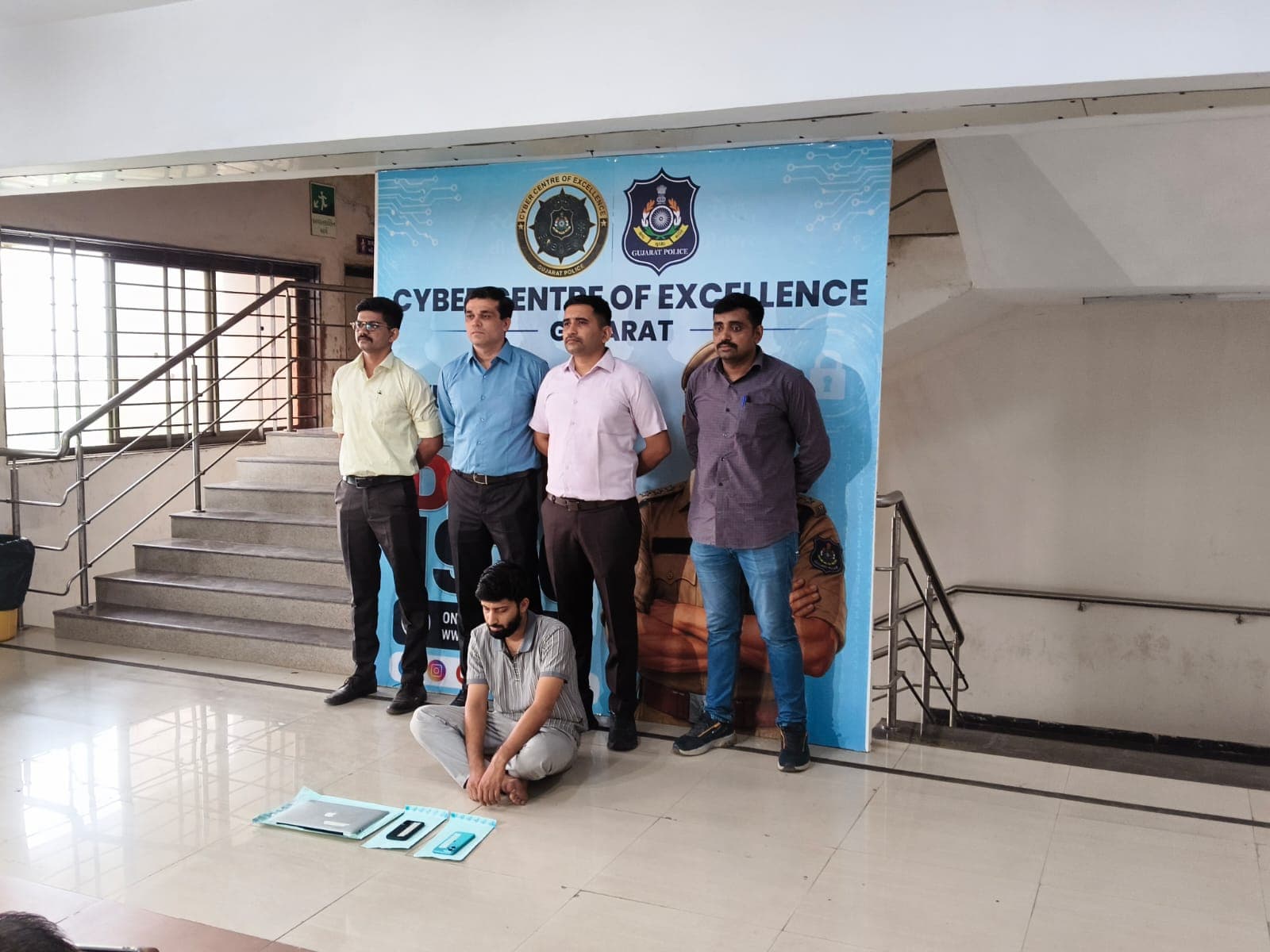
Cyber Centre of Excellence, Gandhinagar, cracks pan-India racket that defrauded citizens through fake "digital arrests" and laundered proceeds into cryptocurrency routed to Chinese handlers.
Amid a nationwide surge in cybercrime, the Gujarat Police intensified its crackdown on a particularly insidious fraud known as the "digital arrest" scam.
Operating under the proactive guidance of senior leadership, the Cyber Centre of Excellence, Gandhinagar, launched a focused investigation after identifying multiple victims being defrauded simultaneously across ten different locations in India.
Director General of Police and Director General-cum-Additional Director General of Police, Shri Gyanendra Singh Malik, IPS, along with Deputy Inspector General of Police, Shri Babin Mehta, IPS, had issued standing instructions to remain proactive and carry out strict, intensive operations against cybercriminal networks.
Acting on these directives, Police Superintendents Dr. Rajdeepsinh Zala, Shri Sanjay Keshwala, and Shri Vivek Bhera formed a specialised technical team to investigate the "digital arrest" fraud pattern end-to-end.
Modus Operandi: How the "Digital Arrest" Scam Worked
The investigation began with a complaint from a senior citizen who had been subjected to a "digital arrest."
During counselling and interrogation, the victim disclosed that individuals impersonating Maharashtra Police, using a fabricated letter bearing the forged signature of a Supreme Court official, had placed him under a so-called "digital arrest."
The fraudsters then coerced him into transferring money from his bank accounts.
Technical analysis of the victim's bank account details revealed that several other victims were being subjected to live "digital arrest" frauds at the same time.
The Cyber Centre team swung into action, visiting the homes of approximately ten such victims across different locations to intervene in real time and stop the ongoing crimes.
Arrest of the Key Financial Operator
Based on technical analysis and victim statements, the Cyber Centre of Excellence team identified the chief financial handler of the syndicate, the individual responsible for laundering the proceeds of the fraud.
The team conducted reconnaissance over three days in Barpeta, Assam, before raiding the suspect's residence.
The accused was arrested along with technical gadgets and mobile devices used in the commission of the crimes.
The arrested accused has been identified as:
Rafiqul Alam, son of Md. Ali, aged 25 years, resident of Sanchuka, Barpeta Road, District Barpeta, Assam.
Role of the Accused in the Syndicate
The accused served as the principal financial handler of the operation.
His responsibilities and activities included:
- Money laundering via cryptocurrency to China: He collected funds obtained through "digital arrest" and other cyber frauds, transferred them across various bank accounts to obscure the trail, and converted the money into cryptocurrency before routing it to Chinese handlers. His mobile phone was found to contain 23 crypto wallets, through which transactions worth approximately ₹16 crore had been processed.
- Use of illegal crypto trading platforms: The accused used a mobile application called "Chip Seller" to carry out illegal trading of cryptocurrency, bypassing regulated exchanges.
- Volume of crimes: The accused has been linked to a total of 1,090 cybercrime cases across India, involving a combined amount of ₹10,71,55,66,034 (approximately ₹10.71 crore as per the aggregate fraud value cited across complaints; the figure as recorded in the FIR).
- Split-transfer technique to evade surveillance: To avoid detection by financial intelligence agencies, the accused would split large sums into smaller amounts and distribute them across as many as 1,754 bank accounts across India within a single hour, making the money trail extremely difficult to trace.
- Direct coordination with Chinese criminals: The accused maintained direct contact with Chinese criminals via WhatsApp and Telegram, exchanging critical operational details including scanner codes, user IDs, passwords, crypto wallet credentials, the modus operandi (MO) of the crimes, and other instructions. He effectively functioned as the central operator coordinating a mule-banking network.
- Gaming-platform transactions: The accused's mobile phone also revealed financial transactions carried out through gaming applications, used as an additional channel for moving illicit funds.
Victims Rescued During Live Operations
In a remarkable feat of real-time intervention, the Cyber Centre team prevented ongoing frauds at ten separate locations across India.
By counselling victims at their homes, often during night time visits, the team stopped the crimes in progress and prevented further financial loss:
- Ahmedabad (Senior Citizen): A senior citizen was threatened with implication in a child pornography case after being falsely identified as a police officer. The fraudsters demanded ₹20 lakh. The team visited the victim's home at night, counselled them, and prevented both the crime from proceeding and the money from being transferred.
- Surat (Senior Citizen): A senior citizen was threatened with implication in ED (Enforcement Directorate) and terrorism-related cases, with an initial demand of ₹60 lakh. The victim had agreed to pay ₹40 lakh and was preparing to sell a flat to arrange the funds. When the flat could not be sold in time, the victim arranged to sell a shop for ₹20 lakh to pay the accused. The Cyber Centre team intervened at night, counselled the victim, stopped the crime, and prevented the loss of funds.
- Jamnagar (Senior Citizen): A senior citizen was lured with promises of 50–60% returns through a brokerage scheme tied to "Morgan Max Company." The fraudsters had already collected ₹9.50 lakh across multiple accounts and were preparing to receive a further ₹10 lakh. The team intervened at night, counselled the victim, and prevented the additional transfer.
- Other victims (5 cases): Similar counselling and intervention were carried out for victims in: In all these cases, the team's timely intervention prevented the crimes from proceeding and protected the victims' money.
- Raipur (01), Chhattisgarh
- Sundergarh (01), Odisha
- Mumbai (01), Maharashtra
- Bhubaneswar (02), Odisha
Legal Sections Invoked
Three First Information Reports (FIRs) have been registered at the Cyber Crime Police Station, Gujarat State:
- FIR No. 11201018260052/2026, Under Sections 61(2), 127(2), 308(6), 318(4), 319(2), 336(2), 336(3), 337, 340(2) of the Bharatiya Nyaya Sanhita (BNS) and Section 66(D) of the Information Technology Act.
- FIR No. 11201018260053/2026, Under Sections 61(2), 127(4), 308(6), 318(4), 319(2), 336(2), 336(3), 337, 340(2) of the BNS and Section 66(D) of the IT Act.
- FIR No. 11201018260054/2026, Under Sections 61(2), 318(4), 319(2) of the BNS and Sections 66(C) and 66(D) of the IT Act.
Public Advisory Issued by Gujarat Police
The Gujarat Police has issued the following advisory to citizens:
- Do not panic if someone claiming to be from the Police, CBI, ED, Supreme Court, or any other government or legal authority calls and threatens to implicate you in money laundering, drug-related, terror, or any other criminal case, and demands money.
- Do not trust fabricated documents or video calls. Never share OTPs, bank details, copies of Aadhaar cards, or transfer money to anyone under such threats.
- Report immediately any suspected cyber fraud to the nearest police station or call the Cyber Crime Helpline at 1930.
Officers and Personnel Who Contributed to the Operation
Senior Officers who gave directions for the operation:
- Shri Gnanendrasinh Malik - Police Mahanideshak
- Shri Bipin Ahire - Nayab Police Mahanirikshak
- Dr. Rajdeepsinh Jhala - Police Adhikshak
- Shri Sanjay Keshwala - Police Adhikshak
- Shri Vivek Bheda - Police Adhikshak
Investigation Team
Inspector V.A. Jograna, V.M. Jotaniya, V.V. Kumkhaniya, Chirag Gosai, A.P. Gadhvi, R.N. Khant, P.D. Solanki, P.M. Vala, S.M. Soni, V.A. Patel, S.M. Patel,
Sub Inspector- M.P. Chavda
Police personnel- Niteshbhai Vyas, Gandaji Thakor, Laxmansinh Thakor, Yogeshbhai Maru, Vikramsinh Rajput, Hirenbhai Patel, Vivekbhai Choudhary, Hardikbhai Jani, Nusratbanu, Bharathbhai Dagar, Mayursinh Zala, Vinodbhai Vanzara, Vijaysinh Chavda, Sumitbhai Vyas, Dineshbhai Choudhary, and Maulikbhai Patel.
The arrest of Rafiqul Alam marks a significant breakthrough in the fight against the "digital arrest" extortion racket, a scam that has targeted senior citizens and vulnerable individuals across India.
With links to over 1,000 cybercrime cases and a sophisticated money-laundering network extending to China, the case underscores the increasingly transnational nature of cybercrime.
The Gujarat Cyber Centre of Excellence's combination of technical analysis, real-time victim intervention, and cross-state field operations demonstrates a proactive model for combating digital fraud.
Citizens are urged to remain vigilant and report suspicious activity promptly.
The Cyber Crime Helpline 1930 is available for immediate assistance.