Cambodia's Telegram Paradox: A Nation Built on Telegram has Zero data disclosure request in 2026
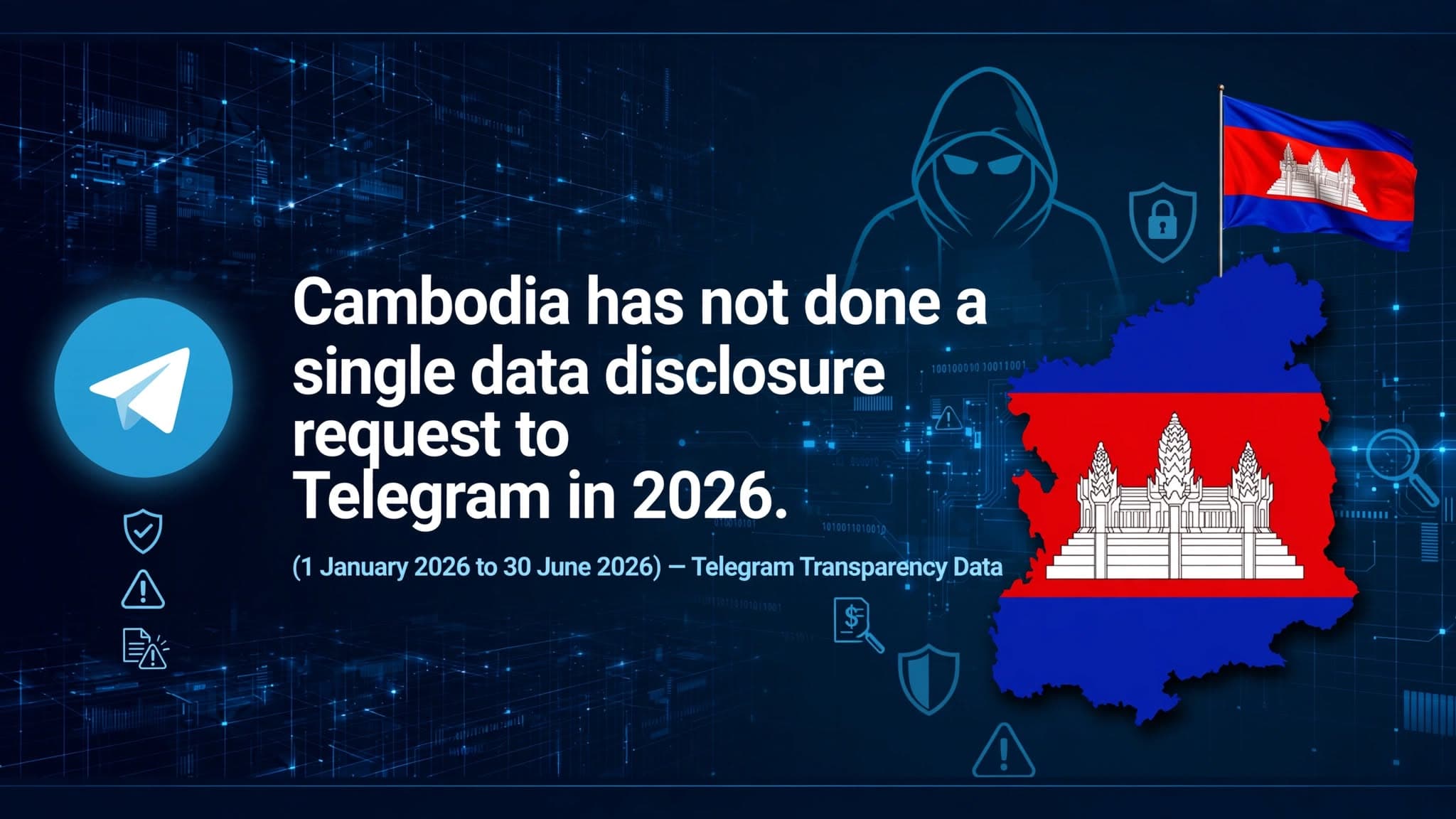
An analysis of exclusive data from Telegram's official transparency bot.
PHNOM PENH - In Cambodia, government directives are issued on Telegram, youth culture is organized on Telegram, and, according to the United Nations, Southeast Asia's industrial-scale scam industry is run on Telegram.
Yet according to data obtained from Telegram's official transparency bot this week, Cambodian authorities barely use the legal tools to police it.
The bot report states:
Fulfilled requests from Cambodia for IP address and/or phone number from 1 January 2025 to 31 December 2025: 5 Affected users: 7
No requests from Cambodia resulted in metadata disclosures from 1 January 2026 to 30 June 2026.
A Country That Lives Inside One App
Cambodia has close to 20 million internet subscribers and a mobile-first population.
Within that ecosystem, Telegram is a primary app.
It is described in market research as a messaging and content distribution hub with high engagement.
By 2023, Telegram had become "cool" for Cambodian youth, seen as something new and not overseen by parents, with Khmer memes and viral content circulating primarily on Telegram groups.
Most critically, Telegram has become the messaging medium of choice for many officials in Cambodia's government, popular because of its encryption for chats and calls.
Besides, Telegram is also a hub of illegal activities from Human Trafficking to Betting / Gambling and even CSEAM content distribution.
The Enforcement Gap
That ubiquity makes the transparency figures extraordinary.
In October 2024, the United Nations reported that powerful criminal networks in Southeast Asia extensively use Telegram which has enabled a fundamental change in the way organised crime can conduct large-scale illicit activity.
Cambodia is named as the center of that economy:
- The U.S. Department of Justice's Scam Center Strike Force seized a Telegram messaging app channel used to recruit human trafficking victims to a scam compound in Cambodia.
- Victims rescued from those compounds said they were forced to use Telegram, WhatsApp and Facebook to try to scam people in India.
- In August 2025, Phnom Penh itself announced it had closed more than 700 online scam centres in a crackdown.
700 compounds raided.
A 6,000-member Telegram trafficking channel seized by U.S. authorities.
And 5 data requests filed with Telegram by Cambodia in a year.
Under paragraph 8.3 of Telegram's Privacy Policy, the company will disclose IP addresses and phone numbers when it receives a valid order from judicial authorities confirming a suspect in a case involving criminal activities that violate the Terms of Service.
If any data is shared, it is published in the quarterly transparency report.
In comparison, European countries operating under the Digital Services Act saw sharp increases in processed requests because more authorities started using DSA-mandated communication channels to request data from Telegram.
Belgium alone logged 594 requests in a single reporting period.
For Cambodia, the low number does not indicate low crime.
It indicates low capacity or low will to build a legally valid case that meets Telegram's threshold.
What World-Class Enforcement Looks Like
If Cambodia wants to align its digital policing with its digital reality, global best practices are clear:
- 1. Create a Single Legal Contact Point The EU model shows that formal, 24/7 law enforcement portals dramatically increase fulfilled requests. Similar in India, as per SSMI Guidelines, Telegram is mandated to have a residential grievance officer. Cambodia needs a dedicated, English-proficient unit registered with Telegram's transparency system.
- 2. Publish Domestic Transparency Global standard now is dual transparency: platforms publish what they receive, governments publish what they send. Cambodia's Ministry of Interior and Ministry of Post and Telecommunications should publish quarterly figures on requests sent, crimes targeted, and outcomes.
- 3. Separate Governance from Policing When the state itself favors Telegram to protect communications, it creates a conflict in regulating it. Moving official government communication to an auditable, separate secure system would remove the excuse for not acting against criminal use of Telegram.
- 4. Shift from Raids to Data Closing compounds is visible. Following the Telegram IDs, wallets, and channels inside them is effective. Every rescue should trigger a preservation order and a batch of 8.3 requests, not just a press release.
For a country where Telegram is de facto infrastructure, being a ghost in Telegram's transparency ledger is no longer tenable.
The world is watching the channels.
Since 6 April 2026, Cambodia has a new primary law:
Law on Combating Technology-based Fraud, promulgated by Royal Decree on 6 April 2026, adopted by National Assembly on 30 March and Senate on 3 April 2026.
It introduces 5 new offences in 5 chapters and 24 articles:
- technology-based fraud
- organising or leading scam centres
- recruiting or training participants
- malicious collection of personal data
- specialized money laundering
Offenders face up to life imprisonment, fines up to 1 billion riel, and asset confiscation.
The law also creates special criminal procedures including detention limits, asset freezes, and provisions for international cooperation.
Time has come for Cambodia to use this law for seeking data from Telegram for cleanup of the online ecosystem.