India’s Landmark AI Content Rules: Mandating Labels and 3-Hour Takedowns
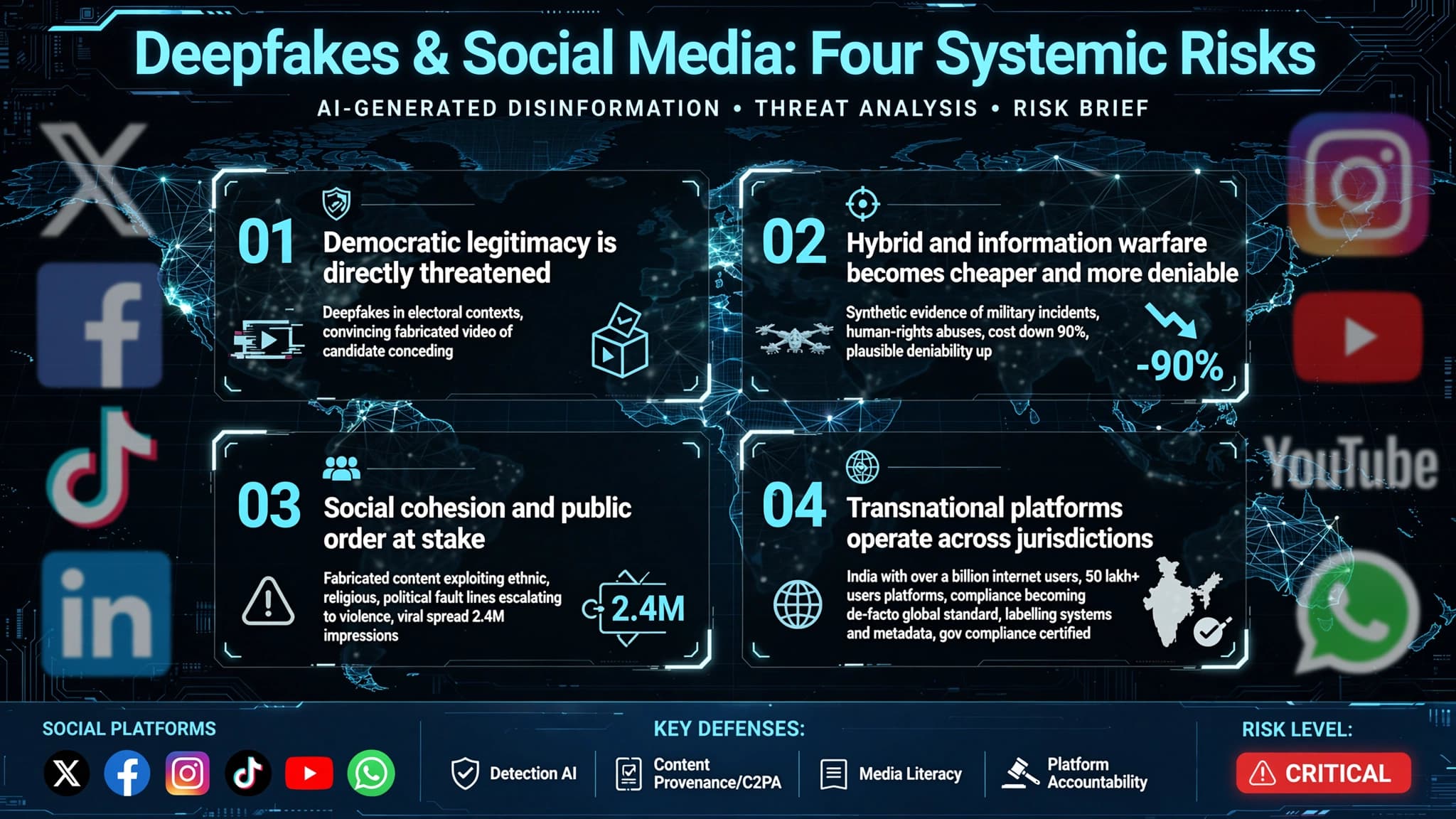
A convincing fabricated video of a candidate conceding or committing a crime can suppress turnout or shift undecided voters in the final hours. Faster, more systematic removal obligations reduce the operational window for such interference.
On August 6, 2026, India’s Ministry of Electronics and Information Technology (MeitY) publicly reinforced a set of amended Information Technology (Intermediary Guidelines and Digital Media Ethics Code) Rules that fundamentally reshape how artificial intelligence-generated content is handled online.
The core requirements are clear and operational: platforms must ensure clear labelling and traceable metadata for permissible AI-generated content so users can identify synthetic material, and the deadline for removing unlawful content after a valid government or court notice has been cut from 36 hours to just 3 hours (with even tighter windows of 2 hours for highly sensitive material such as non-consensual intimate imagery or impersonation).
These changes, notified earlier in February 2026 and now highlighted through an official Press Information Bureau release, target the rapid proliferation of deepfakes, synthetic audio, video, and text.
They place enforceable due-diligence obligations on intermediaries, require deployment of reasonable technical measures (including automated tools), expand coverage to child sexual exploitation material and AI-based impersonation, and warn that non-compliance can strip platforms of safe-harbour protections under Section 79 of the IT Act.
While the rules are Indian, their significance is planetary. In an era when information itself has become a strategic domain, India’s approach offers one of the most concrete regulatory responses yet to a threat that no single nation can contain alone.
The Scale of the AI Content Challenge
AI tools now enable anyone with modest resources to generate photorealistic videos of world leaders making statements they never uttered, clone voices for financial fraud, fabricate evidence of atrocities, or flood social media with tailored disinformation during elections.
The speed of generation and distribution has outpaced traditional content-moderation cycles. A fabricated clip can reach millions before fact-checkers even begin their work.
The previous 36-hour window, while better than nothing, still allowed critical windows of influence, enough time to sway public opinion, trigger market movements, or inflame communal tensions.
India’s decision to compress that window to three hours acknowledges a basic reality of digital physics: virality is measured in minutes, not days.
Coupling this with mandatory labelling and metadata requirements creates both a detection signal for users and a forensic trail for platforms and authorities.
The rules do not ban AI content; they demand transparency for synthetic material that is lawful and rapid removal for material that is not.
Why This Matters for the Global Order
The international system rests on a fragile foundation of shared reality. Diplomatic negotiations, democratic elections, market confidence, and public trust in institutions all depend on a baseline ability to distinguish authentic communication from fabricated narrative. When that baseline erodes, several cascading risks emerge.
- First, democratic legitimacy is directly threatened. Deepfakes have already appeared in electoral contexts across continents. A convincing fabricated video of a candidate conceding or committing a crime can suppress turnout or shift undecided voters in the final hours. Faster, more systematic removal obligations reduce the operational window for such interference.
- Second, hybrid and information warfare becomes cheaper and more deniable. State and non-state actors can manufacture crises without deploying kinetic force. Synthetic evidence of military incidents, human-rights abuses, or economic sabotage can be injected into global information streams to shape third-party perceptions and force policy reactions. Clear labelling and rapid takedown rules raise the cost and lower the effectiveness of these operations.
- Third, social cohesion and public order inside societies are at stake. Fabricated content that exploits ethnic, religious, or political fault lines can escalate local tensions into violence within hours. India’s experience with viral misinformation and communal flashpoints has informed a pragmatic, enforcement-oriented response that prioritises containment of the most harmful material.
- Fourth, transnational platforms operate across jurisdictions. A rule applied only in one large market creates compliance pressure that often becomes a de-facto standard. India’s user base of over a billion internet users, combined with its significant social media intermediaries (platforms with 50 lakh or more registered users), means that engineering solutions developed for Indian compliance, labelling systems, metadata standards, accelerated review pipelines, are likely to be deployed more widely. This can nudge global platforms toward higher baseline transparency even in less regulated markets.
- Finally, the absence of coordinated standards risks a fragmented digital landscape in which authoritarian regimes impose opaque censorship while open societies struggle with unmoderated synthetic chaos. India’s approach attempts a middle path: it does not prohibit AI tools or require prior approval of content; it demands identification of synthetic origin and accelerated action against clearly unlawful categories. That balance is more exportable than pure prohibitions or pure laissez-faire.
A Contribution to Emerging Global Norms
The European Union’s AI Act, various national deepfake bills, and voluntary industry codes have all grappled with similar problems.
India’s rules stand out for their operational specificity, measurable deadlines and concrete labelling mandates, rather than high-level principles alone.
In a multipolar digital environment, such concrete experiments matter. They provide data on what works, what creates friction, and what can be refined.
No single country’s regulation will solve the problem of synthetic media. But every major market that raises the technical and legal cost of undetectable deception strengthens the overall information environment.
India’s move is therefore not merely domestic housekeeping; it is a contribution to the collective infrastructure of trust required for a stable international order in the age of generative AI.
As synthetic media capabilities continue their exponential advance, the alternative to clearer rules is not greater freedom, it is greater vulnerability to those willing to weaponise falsehood at machine speed.
Transparency through labelling and rapid response to unlawful content are no longer optional luxuries. They are becoming baseline requirements for preserving the shared factual ground on which diplomacy, democracy, and open societies depend.
India’s framework is one of the clearest statements yet that this reality has been recognised and acted upon.