Asked to Pay a Fee to Release Your Money? It's a Scam (and What to Do Now)
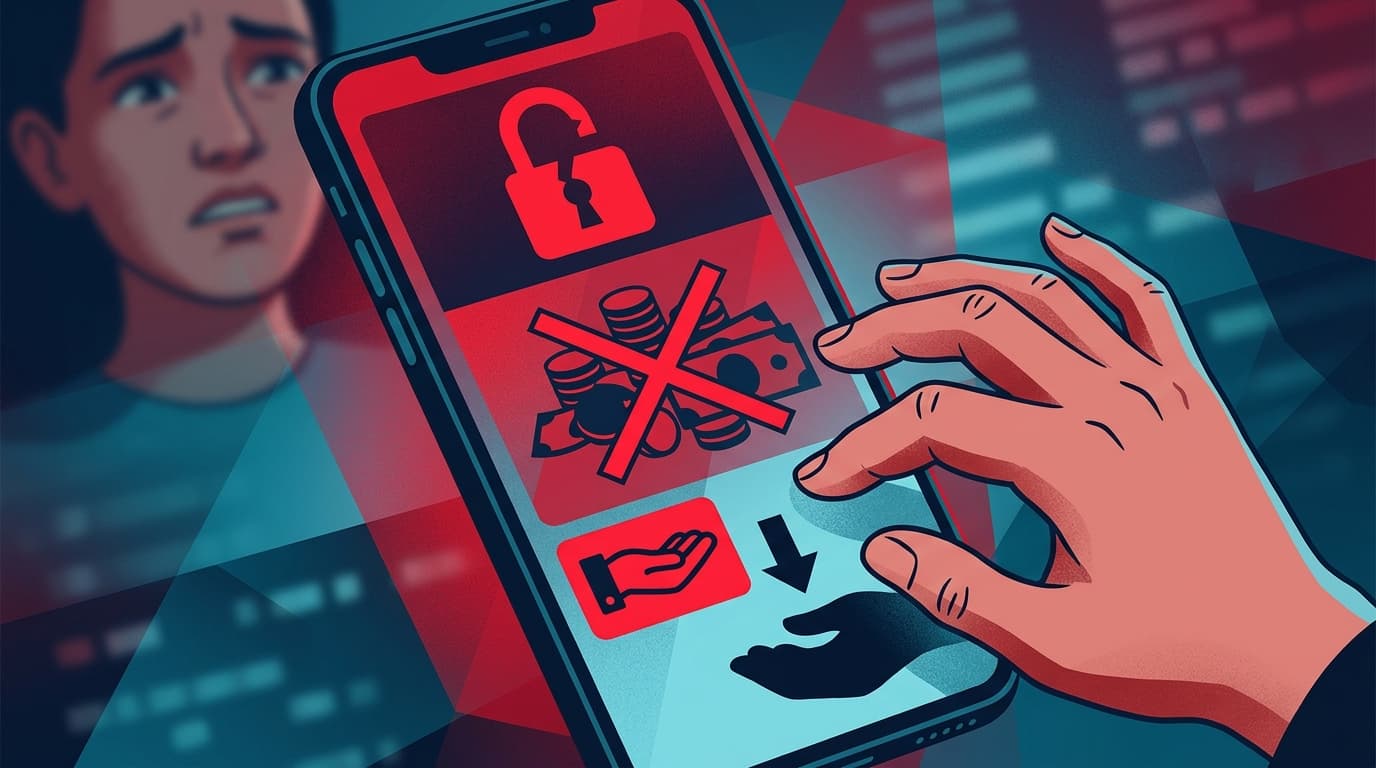
Told to pay a tax, fee or deposit to withdraw your money? That is a scam. How the release-fee trap works, warning signs, and what to do if you've paid.
Quick answer: If a platform, bank or "agent" says you must pay a fee, tax, deposit or "verification" charge before you can withdraw money, the money is not real and the request is a scam. Legitimate platforms take their fees from your balance; they don't ask you to send new money first, and no genuine firm takes payment in gift cards. Stop paying, keep every record, and report it today.
What to do in 3 steps
- Stop paying and stop negotiating. Do not send "one last" fee. Each payment brings a new demand.
- Preserve evidence. Screenshot the fake balance, chats, wallet addresses, receipts and gift card numbers before the site or account disappears.
- Contact your bank or card issuer and report to police the same day. Early reports can sometimes lead to frozen funds.
How the "release fee" trap works
The final stage of many fake trading, crypto and banking schemes looks the same. You see a large balance on a polished dashboard. Then you try to withdraw, and a new cost appears: a "withdrawal fee", "tax clearance", "anti-money-laundering deposit", "account unfreezing fee" or "distribution fee". The FBI says victims "will be charged taxes and fees as a final attempt to exploit money from the victims before the scammers disappear with all the victim funds."
Readers have sent us versions of this. One was a fake "bank" website showing a balance of $99 million and demanding Apple gift cards for "tax". Another was a fake crypto project asking for "distribution fees" to deliver promised tokens. A third was a frozen exchange account that could supposedly be opened for a fee. A fourth was an advance-fee "release of funds" arranged over Telegram. The names differed, the script did not.
The balance is only a number on a page the scammers control. Paying never unlocks it, because nothing is behind it.
Warning signs
- You must pay before you can withdraw, and the amount keeps changing.
- The fee goes to a personal wallet, a different name or a gift card, not deducted from your balance.
- You are pressed to act within hours, or told to keep it secret from your bank or family.
- The contact reached you on Telegram, WhatsApp or social media and will not use a verifiable office or phone line.
If you've already paid
Card payments: call your card issuer, say it was fraud, and ask for a dispute (chargeback). Time limits apply, so do not wait.
Bank transfers: ask your bank to recall the payment at once and note the receiving account details. The FBI says time is of the essence.
Crypto: report the wallet address and transaction ID to the exchange you used. Transfers are hard to reverse, but exchanges can sometimes flag or freeze destination accounts.
Gift cards: contact the card company straight away with the card numbers and receipts. Unspent value can occasionally be frozen.
Report to the authorities:
- US: FBI IC3 (ic3.gov) and FTC (reportfraud.ftc.gov)
- UK: Report Fraud (formerly Action Fraud), 0300 123 2040 (England, Wales and Northern Ireland; in Scotland, call Police Scotland on 101)
- India: call 1930 or use cybercrime.gov.in
- Australia: ReportCyber (cyber.gov.au/report) or the 24/7 hotline 1300 CYBER1 (1300 292 371)
- Canada: Canadian Anti-Fraud Centre reporting system or 1-888-495-8501
- Elsewhere: see our cyber agencies directory.
Beware recovery scams
After you report or post about a loss, new contacts may offer to get your money back. They may pose as a recovery firm, law firm or police officer. They ask for an upfront fee, a "legal deposit" or crypto. It is the same fee trap, aimed at someone already hurt. The FBI recorded 10,516 recovery scam complaints in 2025.
Never pay anyone who contacts you first offering recovery. Real police and regulators do not charge victims to investigate or return funds. Check any firm using contact details you find yourself.
If you have been targeted, you are not alone. See our country-by-country cybercrime help hub for step-by-step reporting guides.