AI Alert from India's Bank of Baroda & Delhi Police intercepted a major law enforcment impersonation scam
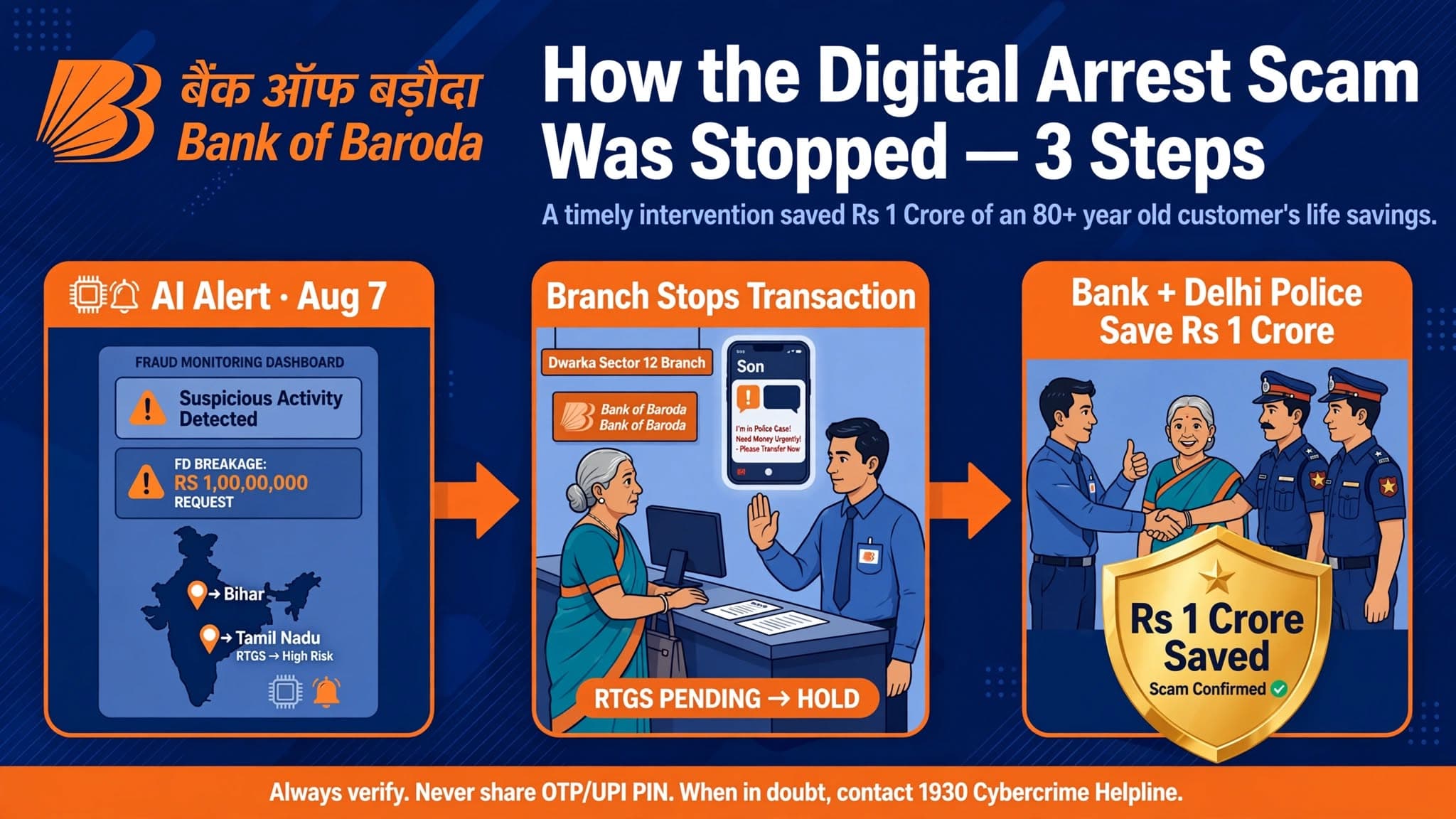
An 80-year-old in Delhi was put under fake digital arrest on WhatsApp and told to transfer Rs 1 crore. Here's how Bank of Baroda's AI model, a vigilant branch, and Delhi Police stopped it, and the 6 red flags of digital arrest scams every family must know.
She is over 80. She lives alone in Dwarka, Sector 12 of New Delhi, India's Capital. Her family is in the US.
On Monday, August 4, 2026, her phone rang on WhatsApp. A man in police uniform was on video. He spoke urgently.
He said an account had been opened in her name in Mumbai. It was linked to cybercrime and money laundering. A case had been filed. She could face 9 months in jail.
Then he said the line that traps almost everyone: Do not tell anyone. If you do, you will be arrested too.
Within hours, she got what looked like official proof on WhatsApp. An Enforcement Directorate order with a signature. A CBI investigation notice. Later, even a Supreme Court receipt. All fake.
She was scared, isolated, and convinced she was under investigation. She agreed to transfer ₹1 crore from her fixed deposits in chunks.
She was not under investigation. She was under a digital arrest.
Globally, police call this law enforcement impersonation. In India, it is called as digital arrest. The script is the same.
How a 24x7 transaction monitoring & Police coordination saved a senior citizen's lifetime earning?
A real incident was shared by Mr. Rohit Kumar, AGM of Fraud Risk Management Department from Bank of Baroda on I4C's live session through their Cyberdost Handle. This story did not end in loss because three layers worked together. The AI, Humans and the Police.
1. The AI alert on August 7
Bank of Baroda had built an AI/ML model specifically for digital arrest and investment scams a few months earlier. It does not just look at amount. It looks at behavior.
On August 7, the model raised an alert: a senior customer suddenly breaking long-term FDs and trying to send large RTGS amounts in chunks to accounts in Bihar and Tamil Nadu that had no prior connection to her.
The central fraud team reviewed it, tagged it as a probable digital arrest, and used the I4C platform, where banks, police, and telecom operators coordinate, to check the beneficiary banks. The accounts were suspicious.
2. The branch that refused to just transact
On August 8, she came to the Dwarka Sector 12 branch to do two RTGS transfers.
The staff could have processed it. Instead, they asked a simple human question: Why are you doing this?
She said she was buying property for her son.
The staff asked to speak to her son. She gave a number. They called on WhatsApp. A man answered and said, yes, I am her son, let her proceed.
That was the moment most systems would have cleared the transaction. The staff felt doubtful. Because the central team had already warned the branch manager to stop her if she came again, they held the transaction and escalated.
That pause saved ₹ 1 crore. The man on WhatsApp pretending to be her son was the cybercriminal who was extorting the senior citizen.
3. Bank of Baroda - Delhi Police collaboration which closed the loop
The bank contacted Delhi Police. The team of Joint CP, IFSO, Mr. Rajnish Gupta responded and sent officers to the branch in person.
Only when real police officers from her own city spoke to her face to face, inside the bank, did she believe she was safe. She finally understood she was being digitally arrested.
What Other Banks Can learn from the incident

1. Create a Vulnerable Customer Safety Layer
Do not treat all customers the same. Flag accounts where risk of coercion is high: age 70+, living alone, NRI family, recent large FD portfolio, low digital activity suddenly shifting to high-value RTGS / IMPS. This is not discrimination, it is protection. For these accounts, add a mandatory pause and human review.
2. Detect behavior, not just amount
Most fraud systems flag Rs 10 lakh debits. Digital arrest is different. Watch for:
- Sudden FD breakage after years of holding
- Chunking: same amount split into 2 to 3 RTGS to different states
- First-time beneficiaries in Bihar, Tamil Nadu, Northeast or other mule hotspots with no prior relationship
- Transaction at odd urgency: customer insisting, anxious, on phone continuously
- WhatsApp call in branch
3. Integrate national mule intelligence
RBI's MuleHunter and the new IDPIC platform built by SBI and Bank of Baroda are built exactly for this. Connect your transaction monitoring to I4C's suspect registry, 1930 complaints, and NPCI's mule account list. If beneficiary account was reported in last 30 days, auto-block and alert.
4. Build a Branch Circuit Breaker SOP
The central AI team can detect, but only the branch can stop. Train every frontline officer with a 3-question script:
- What is this money for?
- Can I speak to your family member on a normal call, not WhatsApp?
- Have you received any police or CBI video call or documents on WhatsApp? Empower them to hold, not just process. In Dwarka, that pause saved Rs 1 crore.
5. Create a 30-minute bank-to-bank and bank-to-police lane
This case worked because Bank of Baroda could ping beneficiary banks and Delhi Police IFSO within minutes via I4C. Every bank needs a hot lane: one phone number, one email group for cyber police and nodal officers of top 20 beneficiary banks.
6. Callback on a trusted channel
If an elderly customer suddenly does high-value RTGS, do an automatic callback on their registered mobile number, not WhatsApp, and speak to a family member if possible. Fraudsters control WhatsApp, they rarely control the SIM.
Digital arrest works because it uses our respect for the law against us. It fails when we use our trust in each other for protection.