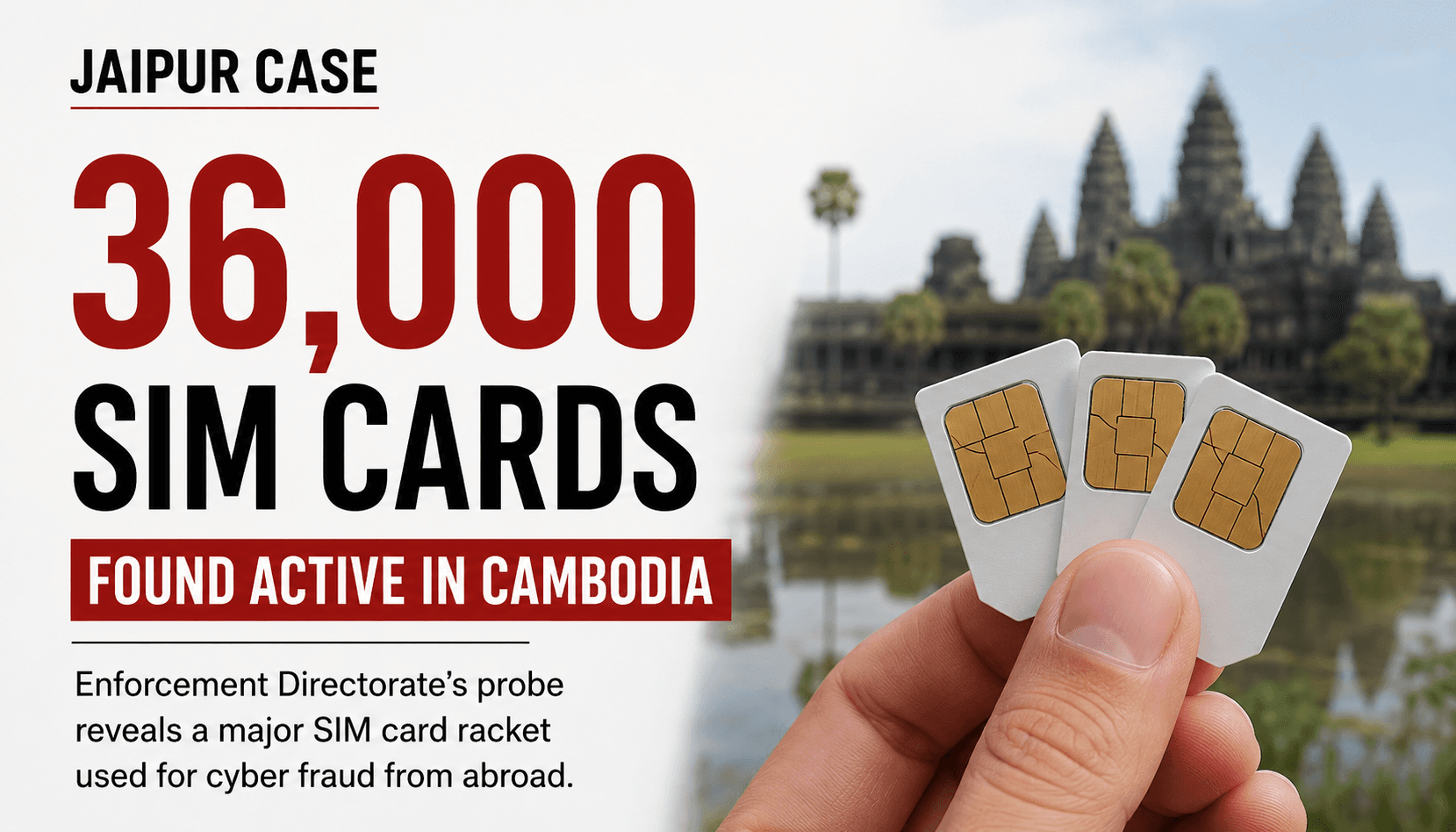
How a Malaysian fraudster used legally-made Indian SIM cards to run scams from Cambodia — and what India and the world can learn.
On June 5, the Enforcement Directorate (ED) raided seven places across Kishangarh, Nagaur, Jodhpur and Ludhiana.
A few simple numbers explain the whole case:
- 2.3 lakh Indian phone numbers were checked.
- 36,000 were found switched on inside Cambodia.
- 5,300 of them were used to steal hundreds of crores from Indians.
The case began with a Jodhpur cyber-police complaint against SIM-card dealers who illegally activated Indian SIMs and gave them to a Malaysian man, who ran them from Cambodia.
How the scam worked, in three steps
Step 1: The secret extra SIM. Dealers who were allowed to sell Airtel, Jio and Vi SIMs targeted people who didn't know better.
When a customer asked for one SIM, the dealer quietly made a second one on the same Aadhaar.
The customer never found out.
On paper, everything looked legal.
Step 2: Send the SIM abroad. These extra SIMs were passed, allegedly through Rahul Kumar Jha and his helpers Mohammad Sharif, Sandeep Bhatt, Prakash Bheel, Ramavatar Rathi, Hareesh Malakar and Hemant Panwar, to the man abroad, who paid a fee for each SIM.
Step 3: Call back home on WhatsApp. From Cambodia, the gang used these numbers to scam people across India by making WhatsApp calls.
The SIM only had to log in once.
After that, the calls travelled over the internet.
So the victim saw a normal Indian number on WhatsApp, while the caller sat thousands of kilometres away.
What India built, and it's working
This is where India deserves real praise.
Its system to catch fake SIMs is among the best in the world:
- Sanchar Saathi lets anyone see every SIM card made on their ID and cancel a fake one themselves. It has found 4 million fake connections and shut down 3.66 million.
- ASTR, an AI tool with face-matching, catches problems like more than nine SIMs made on one ID. The telecom minister says it has disconnected 82 lakh numbers.
- FRI, running since May 2025, rates each number's fraud risk using police complaints and bank data, flagging about 2,000 risky numbers every day.
The result is clear: telecom fraud has dropped 97% since Sanchar Saathi began, helped by mandatory Aadhaar fingerprint checks for new SIMs.
And it was this same technology that cracked this case, checking 2.3 lakh numbers and tracking 36,000 of them to Cambodia is exactly the kind of cross-border work most countries can't do.
What other countries can learn
India's system gives the world four simple lessons:
- Let people protect themselves. Sanchar Saathi works because anyone can see and cancel a fake SIM in their name. Most countries have nothing like it.
- Watch for strange patterns. A simple rule like "stop if one ID has more than nine SIMs" is cheap and catches a lot. Any country can do this.
- Track where the SIM is, not just who made it. The big clue here wasn't the activation, it was 36,000 Indian numbers suddenly working abroad. You have to keep watching the SIM after it's sold.
- Connect phone data with bank data. India's system mixes bank fraud reports into its phone checks. If these two stay separate, scams that cross both slip through.
The gap that's still open
There's an honest catch: that 36,000 figure shows the weak spot.
India's defences are strongest when a SIM is first made.
But this gang got around that, making one extra SIM at a time, on a real ID, with clean paperwork.
The fraud only shows up once the number switches on abroad.
The good news is India can now catch that and follow the money, the ED has already flagged around 30 bank accounts and several properties linked to the accused.
The real weak point now is the dishonest dealer at the counter making one SIM too many.
The bottom line
India has built a fraud-detection system most of the world doesn't have.
This case isn't a sign that it failed, it's proof the system can reach across borders.
The job left to finish, for India and everyone watching, is to close that last gap at the SIM counter, and shut the WhatsApp loophole that lets one secret SIM cause so much harm from a faraway scam centre.
Based on the ED press release (8/6/2026) and other news reports. The named people are accused, not convicted; the investigation is still going on.