WhatsApp Channels’ DSA Report Shows Why Moderation Counts Are Not Enough
WhatsApp Channels’ EU transparency figures expose a central challenge for global platform policy: counting restrictions is easier than measuring protection. The report’s breakdowns of legal grounds, automation and appeals show why policymakers need more than headline enforcement totals to assess accountability.
WhatsApp Channels’ Digital Services Act transparency report offers a lesson for platform policymakers beyond Europe: enforcement volume is a starting point for scrutiny, not a verdict on whether users are protected.
The report, published by WhatsApp Ireland on 28 August 2026, records 886,271 own-initiative measures against likely illegal Channels content during January–June. Its policy significance depends on what was restricted, where access was blocked, how decisions were made and whether users could challenge them.
The figures are company-reported. They neither independently establish the illegality of every restricted item nor reveal how much violating content remained undetected.
A restriction is not necessarily a removal
All 886,271 measures in the own-initiative illegal-content table were recorded as visibility “disables”. WhatsApp defines this as blocking visibility in jurisdictions where content is likely illegal. That differs from removing content altogether, and neither measure automatically represents an account ban.
The company separately recorded 102,483 own-initiative measures under its terms and conditions: 45,581 removals and 56,902 disables. Keeping those grounds distinct matters. Restrictions based on likely illegality and enforcement of a platform’s contractual rules do not answer the same accountability questions.
For policymakers, a headline total therefore needs both a legal basis and an explanation of the practical restriction. Otherwise, geographically limited access controls can be mistaken for universal removal.
Category definitions shape the apparent problem
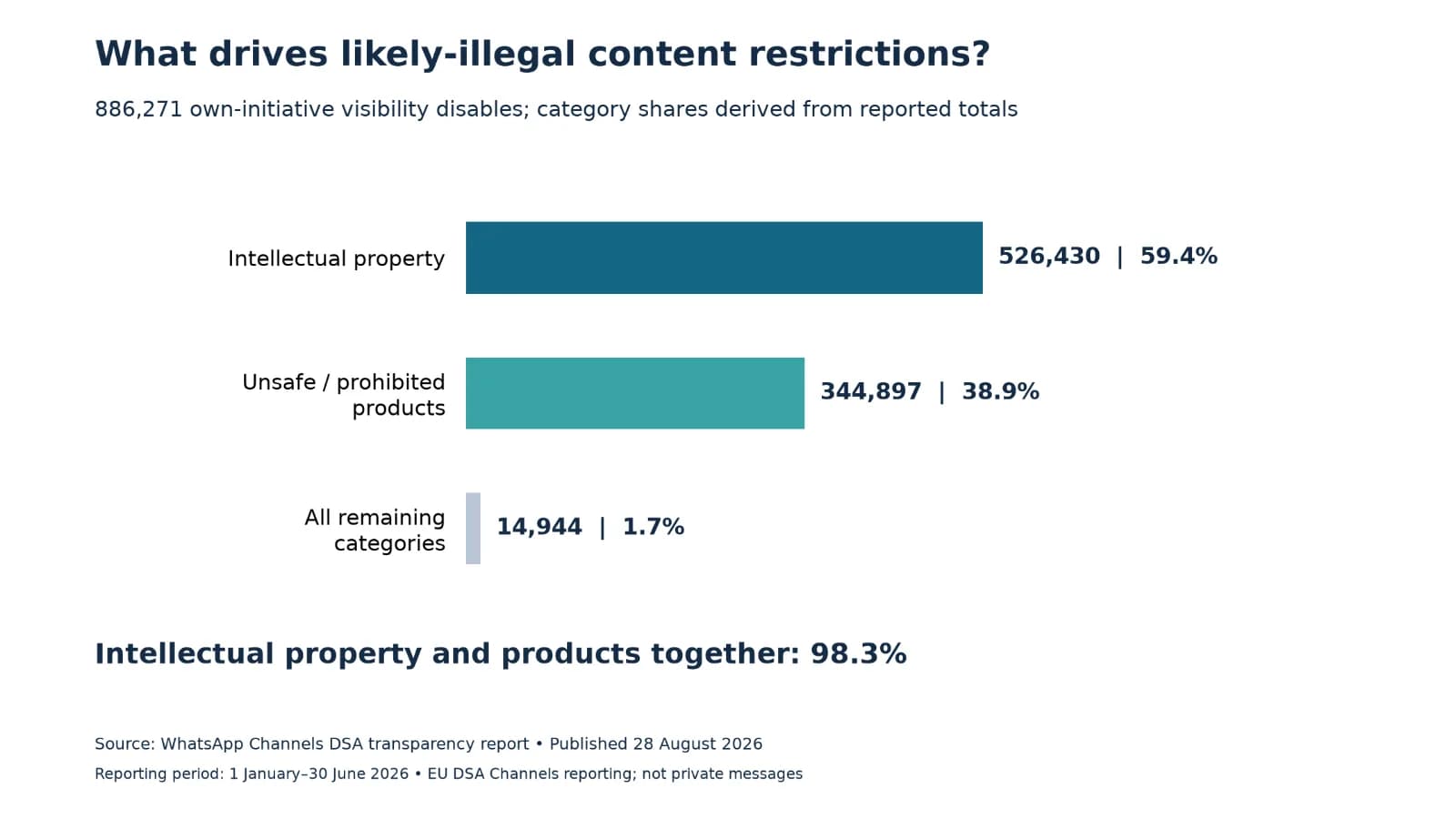
Intellectual property infringements accounted for 526,430 likely-illegal measures, while unsafe, non-compliant or prohibited products accounted for 344,897. Together, they represented a calculated 98.3% of the total. The remaining categories contributed 14,944 measures.

That concentration describes recorded enforcement, not the distribution of actual harm. A category’s size may reflect the reporting taxonomy and the activity captured by enforcement systems; this dataset does not explain why categories differ.
The “scams and fraud” label illustrates the risk. Its 1,197 measures included 1,186 in a subcategory for likely violations of local gambling laws and 11 in the separate fraud-and-deception subcategory. Treating the entire category as conventional financial scams would misrepresent the report.
Nor can these Channels figures establish the prevalence of scams in private WhatsApp messages.
Automation figures do not establish accuracy
Across the two own-initiative enforcement tables, the reported total was 988,754 measures. The automated-means table records 578,465 measures taken solely through automation and 410,289 not taken by automated means, a calculated automation share of 58.5%.

WhatsApp says it uses machine-learning classifiers, known-content matching and human review. However, the numerical split should not be recast as automated decisions versus exclusively human decisions. It also says nothing by itself about accuracy or the severity of errors.
The policy question is therefore not simply how much automation a platform uses, but how its decisions can be evaluated and corrected.
Appeals show challenges to decisions, not an overall error rate
The report records 28,996 internal complaints, 15,417 decisions upheld and 13,579 reversed. Reversals represent a calculated 46.8% of those reported complaint outcomes.

That is not an overall false-positive rate or an automation error rate. Appealed decisions are a subset of enforcement, and WhatsApp cautions that complaints and restorations can relate to earlier reporting periods. The outcomes cannot be treated as a matched group of the same period’s enforcement decisions.
What global policymakers should take away
The lesson is about reporting design, not proof of regulatory success or failure. Comparable reporting periods, clearly defined categories, distinct legal and contractual grounds, and review outcomes linked to the original decisions would make transparency more informative.
A stronger assessment would ask which restrictions were challenged, why decisions were reversed, and how outcomes differed by enforcement method. The aggregate figures presented here do not answer those questions.
Enforcement counts alone cannot establish how much harmful content escaped detection, whether performance improved, or which intervention worked better. For global platform governance, the value of transparency lies not just in publishing numbers, but in making decisions open to meaningful scrutiny.