Vanuatu’s Golden Passports Still Shield Cybercrime Operatives, Latest Myanmar Raid and U.S. Sanctions Show
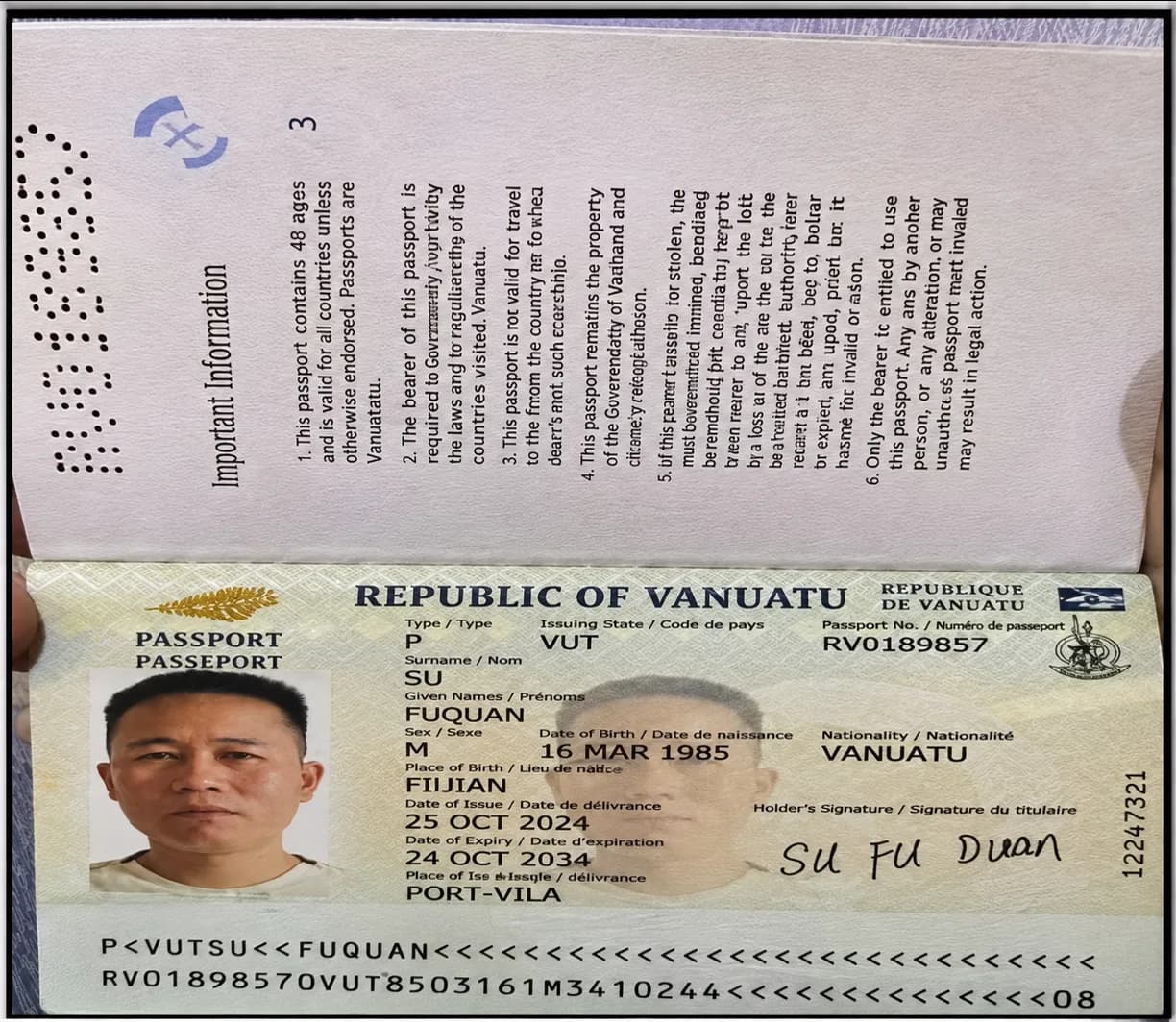
Investigative agencies should therefore examine the authenticity and provenance of travel documents, citizenship acquisition records, immigration movements, KYC documentation and financial linkages to identify potential misuse of foreign nationality as an instrument for evading law-enforcement scrutiny.
PORT VILA / YANGON, Nov. 15, Myanmar security forces arrested Chinese national Su Fu Quan, wanted by China’s Ministry of Public Security with a reward offered for his capture, during a Nov. 12 raid on an online scam and gambling operation in Yangon’s Thaketa Township. Authorities detained 106 people and seized more than 120 computers, nearly 200 mobile phones, and other equipment. Su was among those held after joint teams raided nine condominium units at Golden River Residence Condo.
Investigators linked Su to a recently issued Vanuatu passport numbered RV0189857, according to case details circulating in regional reporting. The episode fits a documented pattern in which holders of Vanuatu citizenship-by-investment (CBI) passports appear in Southeast Asian cyber-scam and fraud networks.

Prince Group and U.S. Treasury designations
In October 2025 the U.S. Treasury’s Office of Foreign Assets Control designated the Cambodia-based Prince Group Transnational Criminal Organization and 146 related targets for cyber-enabled fraud, money laundering, and human trafficking. OFAC listings identified several individuals holding Vanuatu passports:
- Chen Zhi (Prince Group chairman): Vanuatu passport RV047996, alongside Cambodian and Cypriot documents.
- Wei Qianjiang: Vanuatu passport RV0118198.
- Yang Yanming: Vanuatu passport RV0107373.
- Thet Li (also known as Li Tian): Vanuatu passport RV091789.
Further OFAC actions in June and November 2026 expanded the designations, targeting corporate facilitators and noting additional Vanuatu-linked nationality or passport details among network associates. The group has been accused of operating industrial-scale scam compounds that rely on coerced workers and of generating billions in illicit proceeds from investment and romance scams targeting Americans and others.
PlusToken and earlier revocations
In 2019 Vanuatu authorities revoked the citizenship of four Chinese nationals linked to the PlusToken cryptocurrency Ponzi scheme after Chinese law enforcement notified them of Interpol red notices and forged application documents. The four, who had obtained passports through Vanuatu’s Development Support Programme, were deported to China along with two other suspects. Contemporary reporting described the scheme as involving roughly $2.9 billion. Vanuatu’s Financial Intelligence Unit had cleared the applications under its then-standard process; officials later stated Chinese authorities informed them only after the citizenships had been granted.
Scale and clientele of the programme
Vanuatu’s CBI programmes, principally the Development Support Programme, Contribution Programme, and Capital Investment Immigration Plan, have generated substantial revenue. Ministry of Finance figures show CBI receipts of VT11.4 billion (approximately $95.5 million) in the first half of 2026, roughly 39 percent of government revenue excluding donor funds and higher than value-added tax collections. In peak earlier years the share reached the low-to-mid 40 percent range; in 2020 it was reported near 42 percent.
Chinese nationals have long formed the largest single group of applicants. Internal data covering 2020 showed more than half of roughly 2,200 passports issued under the main programmes went to Chinese applicants. Earlier multi-year aggregates also listed Chinese nationals as the clear majority across Vanuatu’s successive CBI schemes.
Applications are typically processed digitally in 30–60 days with limited physical presence requirements. Vanuatu imposes no personal income tax, capital-gains tax, wealth tax, or inheritance tax on residents or citizens.
International restrictions and risk assessments
The European Council suspended Vanuatu’s visa-waiver agreement in stages beginning in 2022 over security concerns tied to the CBI scheme, including short screening times, low refusal rates, and cases involving individuals listed in Interpol databases. The suspension was made permanent in December 2024; Vanuatu nationals now require visas for the Schengen area. The United Kingdom imposed a visa requirement on Vanuatu nationals in July 2023, citing abuse of the scheme.
Vanuatu was removed from the Financial Action Task Force grey list in 2018 after reforms. Its own National Risk Assessment, prepared ahead of a 2026 Asia/Pacific Group evaluation, nevertheless rates the citizenship-for-investment programmes as high risk. The assessment notes multiple instances of foreign criminals obtaining citizenship with payments likely derived from illicit wealth and identifies the programmes as a contributor to Vanuatu’s elevated proliferation-financing risk. The Asia/Pacific Group has previously flagged offshore-sector exposures to foreign tax crimes, illicit cross-border flows, and weak beneficial-ownership transparency.
Remaining exposure
Vanuatu has conducted some revocations, cancelled certain fraudulently obtained passports of Chinese nationals in 2025, and announced temporary suspensions and reviews of aspects of the CBI framework. A recent parliamentary report also documented irregularities in the issuance of more than 1,300 diplomatic passports. Despite these steps, U.S. sanctions lists, Myanmar law-enforcement actions, and domestic risk assessments continue to document Vanuatu passports in the possession of individuals tied to large-scale cyber-scam, cryptocurrency-fraud, and money-laundering networks.
The combination of rapid processing, minimal physical presence, and a favourable tax environment remains attractive to both legitimate investors and illicit actors seeking alternative legal identities and cross-border mobility. International partners have repeatedly urged tighter due-diligence, source-of-funds verification, and post-grant monitoring if Vanuatu wishes to reduce the documented misuse of its golden-passport programme in transnational cybercrime.