Two Bans Every Second: WhatsApp's India-Only Ledger of Abuse — and the Silence Everywhere Else
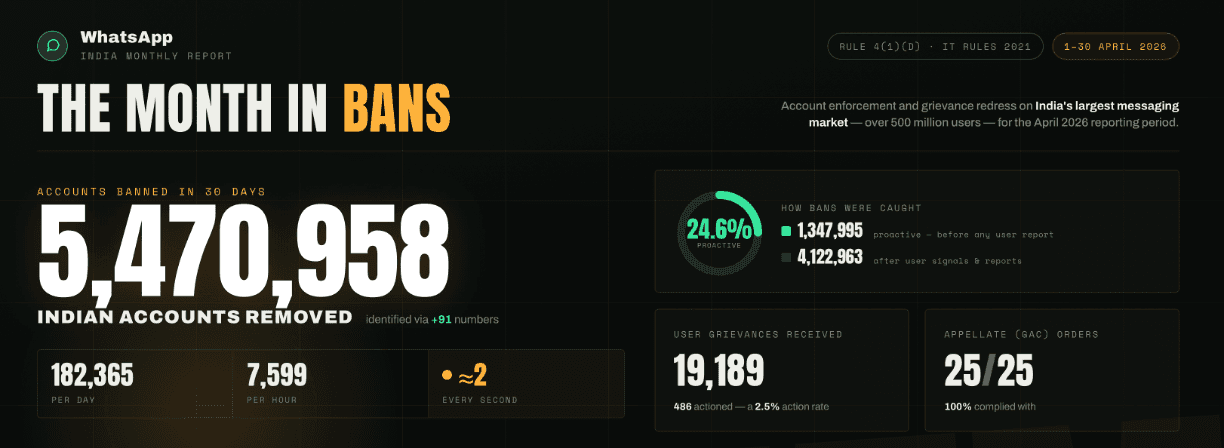
In April 2026 alone, WhatsApp shut down nearly 5.5 million Indian accounts. The report that disclosed it exists because of a single country's law. The bigger story is why no other country gets one.
Roughly twice in the time it takes to read this sentence, WhatsApp banned an account in India.
Across the month of April 2026, the Meta-owned messaging service removed 5,470,958 Indian accounts, about 182,000 a day, more than 7,000 an hour, around two every second.
About 1.35 million of those were cut off proactively, before a single user had complained.
The figures come from WhatsApp's latest monthly compliance report for India, published on 1 June 2026.
Between 1 April 2026 to 30 April 2026, 54,70,958 WhatsApp accounts were banned, 13,47,995 of these accounts were proactively banned, before any reports from users.
The number is staggering on its face, yet for anyone who has followed these filings, it is almost routine.
WhatsApp has been banning between three and ten million Indian accounts a month for years, 4.6 million in February 2023, 9.7 million in February 2025.
The scale is a window onto an industrial problem: the relentless, automated abuse that flows through the world's largest messaging network, and the machinery now required to fight it.
But the report raises a second, sharper question that has nothing to do with India's spam problem and everything to do with global accountability.
Why is this ledger published only for India, and for no other country on Earth?
What the abuse actually looks like
The bans are not, for the most part, about objectionable messages between individuals.
WhatsApp's messages are end-to-end encrypted, meaning the company cannot read their contents.
By its own long-standing account, more than 95 percent of the accounts it removes are tied to the unauthorized use of automated or bulk messaging, the engine of spam, phishing, investment and "task" scams, and coordinated law enforcement authority impersonation based extortion.
Because it cannot see message text, WhatsApp polices abuse through what it calls unencrypted signals: behavioral patterns at the moment of registration, the velocity and volume of outbound messaging, profile and group photos and descriptions, and the negative feedback it receives when users press "Report" or block a contact.
Layered over this is a set of machine-learning systems and a team of human analysts who review edge cases.
The abuse-detection pipeline, the company says, operates at three points in an account's life: when it signs up, while it sends messages, and after users push back.
The April report frames the same effort from the user's side.
Of 19,189 grievances received through WhatsApp's India grievance channels, emails to its grievance officer and physical post, the company took remedial action in 486 cases, or roughly one in forty.
The largest single category was ban appeals (9,421 complaints), where 178 accounts were actioned, in many cases restored.
Safety complaints, by contrast, are not generally "actioned" through this channel: WhatsApp redirects them to in-app reporting, where it can capture the most recent messages and interactions and assess them directly.
Separately, WhatsApp reported receiving 25 orders from India's Grievance Appellate Committee (GAC) during the month and complying with all 25.
The picture, then, is of a platform fighting abuse at enormous volume, and of a complaints system in which the vast majority of grievances are requests for help or appeals rather than actionable safety reports.
Why only India sees these numbers
The blunt answer is that India is the only major jurisdiction whose law requires this exact disclosure.
The report is published under Rule 4(1)(d) and Rule 3A(7) of India's Information Technology (Intermediary Guidelines and Digital Media Ethics Code) Rules, 2021.
Those rules created a category called "Significant Social Media Intermediaries", platforms with more than five million registered Indian users, and obliged each of them to publish a monthly compliance report detailing the grievances received, the action taken, and the accounts removed through their own proactive enforcement.
The 2022 amendments added the Grievance Appellate Committee and the duty to report on its orders.
India is WhatsApp's single largest market, with somewhere north of 500 million users, so the rules bite hard here.
No other country imposes the same obligation in the same shape.
That does not mean WhatsApp is silent everywhere else, and it is worth being precise about the gap rather than overstating it:
WhatsApp does report a global figure, just not a granular one. The company has historically said it bans on the order of eight million accounts a month worldwide.
But that number is an aggregate, it predates much of WhatsApp's recent growth to more than three billion users, and the company does not publish a country-by-country breakdown outside India.
The world knows precisely how many accounts fall in India every thirty days, and almost nothing about how many fall in Brazil, Indonesia, Nigeria, or Mexico.
The European Union has its own regime, but a very different one. Under the Digital Services Act, in-scope services must publish transparency reports covering content moderation, government orders, and complaint handling.
Crucially, those reports are annual rather than monthly, EU-wide rather than per-country, and built around standardized templates that took effect in mid-2025, with the first harmonized reports appearing in early 2026.
The DSA's heaviest obligations also fall on "very large" platforms judged by their public, content-distribution role, categories that capture services like Facebook and Instagram more cleanly than a private, encrypted messenger.
The EU's instinct is toward standardized, auditable, comparable disclosure; India's is toward frequent, granular, but largely self-reported tallies.
So the honest summary is this: India compels a monthly, country-specific accounting of bans and grievances that exists nowhere else; most other governments either require nothing of the kind or require something less frequent and more aggregated.
Which countries should follow, and which model
The case for more transparency is strong.
Messaging abuse is a global harm, and the public interest in knowing the scale of it does not stop at India's borders.
The candidates for similar disclosure are obvious from the user map:
Brazil is the most compelling.
It is WhatsApp's second-largest market, the app reaches the overwhelming majority of the country's smartphone users, and it has a documented history of viral disinformation and scam campaigns surging through WhatsApp around national elections, compounded now by in-chat payments that raise the stakes for fraud.
Brazil also already has an active judiciary and a years-long legislative debate over platform accountability, which makes it institutionally ready for a reporting mandate.
Indonesia and Mexico, the next-largest markets, face similar exposure, as do high-penetration markets such as Nigeria and Pakistan where scams and rumor-driven violence are recurring problems.
But "should they copy India?" is the wrong framing.
The lesson of the Indian experience is that what kind of transparency matters more than whether it exists.
A model worth exporting would have four features India's does not fully deliver:
- It would be independently auditable, not merely self-attested, so the public can trust the numbers.
- It would be standardized and comparable across platforms and over time, the EU's template approach, for all its flaws, points the right way.
- It would be privacy-preserving by design, drawing a hard line that transparency duties must never become a backdoor to weaken or break encryption.
- It would cover both proactive enforcement and grievance redress, so citizens can see not just how many accounts vanish, but how easily a wrongly banned user can get their account back.
The notable absence from any such list is the United States, which has roughly 100 million WhatsApp users and no federal transparency mandate of this kind.
There, the obstacle is constitutional: the First Amendment sharply limits the government's power to compel platforms to disclose or moderate speech, which is why even modest transparency laws have run into legal trouble.
Transparency in the U.S. will likely remain voluntary for the foreseeable future.
The bottom line
WhatsApp's India report is the closest thing the world has to a public meter on the scale of messaging abuse, and 5.5 million bans in a single month is a sobering measure of the problem.
The right response from other Government is to atlest have a mechanism or an oversight, similar to India, where social media intermediaries disclose monthly trends of abuse - which can help Government navigate important decisions.
Social Media is one of the major concern across the world - governance and laws is need of the hour.
Figures in this article are drawn from WhatsApp's India Monthly Report for 1–30 April 2026 (published 1 June 2026) under the IT Rules, 2021, with regulatory context from India's IT Rules, the EU Digital Services Act, and publicly reported WhatsApp user-base estimates.