The Digital Chains: Inside Rajasthan’s Cyber Slavery Pipeline to Southeast Asia’s Scam Compounds
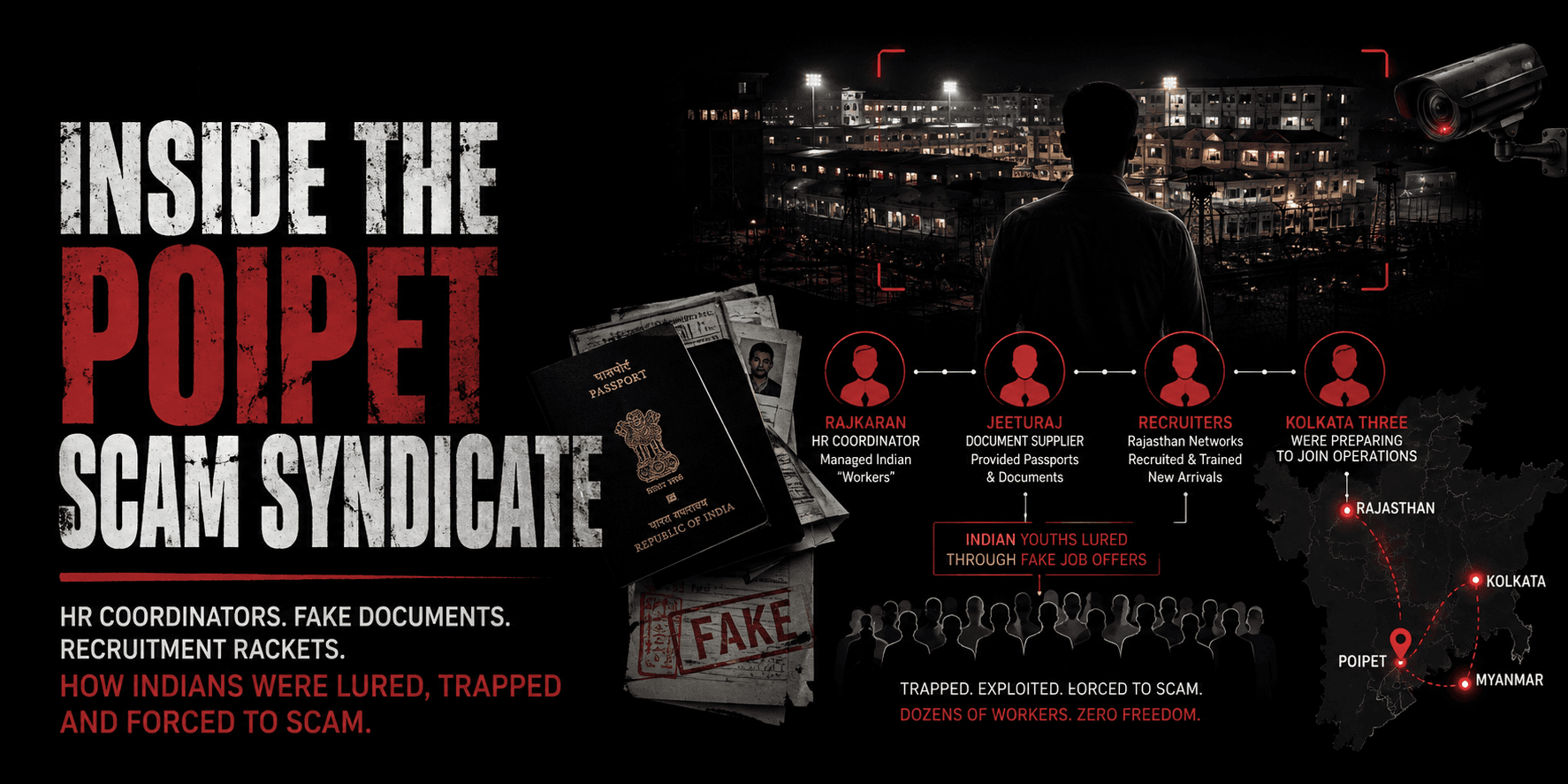
The investigation, fed by intelligence from the Indian Cyber Crime Coordination Centre (I4C), Ministry of Home Affairs has so far identified more than 500 people from Rajasthan alone who were sent into these compounds. Many remain unaccounted for.
JAIPUR, For hundreds of young men from Rajasthan’s smaller towns, the promise was simple and intoxicating: a well-paid job abroad, often in hotels or IT support, earning $800 to $1,000 a month, roughly ₹65,000 to ₹80,000.
The reality that awaited them in Cambodia, Myanmar, Laos, Vietnam and Thailand was something closer to modern slavery.
Their passports were seized on arrival. Their phones were taken or wiped. They were confined inside fortified compounds, many run by Chinese criminal networks, and forced to work 14-hour days running online frauds against people in India and beyond.
Those who resisted faced beatings, starvation, solitary confinement or threats of massive “fines.” Some never came home.
In the first week of August 2026, Rajasthan Police’s State Cyber Crime team struck at the Indian end of this pipeline.
By Wednesday, eight alleged recruiters and facilitators were in custody.
The investigation, fed by intelligence from the Indian Cyber Crime Coordination Centre (I4C), Ministry of Home Affairs has so far identified more than 500 people from Rajasthan alone who were sent into these compounds.
Many remain unaccounted for.
Arrests of Agents
The operation unfolded in two waves.
On the night of 3–4 August, police arrested five men.
Two, Rajkaran alias Ronnie (also referred to as Roxx) and Sagar Singh, were picked up in Beawar.
The other three, Jeeturaj Phulwari alias James, Ravi Kumar alias Mahi and Anil Kumar alias Devil, were intercepted at Sealdah railway station in Kolkata after stepping off the Ajmer Express, reportedly on their way to Myanmar.
Two days later, three more were arrested: Arif Kathat alias Deepu, Kanu Singh alias Python and Firoz Kathat alias Mafia.
The total reached eight.
SP (Cyber Crime) Sumeet Meharda confirmed the latest arrests were based on I4C inputs and digital evidence recovered from the first group.
Additional Director General of Police (Cyber Crime) Vijay Kumar Singh (V.K. Singh) has described the network as a transnational syndicate that combined human trafficking with organised cybercrime.
The accused, police say, acted as local recruiters and logistics handlers for Chinese-run scam centres concentrated in places such as Poipet in Cambodia and border areas of Myanmar.
How the Trap Was Set
The recruitment pattern was consistent.
Agents targeted educated but underemployed youth in towns including Beawar, Rajsamand, Udaipur and Sikar.
They dangled overseas jobs with salaries far higher than anything available locally.
Travel arrangements were made, sometimes with partial reimbursement of costs promised once the “job” began.
Once the recruits landed, often routed through Thailand, the mask dropped.
Passports and identity documents were confiscated.
Phones were seized or communications cut.
The young men were moved into compounds and told they now worked for the network.
Refusal brought violence or financial penalties measured in thousands of dollars.
Returned survivors told investigators they were forced to work from roughly 9 a.m. to 11:30 p.m. daily.
Their primary task was to create and operate fake social media profiles, frequently posing as young Indian women, befriend targets, build trust over days, and then steer them into cryptocurrency investment platforms that were entirely fraudulent, or into “digital arrest” scams in which victims were told they faced legal trouble and must transfer money to “resolve” it.
Funds harvested were typically converted into USDT or other cryptocurrencies and moved to handlers in China or the region.
Police recovered WhatsApp chats, VPN records, Binance app data, travel documents and contacts with foreign operators from the phones of the arrested men.
One accused allegedly admitted recruiting four additional Indians to Cambodia for commission.
Another described how conversations started on fake Facebook profiles were handed over to overseas controllers.
Roles Inside the Network
Investigators have begun mapping specific functions.
Rajkaran is alleged to have worked as an HR coordinator inside a Poipet compound, overseeing Indian “workers.”
Jeeturaj is said to have supplied passports and personal documents of at least ten Indian youths to Chinese handlers.
Others handled recruitment in Rajasthan, training of new arrivals, or movement of people toward Myanmar.
The three men arrested in Kolkata were reportedly preparing to join operations themselves.
The compounds themselves were not small operations.
Police say many housed dozens of workers, predominantly Indians, Pakistanis and Bangladeshis, under Chinese management.
Surveillance, restricted movement and collective punishment for missed targets were standard.
The Scale of the Crisis
I4C data analysis has flagged more than 500 Rajasthan residents who travelled to these countries after accepting job offers linked to the network.
Significant numbers have not returned.
This is not an isolated Rajasthan problem.
Nationally, tens of thousands of Indians have been drawn into similar Southeast Asian scam compounds in recent years.
Earlier rescue operations have brought back hundreds at a time, including groups from Rajasthan in 2025, yet the pipeline continues.
Previous cases investigated by the CBI and other agencies show the same pattern: Telegram interviews, promises of reimbursed travel, arrival in Bangkok or similar hubs, then transfer into Myanmar or Cambodian compounds, followed by forced labour in fraud.
Victims describe beatings, denial of food, forced “frog jumps” in the sun, and in extreme accounts, deaths from violence.
What Happens Next
The investigation remains active.
Police are examining bank trails, further digital evidence and links to additional recruiters.
Coordination with central agencies and the Ministry of External Affairs is underway to locate and repatriate those still trapped.
Cases have been registered at the Cyber Crime police station in Jaipur.