Proton VPN Sees Over 120% Jump in Daily Registrations from India Amid Temporary Telegram Access Restriction
Google trends showed breakout in keywords like Download Proton VPN, Proxy for Telegram.
19 June, 2026, New Delhi
New data from Proton VPN and Google Trends show a significant spike in interest and sign-ups for the service in India, coinciding with the government’s temporary restriction on Telegram access.
The increase aligns with the period when authorities acted to address concerns over exam-related fraud ahead of the NEET-UG 2026 re-examination.
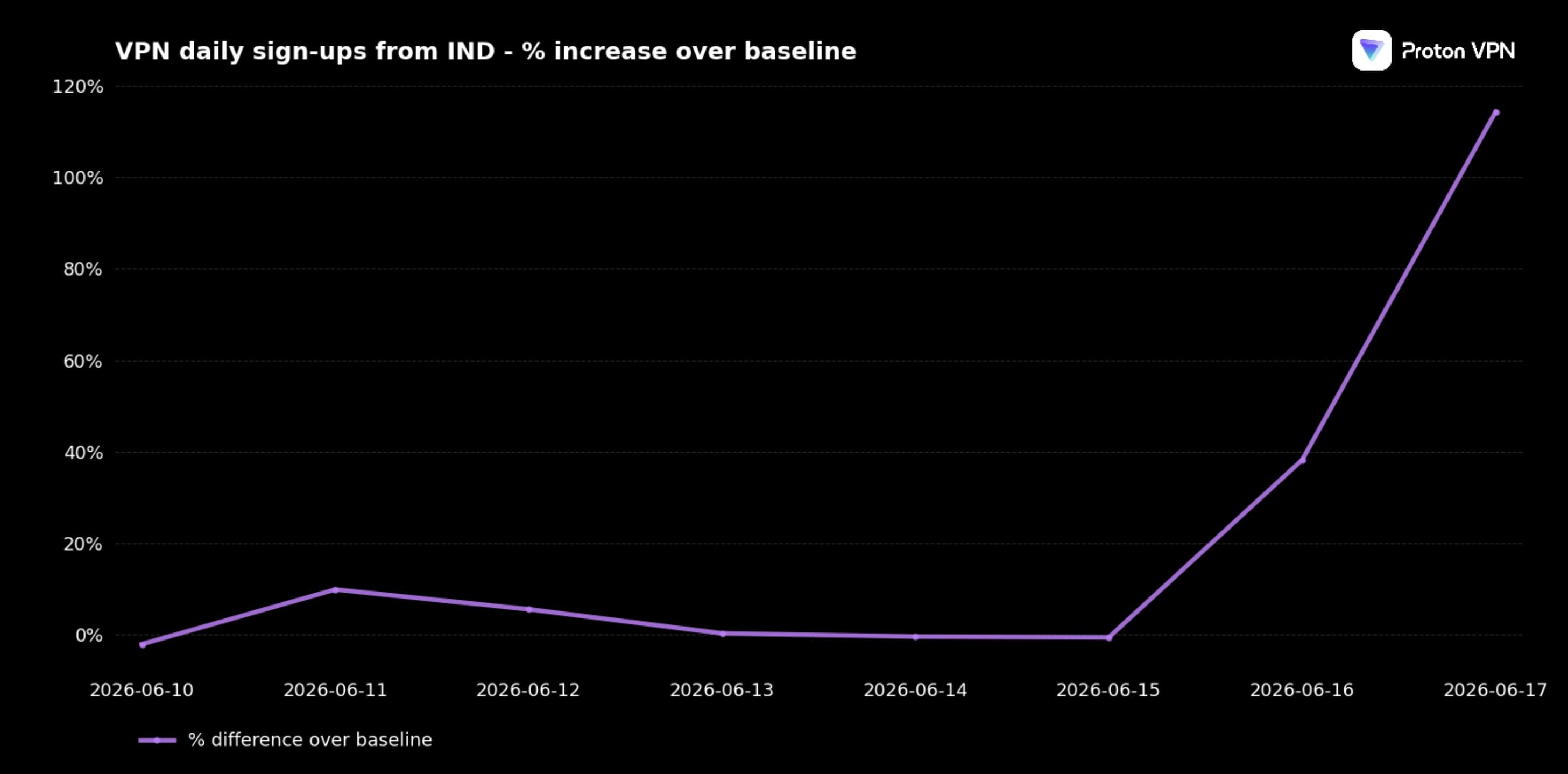
Proton VPN General Manager David Peterson reported that daily registrations from India rose +120% above baseline on Wednesday, following a +150% spike in hourly registrations on Tuesday evening.
A chart shared with the post illustrated the sharp percentage increase in daily sign-ups from India, with the most pronounced rise occurring between June 16 and June 17, 2026.
Google Trends data for the search term “protonvpn” in India (Web Search, past month) further confirms the surge in public interest.
Interest remained relatively stable, fluctuating between approximately 20–40 index points through early to mid-June, before rising sharply starting around June 15–16.
It peaked near the maximum level (close to 100) around June 17–18 and remained elevated thereafter.
This pattern in search interest corresponds directly with the timing of the Telegram access restriction and matches the reported spikes in Proton VPN registrations and downloads.
Other VPN services also saw increased app downloads and improved rankings in Indian app stores during the same window.
Background on the Telegram Restriction
On or around June 16, 2026, the Ministry of Electronics and Information Technology (MeitY) directed a temporary restriction on Telegram access across India under Section 69A of the Information Technology Act, 2000.
The measure, requested by the National Testing Agency (NTA), runs until June 22, 2026, covering the NEET-UG 2026 re-examination on June 21 and its immediate aftermath.
Officials cited Telegram channels spreading fraudulent claims of access to re-examination papers and running scams targeting students.
India's IT Ministry, MeitY additionally ordered Telegram to disable its message-editing feature for previously sent messages in India until June 30, 2026, to prevent “timestamp fraud”, the alleged practice of editing older posts after an exam to insert question papers while preserving original timestamps.
The restriction affects an estimated 150 million Telegram users in India.
NTA noted that earlier targeted channel takedowns had proven insufficient as new channels continued to appear.
Government’s Stand
On June 18, 2026, the Delhi High Court heard Telegram’s challenge to the temporary restriction and reserved judgment.
The Centre defended the action with the following key points:
- Platform architecture: Telegram’s design, including ease of creating multiple bots and channels, cloud-based infrastructure that limits available metadata, and rapid migration of large user groups between channels, makes it difficult to identify offenders or preserve evidence in investigations into exam fraud and other crimes.
- Lack of proactive cooperation: Despite repeated requests, Telegram had not taken sufficient action against illegal or suspicious channels involved in spreading fraudulent exam material.
- Preventive necessity for exam integrity: The government argued that time-bound preventive measures were required to protect the re-examination process involving over 22 lakh students and to avoid potential law-and-order issues. It submitted examples of actions taken by other countries against Telegram for objectionable uses.
- Balancing rights: Officials noted that in cases of misuse by a small number of actors, measures affecting broader access have precedents, as the need to safeguard the larger public interest (here, students and the examination system) can justify temporary restrictions.
The government emphasized that the restriction is limited in duration and specifically targets structural features that had been exploited in national exam-related fraud.
User Response and Increased Interest in Proton VPN
With Telegram access limited for many users, reports indicate a shift toward VPN services and alternative platforms.
The combination of Proton VPN’s internal registration data and Google Trends evidence of a sharp, time-aligned spike in searches for “protonvpn” demonstrates heightened public interest in tools that can help maintain connectivity or privacy during the restriction period.
The observed trends are consistent with users actively seeking options such as Proton VPN in response to the temporary measures.
David Peterson’s post sharing the registration data was subsequently withheld in India.
The temporary Telegram restriction remains in effect until June 22, 2026.
The Delhi High Court’s final decision on the challenge is pending.
NTA has reiterated that no question papers existed outside the official secured chain and has advised students to rely solely on official communications.
These developments illustrate how short-term access restrictions on major communication platforms can produce rapid, measurable shifts in user behavior toward privacy-focused services, as reflected in both company data and public search trends.